

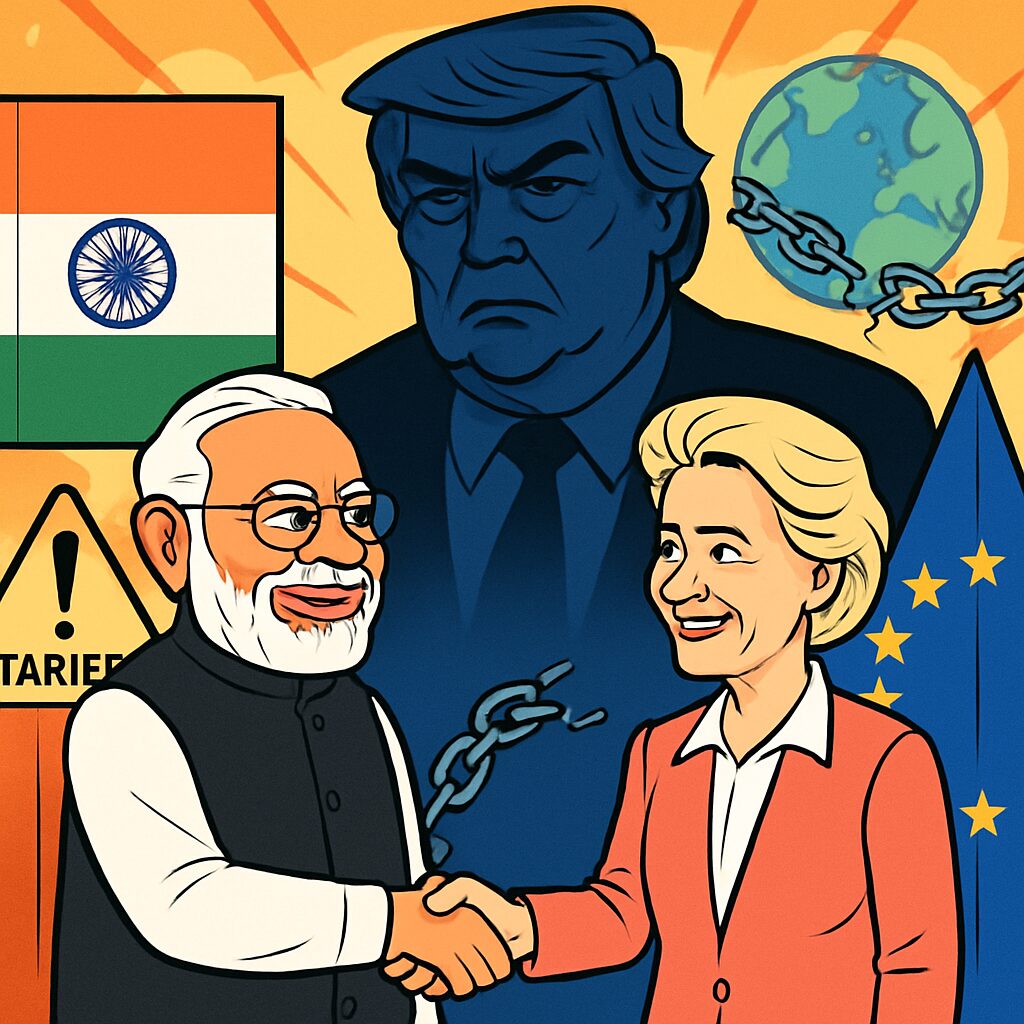
India and the European Union have announced a landmark trade deal, often referred to as the ‘mother of all deals,’ which comes amid heightened geopolitical tensions and the unpredictable trade policies of the Trump administration in the United States. This agreement aims to bolster economic ties between the two giants while sending a strategic message about reducing dependencies in an increasingly weaponized global trade environment.
On Tuesday, January 27, 2026, Indian Prime Minister Narendra Modi and European Commission President Ursula von der Leyen announced the free trade agreement in Delhi, highlighting it as a partnership between the world’s second and fourth largest economies. The deal, which has been in negotiation for two decades, marks a significant breakthrough after years of stagnation.
The acceleration of talks is largely attributed to the shifting geopolitical landscape, particularly the Trump administration’s use of tariffs as a tool of foreign policy. Both India and the EU have faced recent tariff threats from the U.S., including 50% tariffs on Indian goods over its oil purchases from Russia and threats against EU countries over Greenland, creating a sense of urgency to hedge against American unpredictability.
Michael Kugelman of the Atlantic Council notes that the ‘Trump factor’ provided a strong impetus for the deal, as both parties seek to protect themselves from shock tariffs. This has allowed them to overcome longstanding differences and prioritize agreement on core issues, leaving other matters for future discussions.
The India-EU pact is part of a wider trend where countries are striking deals to cope with global instability. For instance, the EU recently signed a trade accord with Mercosur after 25 years, and Canadian Prime Minister Mark Carney’s visit to China has drawn Trump’s ire, indicating a realignment of trade alliances.
Beyond trade, the deal carries geopolitical weight by signaling a collective effort to counterbalance U.S. dominance and China’s growing influence. India views this partnership as a way to diversify its trade and defense imports, reducing reliance on Russia and China, while the EU gains access to a vast market to lessen its dependency on China.
However, the deal is not without hurdles. It still requires ratification by the European Parliament and member states, a process that could be lengthy and contentious, as seen with the Mercosur agreement. Issues like intellectual property, agriculture, and the EU’s Carbon Border Adjustment Mechanism (CBAM) remain unresolved, posing risks to equitable benefits.
U.S. Treasury Secretary Scott Bessent criticized the deal, accusing the EU of ‘financing the war against themselves’ due to India’s Russian oil purchases. Meanwhile, business groups in both regions have welcomed the increased market access. Implementation will be key, and both India and the EU continue to engage with the U.S. in negotiations, leveraging this deal for better terms.
Ultimately, the India-EU trade deal represents a strategic pivot in global economics, driven by the need for stability in the face of American protectionism. While it promises enhanced cooperation and prosperity, its success hinges on smooth ratification and effective execution, with the world watching how Trump’s administration responds to this bold move.

