

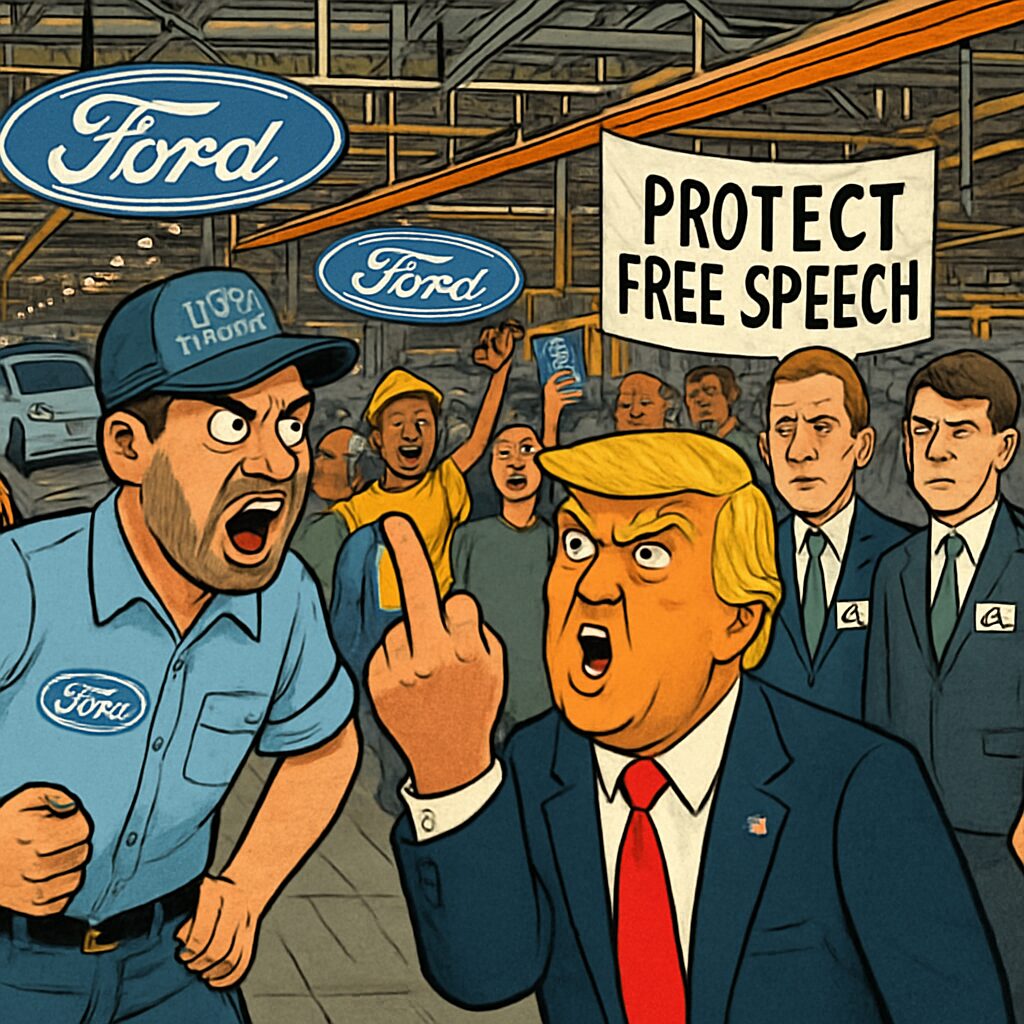
The United Auto Workers union is vigorously defending a Ford Motor Company employee suspended after he shouted an insult at President Donald Trump during a factory tour in Michigan, asserting that workers’ free speech rights must be protected even in confrontations with high-profile figures.
On January 13, 2026, during President Trump’s visit to the Ford River Rouge Plant in Dearborn, Michigan, autoworker TJ Sabula yelled “pedophile protector” at the president, a reference to Trump’s handling of the Jeffrey Epstein investigation. Trump responded by making an obscene gesture with his middle finger and mouthing the words “f— you” twice, as captured in a cellphone video that quickly went viral. The incident occurred as Trump walked through the factory floor, accompanied by Ford executives Bill Ford and Jim Farley, with other workers cheering and taking selfies nearby.
Sabula, a 40-year-old line worker and member of United Auto Workers Local 600, told The Washington Post and Detroit News that he has no regrets about confronting Trump. He estimated he was standing about 60 feet away and said the president could hear him “very, very, very clearly.” Sabula, who identifies as politically independent and has never voted for Trump but supported other Republicans, believes his subsequent suspension by Ford is “targeted for political retribution” for embarrassing the president. He added, “I don’t feel as though fate looks upon you often, and when it does, you better be ready to seize the opportunity.”
The United Auto Workers has firmly backed Sabula, with UAW Vice President and Ford Department Director Laura Dickerson stating, “He believes in freedom of speech, a principle we wholeheartedly embrace, and we stand with our membership in protecting their voice on the job.” Dickerson emphasized that the union will ensure Sabula receives full protection under negotiated contract language, asserting that “workers should never be subjected to vulgar language or behavior by anyone—including the President of the United States.” This stance highlights the union’s commitment to defending members’ rights amid politically charged incidents.
Ford Motor Company has taken disciplinary action, suspending Sabula pending an internal investigation. Company spokesperson Dave Tovar said, “One of our core values is respect, and we don’t condone anyone saying anything inappropriate like that within our facilities.” Tovar noted that except for this incident, Ford is proud of how employees represented the company during the visit. The White House defended Trump’s reaction, with communications director Steven Cheung calling it “appropriate and unambiguous” in response to what he described as a “lunatic wildly screaming expletives in a complete fit of rage.”
The incident has sparked broader discussions on free speech in the workplace and political polarization. Online fundraisers for Sabula on GoFundMe have raised over $480,000, reflecting significant public support for his actions. Democratic lawmakers, including Rep. Rashida Tlaib of Detroit and Rep. Debbie Dingell of Ann Arbor, have questioned Ford’s response, noting that past hecklers of political figures, such as during President Obama’s visits, did not face similar consequences. Tlaib said the union informed her Sabula was facing disciplinary action, while Dingell emphasized the importance of protecting free speech rights.
Contextually, the insult referenced Trump’s association with Jeffrey Epstein, a convicted sex offender. Trump has faced criticism for dismissing the federal investigation into Epstein and initially opposing the release of related files. Although not accused of wrongdoing, Trump’s ties to Epstein have been a point of controversy. This incident adds to the tensions as Trump engages with blue-collar workers in key industrial states like Michigan, where economic issues and political loyalty are fiercely contested.
Looking ahead, the case may test the limits of First Amendment protections in private employment and labor union contracts. Legal experts suggest that while private employers can regulate speech, union agreements and potential retaliation claims could influence the outcome. The resolution could set precedents for how companies handle employee conduct during political events, balancing workplace respect with expression rights. As the investigation continues, attention remains on Ford and the UAW to see whether Sabula will be reinstated or face further action, shaping future interactions between workers and visiting dignitaries.

