

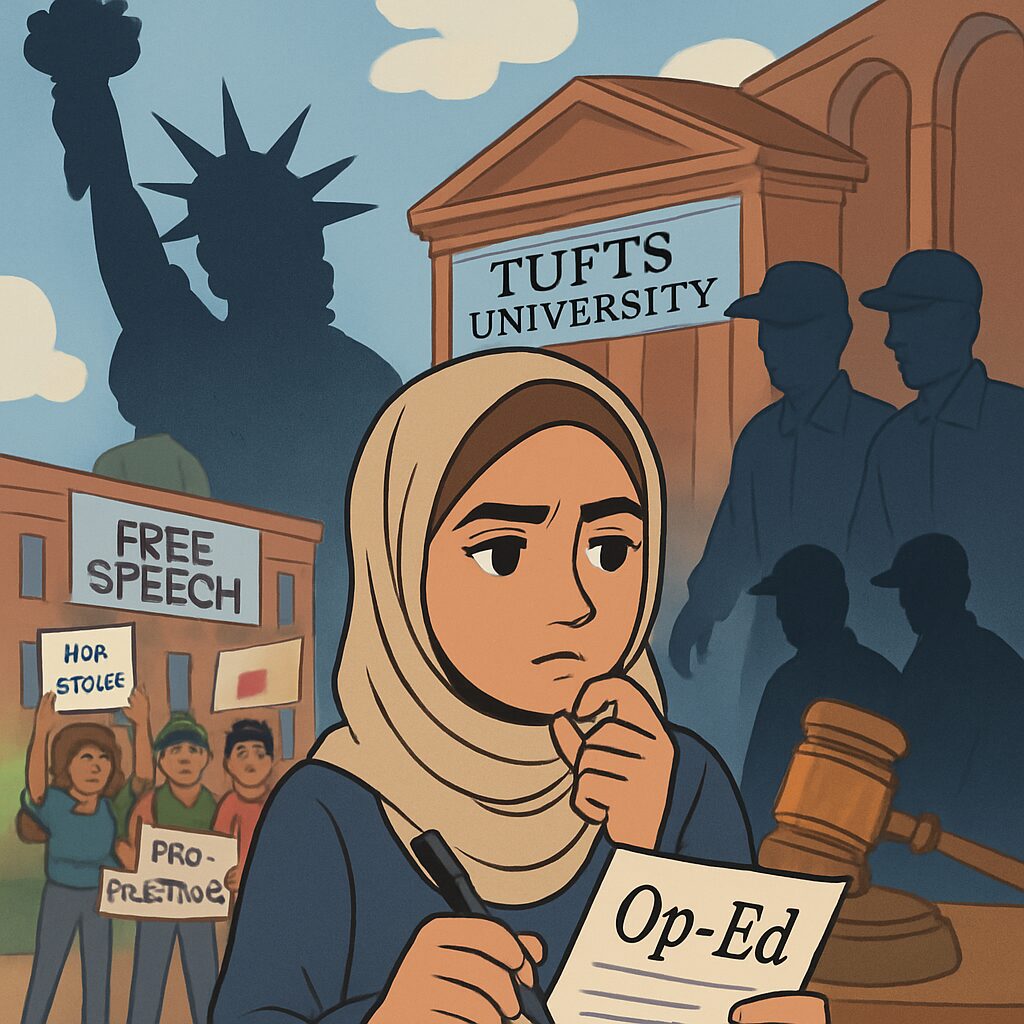
Newly unsealed court documents reveal that the Trump administration detained Tufts University doctoral student Rümeysa Öztürk and revoked her visa primarily because of an op-ed she co-authored criticizing Israel, with internal memos showing no evidence of terrorist activity or antisemitism. Rümeysa Öztürk, a 30-year-old Turkish national pursuing a PhD at Tufts, was arrested on March 25, 2025, after her F-1 student visa was revoked by the State Department. The arrest occurred outside her home by plainclothes officers, and she was held in immigration detention in Louisiana for 45 days. Her detention followed the publication of an opinion piece in the Tufts student newspaper that criticized the university’s response to pro-Palestinian activism and called for divestment from companies with ties to Israel.
According to documents unsealed in January 2026, investigations by the Department of Homeland Security (DHS) and Immigration and Customs Enforcement (ICE) found no proof that Öztürk had engaged in antisemitic activity or supported terrorist organizations. A State Department memorandum, prepared for the acting head of the Bureau of Consular Affairs, stated that DHS did not identify any grounds for removability based on material support to terrorism. The memo cited the op-ed as the primary reason for recommending visa revocation, despite acknowledging the lack of evidence for other ineligibilities. This internal assessment contrasts with public statements from administration officials who accused Öztürk of supporting Hamas.
The Trump administration defended its actions, with DHS spokeswoman Tricia McLaughlin claiming that Öztürk’s op-ed ‘recycled Hamas talking points and propaganda’ and made false genocide claims. McLaughlin argued that the student effectively advocated for the end of Israel, justifying the visa revocation on foreign policy grounds. However, the unsealed documents show that State Department officials were aware of the weak evidentiary basis, with one memo noting that the administration would likely face scrutiny in court due to First Amendment protections. This discrepancy highlights the tension between political rhetoric and legal standards.
The case is part of a broader pattern targeting international students critical of Israel. Secretary of State Marco Rubio had announced in March 2025 that the administration would revoke visas of ‘Hamas supporters,’ leading to similar actions against other activists like Mahmoud Khalil. The unsealed documents reveal that in multiple cases, visa revocations were recommended based on students’ involvement in protests criticizing Israel’s war in Gaza, despite arguments about antisemitism. This systematic approach suggests a coordinated effort to silence pro-Palestinian speech on campuses.
Legal challenges have ensued, with a federal judge ordering Öztürk’s release in May 2025, stating that her detention ‘potentially chills the speech of millions.’ In December 2025, another court ordered the restoration of her student visa record, criticizing the administration’s overreach. These rulings underscore the judiciary’s role in checking executive power and protecting constitutional rights. The American Civil Liberties Union (ACLU) and other groups have filed lawsuits arguing that such deportations violate free speech guarantees.
The revelations from the unsealed documents have sparked widespread concern among civil liberties advocates and academic institutions. They raise fundamental questions about the use of immigration enforcement to suppress political dissent and the implications for international students’ rights. As the cases proceed in immigration courts, the outcomes could set precedents affecting how the U.S. balances national security concerns with the protection of free expression. The ongoing legal battles highlight the delicate interplay between government authority and individual freedoms in a polarized political climate.

