

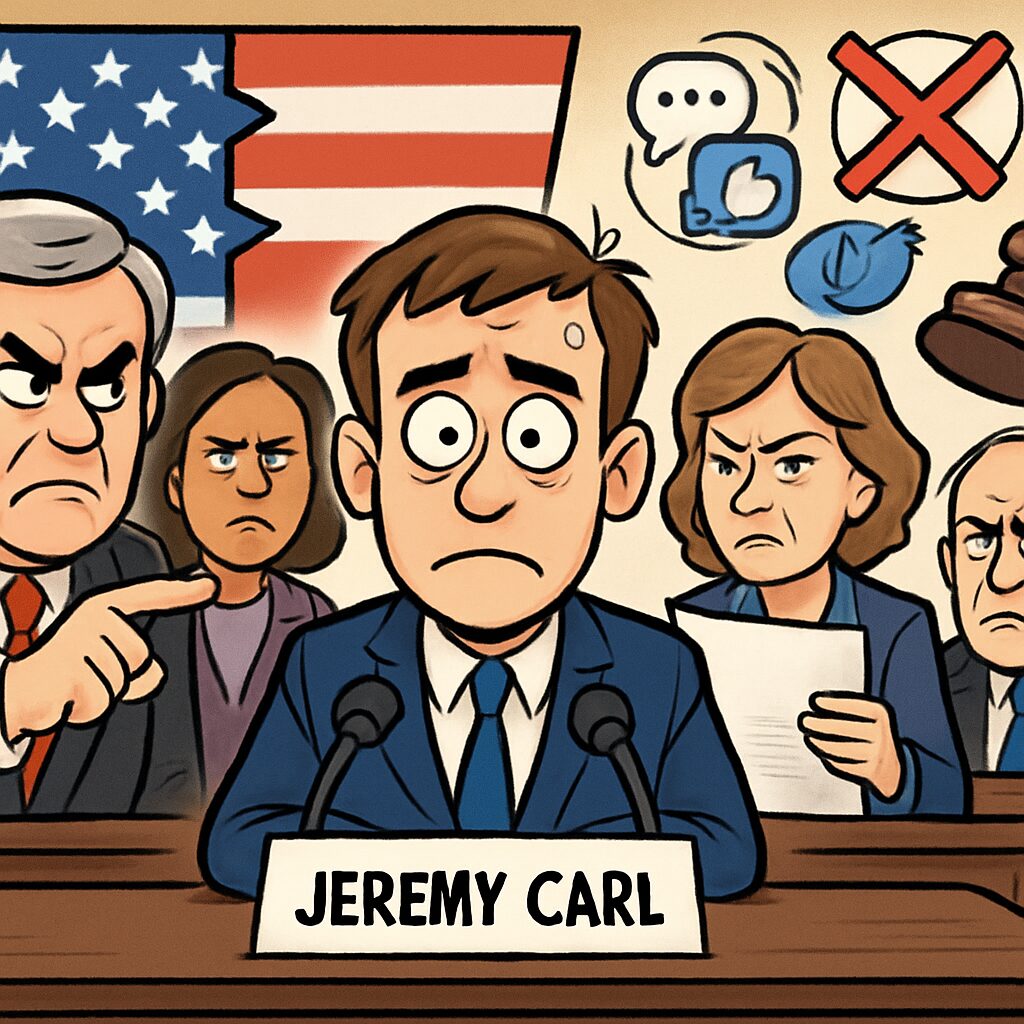
Jeremy Carl, President Donald Trump’s nominee for assistant secretary of state for international organizations, is facing bipartisan opposition that is likely to sink his confirmation after a contentious Senate Foreign Relations Committee hearing on February 12, 2026. Republican Sen. John Curtis of Utah announced his opposition following the hearing, citing Carl’s “anti-Israel views and insensitive remarks about the Jewish people,” which, combined with unified Democratic opposition, leaves the nomination without the necessary votes to advance.
During the hearing, Carl was pressed on a history of inflammatory comments uncovered by a CNN KFile investigation, which revealed that he had deleted thousands of social media posts containing racist, sexist, and antisemitic content. Senators from both parties questioned him about these remarks, including past statements where he minimized the Holocaust and expressed views aligned with the “Great Replacement” conspiracy theory. Sen. Jeanne Shaheen, a New Hampshire Democrat, highlighted that since his nomination, Carl had continued to engage in provocative commentary, undermining trust in his ability to exercise restraint in a diplomatic role.
Sen. Curtis specifically challenged Carl on a 2024 podcast appearance where the nominee agreed with a host’s assertion that Israel is a perpetrator rather than a victim and that Jewish people should not “rest on the Holocaust.” Curtis stated that such views are “unbecoming” for a position representing the U.S. in international forums like the United Nations. His opposition is critical because Republicans hold a narrow 12-10 majority on the committee; without Curtis’s support, the nomination would result in a tie, preventing it from moving to the full Senate.
Other senators, including Democrat Chris Murphy of Connecticut, interrogated Carl on his comments about “anti-White discrimination” and “the erasure of White culture.” Carl struggled to define “White culture” but asserted that mass immigration has balkanized American society, weakening it. Murphy later called Carl a “legit white nationalist” on social media, reflecting the deep concerns among Democrats about his suitability for the role.
Carl, a senior fellow at the conservative Claremont Institute and a former deputy assistant secretary at the Interior Department during Trump’s first term, defended himself by stating that he understands the importance of restraint but must balance it with his current advocacy work. He expressed regret for some comments about Jewish people, particularly those minimizing the Holocaust, but stood by other remarks, echoing Trump’s emphasis on unity over diversity.
The bipartisan pushback underscores the heightened scrutiny on nominees with controversial backgrounds in the current political climate. Sen. Jacky Rosen, a Jewish Democrat from Nevada, labeled Carl’s past comments “vile” and urged all senators to reject the nomination based on “basic decency.” The White House has not withdrawn the nomination, but with key Republican opposition, Carl’s path to confirmation appears effectively blocked.
This event follows other instances where Trump appointees have faced criticism for extremist views, such as the recent ouster of Carrie Prejean Boller from the Religious Liberty Commission over antisemitic remarks. The Carl nomination highlights ongoing tensions within the Republican Party and the challenges of confirming polarizing figures to sensitive diplomatic positions.
Looking ahead, the Senate Foreign Relations Committee is expected to vote on the nomination soon, but with Curtis’s opposition, it is likely to be defeated or stalled indefinitely. If confirmed, Carl would oversee U.S. policy at the UN and other international organizations, a role that requires nuanced diplomacy—a skill senators doubt he possesses given his inflammatory record. The outcome may influence future nomination battles and the administration’s approach to staffing key foreign policy roles.

