

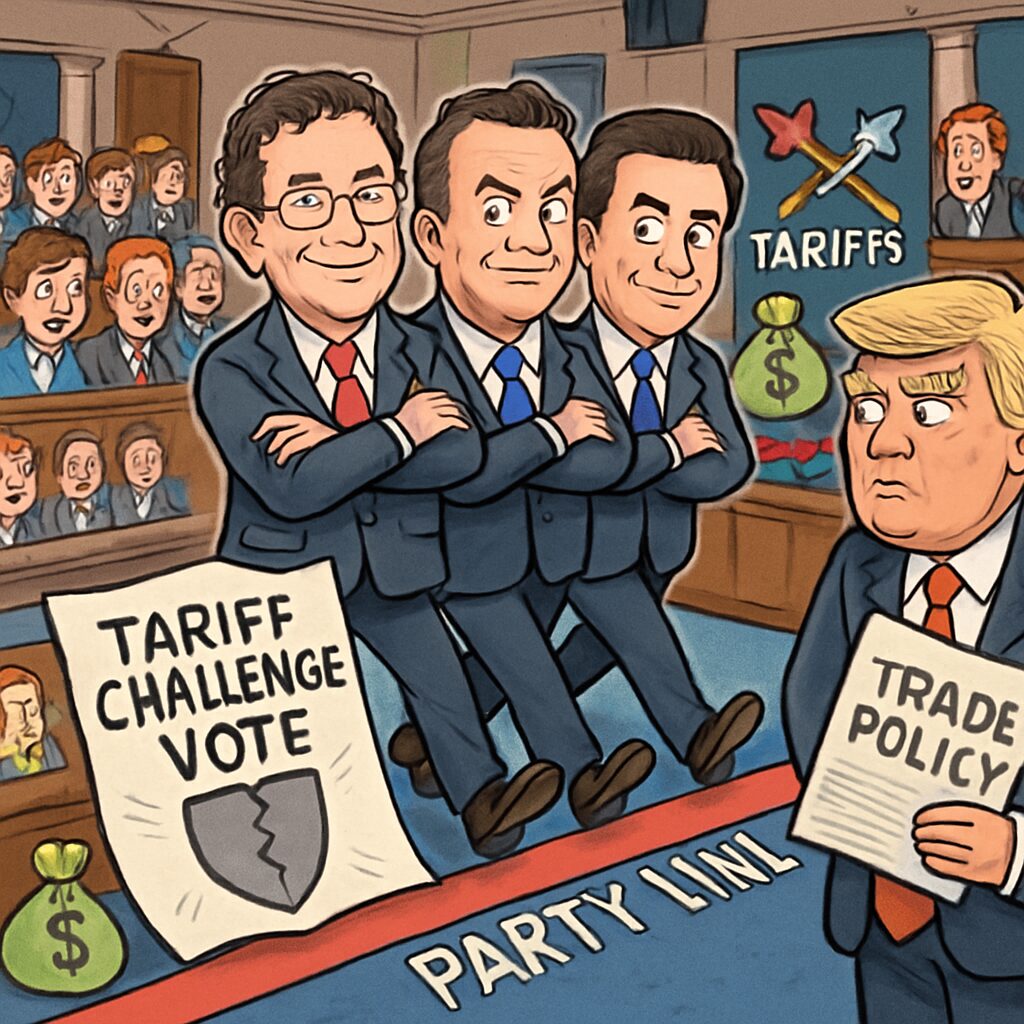
Three House Republicans broke ranks with their party on Tuesday, February 10, 2026, to defeat a procedural vote that would have barred lawmakers from challenging President Donald Trump’s tariffs. This move allows Democrats to potentially force votes to repeal the tariffs, highlighting internal GOP divisions and the challenges of governing with a razor-thin majority.
The House sank a key procedural vote on Tuesday when Republicans Thomas Massie of Kentucky, Don Bacon of Nebraska, and Kevin Kiley of California joined all Democrats in opposition. The vote was on a rule that included language preventing members from bringing up resolutions to disapprove of Trump’s tariffs through July 31. GOP leaders had inserted this language into a procedural resolution for unrelated legislation, aiming to shield the president’s trade policies from congressional scrutiny. The effort to block challenges to tariffs comes after a previous ban expired in January, and as Democrats planned to force a vote on terminating Trump’s tariffs on Canada.
House Speaker Mike Johnson and other Republican leaders argued that the extension was necessary to allow the Supreme Court time to rule on a case challenging Trump’s authority to impose tariffs unilaterally. However, the defecting Republicans criticized the move as an abuse of procedural rules. Rep. Don Bacon stated on social media that tariffs have been a ‘net negative’ for the economy and emphasized that Congress should reclaim its constitutional authority over taxes and tariffs. Similarly, Rep. Kevin Kiley argued that the rule was being used to sneak in unrelated language that expands leadership power at the expense of members’ ability to debate important issues.
With Republicans holding a narrow majority, Johnson can only afford to lose one vote on such measures, making the defection of three members significant. Johnson acknowledged the difficulties, telling reporters, ‘This is life with a small majority. I need unanimity every day, and we didn’t get it tonight.’ He expressed that most House Republicans support the president’s trade policy but admitted the setback. The Senate has previously passed resolutions rebuking Trump’s tariffs, with some Republicans crossing party lines, but these measures have stalled in the House.
The Supreme Court heard oral arguments in November on the legality of Trump’s tariff authority, and a decision is expected by summer. This vote could influence future congressional actions and the court’s deliberations. Trump imposed steep tariffs on Canada, Mexico, and China last year using emergency powers, citing issues with fentanyl and migration. While Canadian goods compliant with trade agreements are exempt, tensions have risen, and Trump has threatened additional tariffs.
The House vote opens the door for Democrats to push for votes to repeal these tariffs, potentially testing Republican unity further. Looking ahead, the failed vote underscores the fragility of Johnson’s leadership and the ongoing debate over executive versus legislative power in trade policy. It may prompt more Republicans to challenge leadership on other issues, and it sets the stage for potential floor votes on tariff repeals in the coming weeks.

