

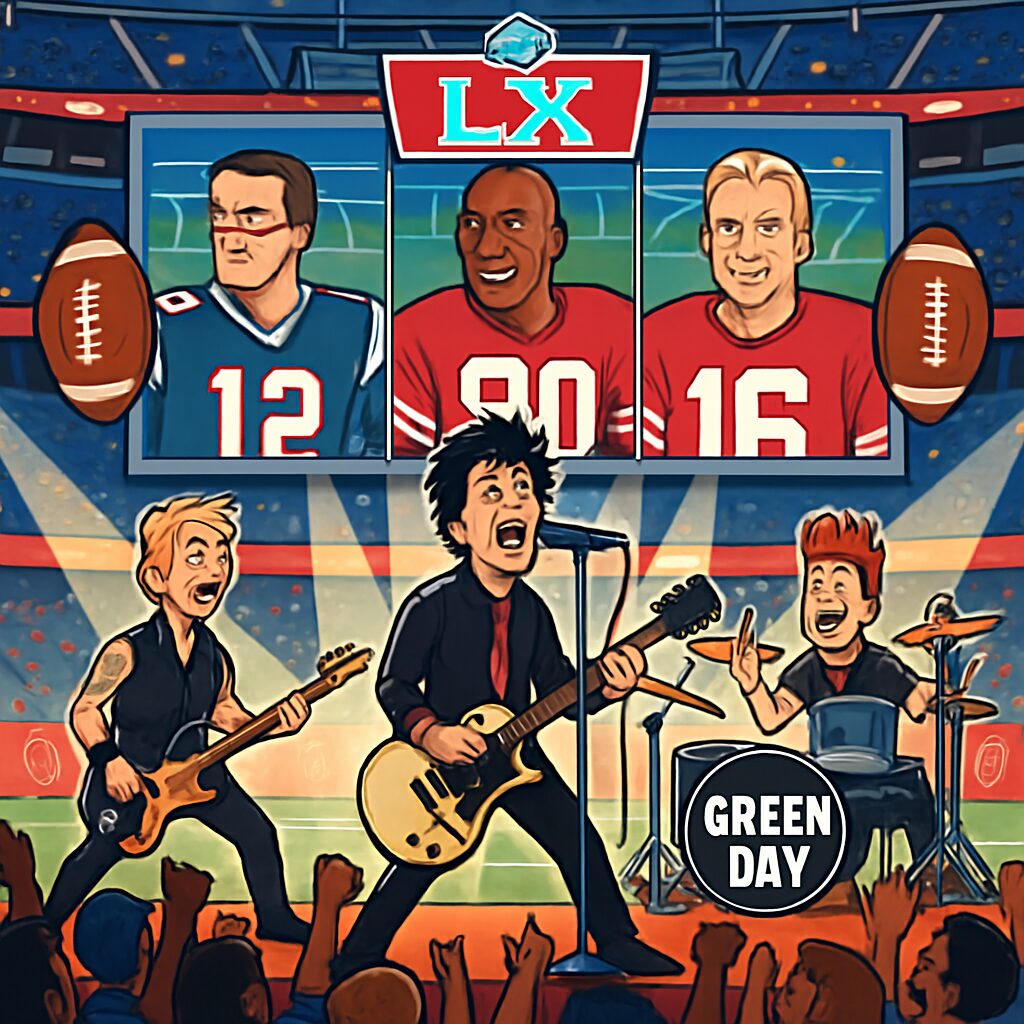
Green Day kicked off Super Bowl LX with a spirited performance on February 8, 2026, deliberately steering clear of the political statements that have marked their recent shows, even as they remain vocal critics of former President Donald Trump.
The iconic punk rock band Green Day took the stage at Levi’s Stadium in Santa Clara, California, to open the 60th Super Bowl, setting the tone for a night of football and entertainment. Their set was part of a ceremony that celebrated decades of NFL history, featuring appearances by legendary Super Bowl MVPs like Tom Brady, Jerry Rice, and Joe Montana. This homage to past champions added a nostalgic layer to the event, connecting the sport’s rich legacy with contemporary pop culture.
Performing a medley of their hits including ‘Holiday,’ ‘Boulevard of Broken Dreams,’ and ‘American Idiot,’ the band delivered an energetic show that captivated the live audience and viewers worldwide. Notably, they opted to let the songs’ lyrics speak for themselves without adding overt political commentary, a departure from their usual style. This choice was particularly striking given the politically charged nature of ‘American Idiot,’ a song that has often been interpreted as a critique of American society and leadership.
This restraint was surprising given Green Day’s well-documented activism, particularly their opposition to Donald Trump. In past concerts, frontman Billie Joe Armstrong has led chants against Trump and altered lyrics to criticize his policies, making their neutral Super Bowl performance a topic of discussion. Just days before the Super Bowl, at a San Francisco concert, Armstrong urged ICE agents to ‘quit your shitty-ass job,’ highlighting the band’s ongoing engagement with political issues.
Trump himself had publicly condemned the choice of Green Day and halftime performer Bad Bunny, calling it ‘terrible’ and announcing a boycott of the game. His comments added a layer of political tension to the event, even as the band chose to focus on entertainment. Trump cited the distance as his reason for skipping the game, but his criticism underscored the polarized reactions to the performers’ inclusion.
In a press release prior to the event, Armstrong expressed excitement about performing in their home state, saying, ‘We are super hyped to open Super Bowl 60 right in our backyard.’ The NFL’s Tim Tubito highlighted the significance of having a hometown band help celebrate the Super Bowl’s milestone anniversary, noting it as ‘an incredibly powerful way to kick off Super Bowl LX.’ The performance was announced on January 18, building anticipation for the band’s return to a major national stage.
The opening ceremony also featured performances by Charlie Puth singing the national anthem, Brandi Carlile with ‘America the Beautiful,’ and Coco Jones performing ‘Lift Every Voice and Sing.’ Bad Bunny headlined the halftime show, continuing the theme of high-profile musical acts. This lineup reflected the NFL’s effort to blend sports with diverse entertainment, appealing to a broad audience across generations and musical tastes.
By avoiding political statements during this high-visibility event, Green Day may have signaled a strategic shift towards broader appeal in mainstream settings. However, their history of activism ensures that their performances will continue to be scrutinized for political undertones, balancing art and message in the public eye. As the Super Bowl moves forward, the balance between entertainment and expression remains a delicate dance for performers on one of the world’s biggest stages.

