

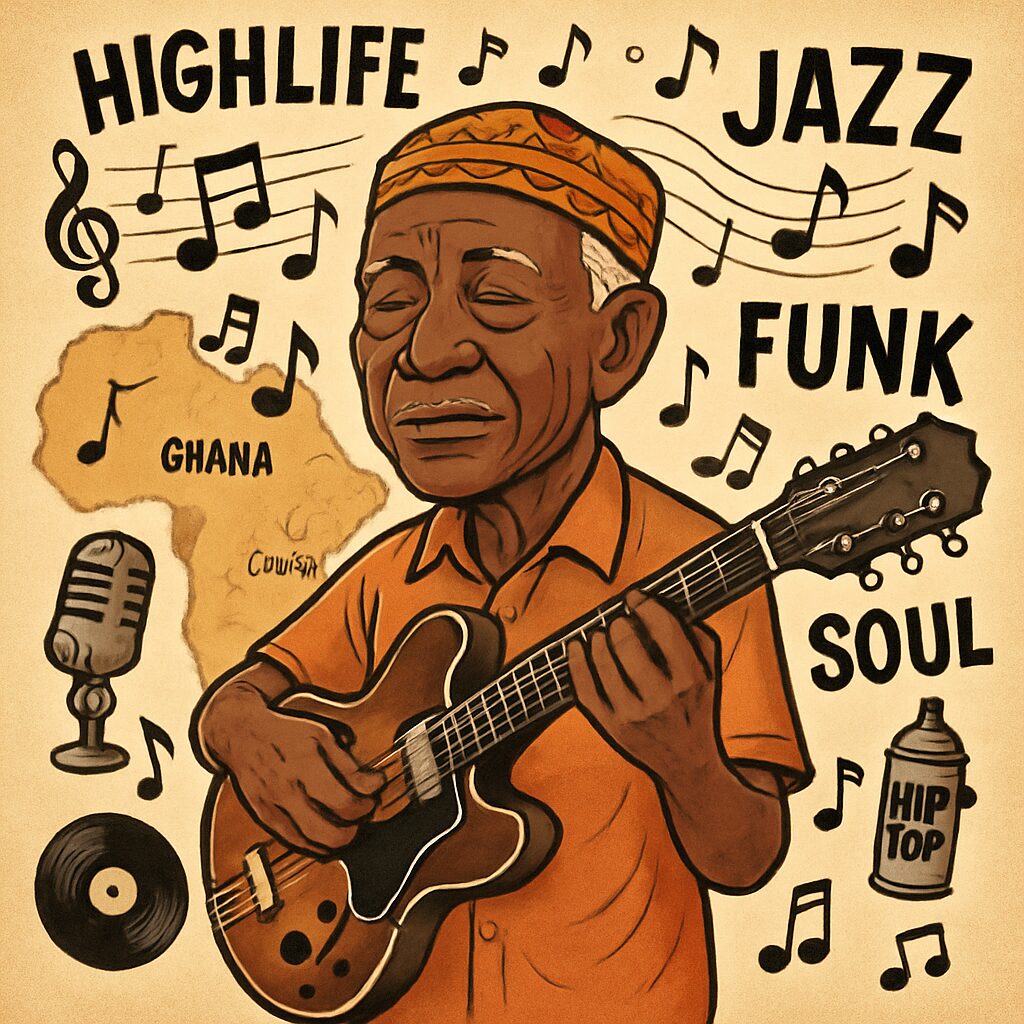
Ebo Taylor, the legendary Ghanaian musician renowned as a foundational figure in highlife and Afrobeat, has died at the age of 90. His passing, confirmed by his family on February 7, 2026, has prompted an outpouring of grief and tributes from the global music community, with news reports emerging today from major outlets.
Born Deroy Taylor in Cape Coast in 1936, Taylor began his musical journey in the 1950s, performing with seminal bands such as the Stargazers and the Broadway Dance Band. His innovative guitar style and intricate arrangements quickly established him as a key architect of the highlife genre, which dominated Ghana’s soundscape during that era. Over six decades, he skillfully blended Ghanaian rhythms with jazz, funk, soul, and early Afrobeat, creating a unique sonic palette that resonated across Africa.
A pivotal moment in Taylor’s career came in the early 1960s when he travelled to London to study music. There, he collaborated with Nigerian artist Fela Kuti, an exchange now seen as instrumental in shaping Afrobeat. This period fostered a cross-pollination of ideas, with highlife providing a crucial foundation for the genre that Fela would later popularize worldwide. Upon returning to Ghana, Taylor became a sought-after band leader, arranger, and producer, working with acclaimed artists like Pat Thomas and CK Mann, further cementing his influence.
In the latter part of his career, Taylor’s music experienced a global renaissance. Albums such as “Love & Death,” “Appia Kwa Bridge,” and “Yen Ara” attracted international attention, particularly through sampling by hip-hop and R&B artists. Tracks like “Heaven,” “Odofo Nyi Akyiri Biara,” and “Love & Death” have been used by performers including Usher, the Black Eyed Peas, Kelly Rowland, and Jidenna, introducing his work to new generations of listeners. Reflecting on this late-career recognition, Taylor once remarked, “I think I’ve had my day, though it came much later.”
Tributes have flooded in from prominent figures, highlighting Taylor’s profound impact. Ghanaian presidential spokesperson Felix Kwakye Ofosu described him as a “colossus” of the country’s music, while musicians like Black Sherif praised his “worldwide ripples” in the industry. Producer Panji Anoff recalled Taylor’s humility and mentorship, noting how he treated younger artists as equals. Singer Rocky Dawuni saluted him as “a great African music legend” who brought Ghanaian highlife to the world.
Beyond performance, Taylor contributed to music education, teaching at the University of Ghana and focusing on production in his later years. His accolades include the Music In Africa Honorary Award in 2019, recognizing his significant contributions to African music. This award, presented alongside fellow musician Bibie Brew, underscored his status as a cultural icon whose work transcended borders.
Taylor’s legacy extends far beyond highlife, influencing contemporary genres like afrobeats and serving as a bridge between traditional and modern African sounds. His ability to ground innovation in cultural continuity has left an indelible mark on popular music, with his compositions continuing to inform artists today. From the diaspora to the continent, he is celebrated as a figure who helped put Ghanaian music on the global map during a time when other genres were prominent.
The news of his death, reported today by reliable sources such as the BBC and Music in Africa, underscores the enduring relevance of his artistry. As the world mourns his loss, Taylor’s body of work remains a testament to his creativity and influence, ensuring that his musical spirit will continue to inspire future generations.

