

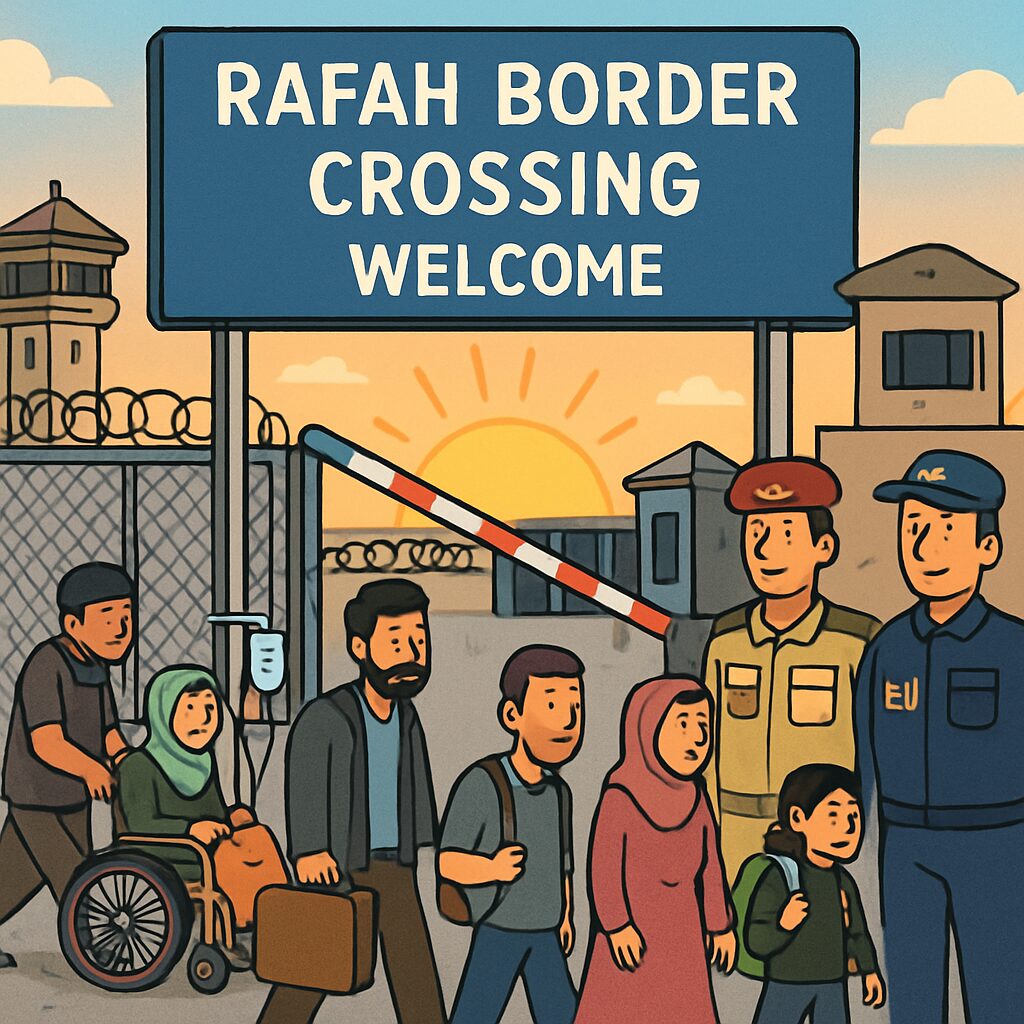
The Rafah border crossing, Gaza’s primary connection to Egypt, reopened on Monday in a limited pilot phase, enabling the medical evacuation of critically ill Palestinians as part of the ongoing ceasefire between Israel and Hamas. This development follows Israeli announcements that the crossing would resume operations after nearly two years of closure, offering a glimmer of hope for thousands seeking urgent care abroad.
On Sunday, the Israeli military agency COGAT confirmed that the crossing would reopen for limited travel, with residents allowed to cross on foot in both directions starting Monday. The operation is being coordinated with Egypt and the European Union, which will provide border patrol agents to supervise the process. Initially, only a small number of people will be permitted to cross, with plans to scale up gradually based on the pilot’s success.
Specifically, Israel has stated that 50 patients requiring medical evacuation can leave Gaza daily, each accompanied by up to two relatives, while 50 Palestinians who exited during the conflict can return each day. In the first few days, approximately 200 people, including patients and family members, are expected to transit daily into Egypt, with a similar number returning to Gaza. This controlled approach aims to balance humanitarian needs with security concerns.
The reopening addresses a critical humanitarian crisis in Gaza, where an estimated 22,000 sick and wounded individuals are in dire need of medical treatment unavailable locally due to the destruction of healthcare infrastructure during the war. Additionally, about 80,000 Palestinians who left Gaza during the conflict are seeking to return, highlighting the crossing’s role as a vital lifeline for movement and reunion.
Rafah crossing has been largely shut since Israel seized it in May 2024 as part of military operations, severely restricting the flow of people and aid. Before the war, it was the main crossing for Palestinians moving in and out of Gaza, managed jointly by Palestinian and Egyptian authorities with Israeli oversight. Its closure exacerbated the humanitarian situation, making this reopening a significant, though limited, step towards normalization.
International involvement is key to the crossing’s operation. Egypt has insisted that it must be open in both directions to prevent forced displacement, while the EU’s supervision ensures adherence to agreed protocols. Lists of Palestinians approved to cross have been prepared by Egypt and vetted by Israel, with the process designed to prevent security risks while facilitating essential travel.
Despite the positive development, challenges persist. Many Palestinians express fear that leaving might mean they cannot return, reflecting broader anxieties about permanent displacement. Concurrently, Israel announced it would terminate the operations of Doctors Without Borders in Gaza by February 28, citing the organization’s failure to comply with new registration requirements. This move could further hinder healthcare delivery in a territory already reeling from shortages.
The reopening aligns with the ceasefire that began in October, which has seen periodic violations but overall reduced hostilities. Future phases of the agreement aim to establish a new Palestinian governance structure, deploy international security forces, and initiate reconstruction efforts. While the road to peace remains uncertain, the Rafah crossing’s reopening marks a cautious step forward in alleviating human suffering and rebuilding trust.
This summary is based on reports from Al Jazeera and PBS NewsHour, cross-checked for accuracy and synthesized into a cohesive narrative.

