

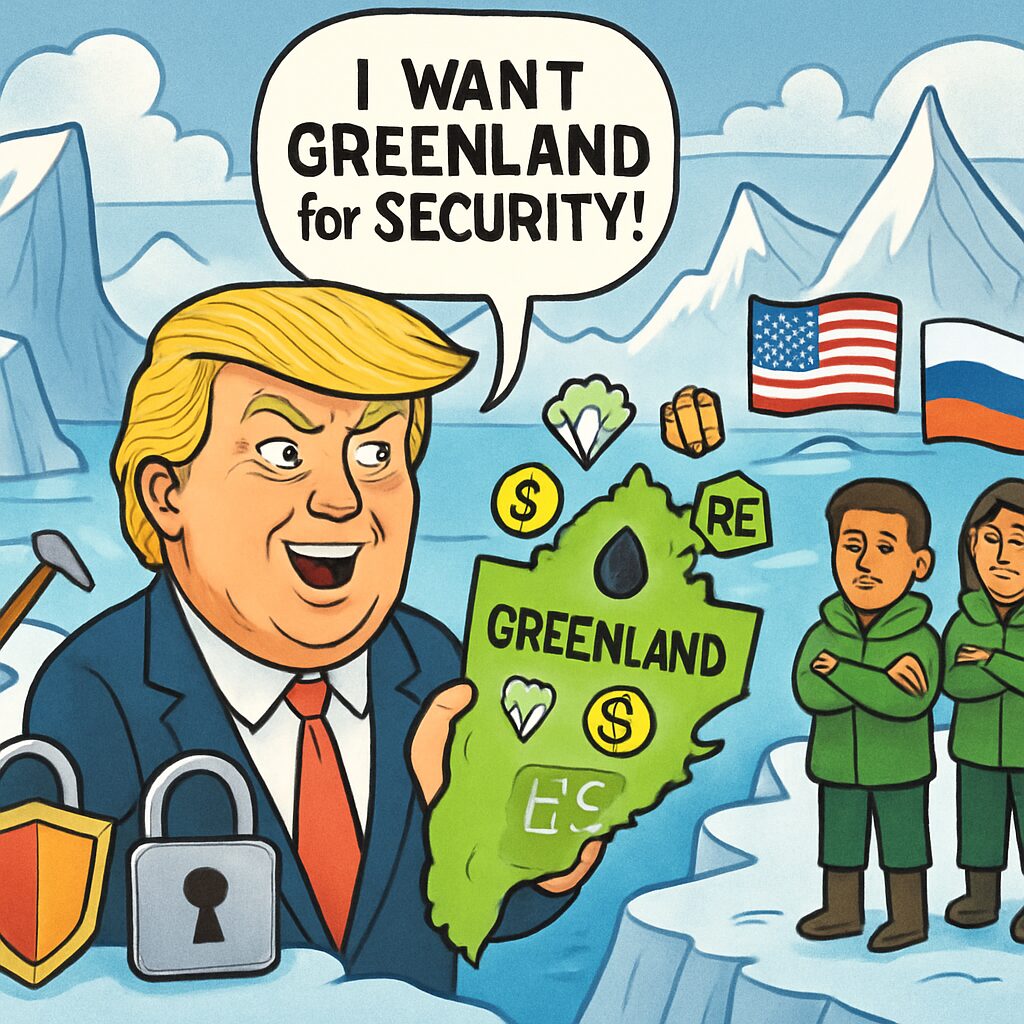
President Donald Trump’s renewed ambition to acquire Greenland is fueled by the island’s extensive natural resources, especially rare earth minerals vital for modern technology and national security, but formidable Arctic conditions and logistical barriers make extraction highly uncertain.
Trump recently asserted that he has secured a ‘framework’ for a future deal over Greenland, emphasizing defense and access to rare earth minerals. This aligns with his administration’s broader goal of reducing dependence on China for critical materials, a priority in U.S. economic and geopolitical strategy. At the World Economic Forum in Davos, Trump stated, ‘I want Greenland for security,’ though his allies have highlighted the resource potential.
Greenland is estimated to hold significant reserves of oil, natural gas, and rare earth elements. According to the 2023 Geological Survey of Denmark and Greenland, 25 of the 34 critical raw materials identified by the European Commission are present, including graphite, niobium, and titanium. These minerals are essential for electronics, green energy, and military technologies, making Greenland a strategic asset.
The geopolitical context is crucial, with Trump’s interest seen as a response to increasing Russian and Chinese influence in the Arctic. U.S. officials, such as former national security adviser Mike Waltz, have framed Greenland as key to securing critical minerals and enhancing Arctic security. Senator Ted Cruz echoed this, citing the island’s ‘vast reserves of rare earth elements’ during Senate hearings.
Despite the potential, practical challenges are immense. Greenland’s Arctic environment features remote locations, a mile-thick ice sheet, and extreme weather, making mining operations five to ten times more expensive than elsewhere. Malte Humpert of The Arctic Institute likened the endeavor to ‘mining on the moon,’ noting the lack of infrastructure and small labor force. Currently, only two productive mines exist in Greenland, despite numerous exploration permits.
Environmental factors compound the difficulties. Climate change is melting ice, potentially exposing new areas for mining but also causing ground instability and increasing landslide risks. Greenland’s stringent environmental regulations, supported by the local population, aim to preserve the pristine environment, which could clash with aggressive extraction plans and lead to political resistance.
Local opposition is strong, with a January 2025 poll showing only 6% of Greenlanders favor becoming part of the United States. Christian Keldsen of the Greenland Business Association warned that Trump’s rhetoric is damaging relations, making American investments a ‘red flag.’ This hostility could undermine any economic or strategic gains.
The Trump administration has taken steps to support mining, such as approving $120 million in financing for an American company’s project in Greenland via the Export-Import Bank. However, experts like Jacob Funk Kirkegaard of the Peterson Institute argue that without substantial taxpayer guarantees, the business case remains weak, as high upfront costs deter private investment.
Looking ahead, the realization of Trump’s Greenland ambitions hinges on overcoming these multifaceted barriers. While the resources could potentially shift global supply chains and enhance U.S. security, the path is fraught with uncertainty, requiring careful navigation of technical, economic, and diplomatic challenges in the evolving Arctic landscape.

