

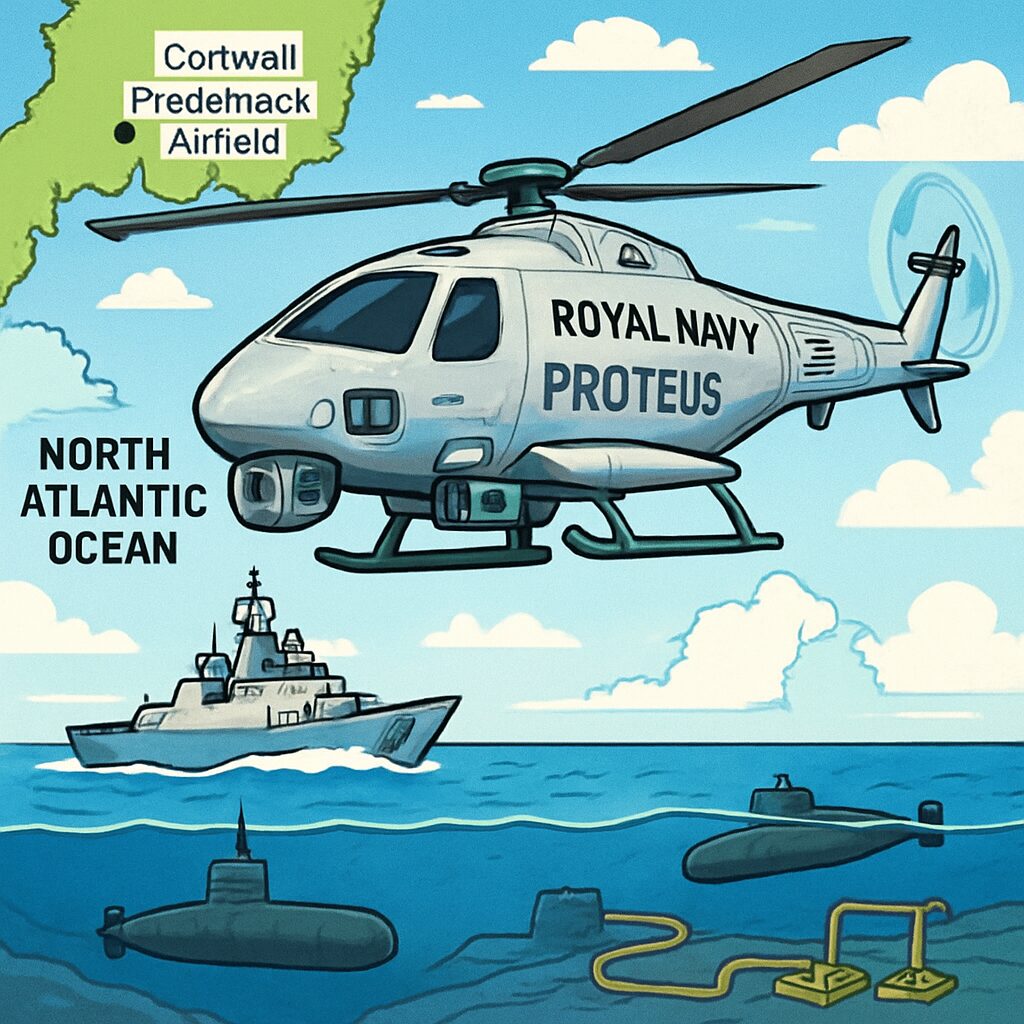
The British Royal Navy has launched its first full-size autonomous helicopter, marking a significant advancement in military aviation. The Proteus helicopter, developed by Leonardo, completed its maiden flight, designed to operate without a crew and enhance naval capabilities against emerging threats in the North Atlantic.
On January 16, 2026, the Royal Navy announced that the Proteus demonstrator had successfully taken to the skies from Predannack airfield in Cornwall. This event was described as making ‘British aviation history,’ with the navy emphasizing that it is one of the world’s first autonomous helicopters of its size. The helicopter is equipped with advanced sensors and computer systems that allow it to interpret its environment, make decisions, and execute missions independently, representing a leap in autonomous technology.
Proteus is specifically engineered for high-risk missions such as anti-submarine warfare, sea patrols, and tracking underwater vessels. Its design includes a large modular payload bay capable of carrying two standard NATO pallets, enabling versatility in roles from surveillance to logistics. This capability is crucial for the UK’s Atlantic Bastion strategy, aimed at countering Russian submarine threats and protecting critical seabed infrastructure in the region.
The development of Proteus is part of an approximately $80 million program funded by the UK government and Leonardo. According to the Royal Navy, this investment is intended to ‘unlock the potential of uncrewed aerial systems’ and serve as a testbed for future hybrid air wings. In these wings, autonomous aircraft like Proteus would operate alongside crewed platforms, increasing operational flexibility and reducing risks to human personnel.
This move places the UK in direct competition with US defense firms, particularly following Sikorsky’s unveiling of the autonomous U-Hawk Black Hawk helicopter in October 2025. The global push towards autonomous military systems is driven by Pentagon commitments and a desire to invert the ratio of crewed to uncrewed aircraft, with the US Army, for example, aiming for 90% drone usage. The Proteus flight demonstrates that European allies are also advancing rapidly in this domain.
The Royal Navy already operates smaller drones, such as octocopters for supply transport and the Peregrine for surveillance, but Proteus is significantly larger and more complex. Its autonomy allows it to ‘eclipse’ previous systems in terms of capability, paving the way for more sophisticated unmanned missions. The navy plans to use Proteus for trials and experimentation, with no immediate plans for mass production, focusing instead on refining the technology for future deployments.
Looking ahead, the successful flight of Proteus signals a shift towards integrated autonomous systems in naval warfare. It underscores the UK’s commitment to maintaining a technological edge in defense, particularly in the contested waters of the North Atlantic. As threats evolve, such innovations are expected to play a key role in deterrence and response strategies for NATO allies.
In conclusion, the unveiling of the Proteus autonomous helicopter represents a milestone in military aviation, with implications for global defense dynamics. It highlights the ongoing transformation towards uncrewed operations and sets the stage for further advancements in autonomous naval capabilities.

