

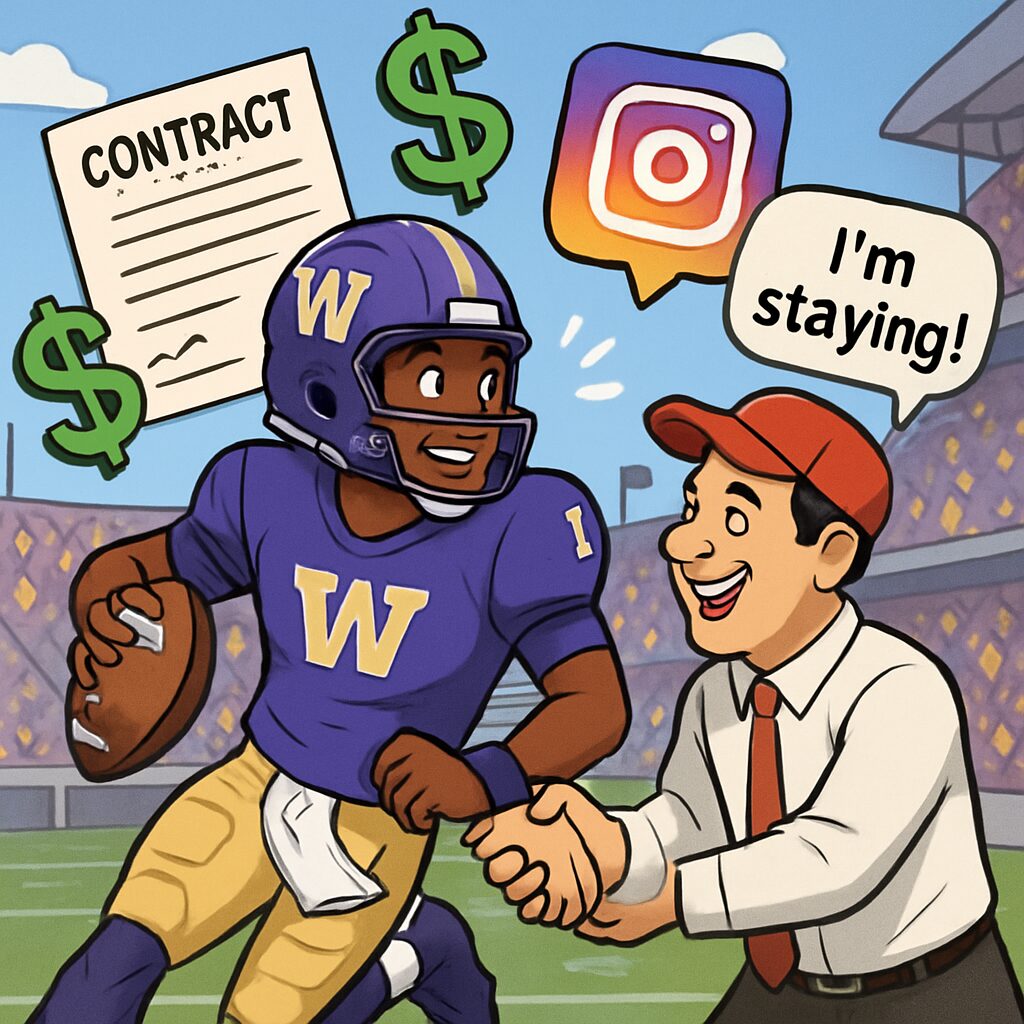
Quarterback Demond Williams Jr. has decided to remain at the University of Washington, reversing his brief entry into the transfer portal after signing a lucrative contract, in a move that underscores the evolving landscape of college athlete contracts. This decision ends a frenetic 48-hour saga that sent shockwaves through college sports and tested the enforceability of contracts in the modern era.
Williams, who will be a junior, announced his return via Instagram on Thursday night, just hours after his initial transfer declaration had sparked widespread concern. His announcement came during the College Football Playoff national semifinal between Miami and Ole Miss, capping a period of intense speculation and legal maneuvering. Sources indicated that Williams had signed a deal with Washington worth in the mid-$4 million range for the 2026 season, making his sudden transfer announcement particularly jarring for the program.
The university and the Big Ten conference were prepared to pursue legal action to enforce the contract, highlighting growing tensions between player mobility and contractual obligations in college athletics. Williams was expected to transfer to LSU, but any move would have required significant legal wrangling, given Washington’s firm stance on holding him to the agreement. This situation quickly became a flashpoint for the validity of contracts in college sports, with one high-ranking official calling it a “very bright line” issue.
Over the course of the day on Thursday, Williams’ agent, Doug Hendrickson of Wasserman Football, dropped him as a client, leading the quarterback to retain lawyer Darren Heitner, a veteran of NCAA eligibility cases. Williams and his camp spent the day discussing options before concluding that returning to Washington was the best path forward, amid the threat of legal challenges and potential eligibility issues.
Washington coach Jedd Fisch issued a statement expressing relief and a commitment to rebuilding trust within the Husky community. He noted that he and Williams had engaged in “very honest and heartfelt conversations” and agreed that the University of Washington remains the optimal place for his academic, athletic, and social development. Fisch emphasized that they will work together to repair relationships and focus on the upcoming season.
Williams’ situation has broader implications for college sports, serving as a critical test case for contract enforcement in the era of name, image, and likeness (NIL) deals. It raises questions about whether agreements will be respected moving forward, potentially influencing how schools and athletes negotiate in the future. The incident underscores the uncertain realities of modern college athletics, where large financial commitments intersect with traditional transfer rules.
Looking ahead, Williams is expected to be one of the top quarterbacks in college football next season, having thrown for 3,065 yards and 25 touchdowns in his first year as a full-time starter, earning honorable mention All-Big Ten honors. His return stabilizes Washington’s quarterback position and allows the program to avoid the disruption of seeking a replacement, positioning the Huskies for competitiveness in the 2026 season.
In his Instagram post, Williams apologized for the timing of his initial announcement, which coincided with a celebration of life for UW women’s soccer player Mia Hamant, and affirmed his commitment to the team. He wrote, “I am fully committed and focused on contributing to what we are building,” signaling a desire to move forward positively and contribute to Washington’s ongoing efforts. This resolution brings closure to a high-profile case that captivated the college football world and may set precedents for future contract disputes.

