

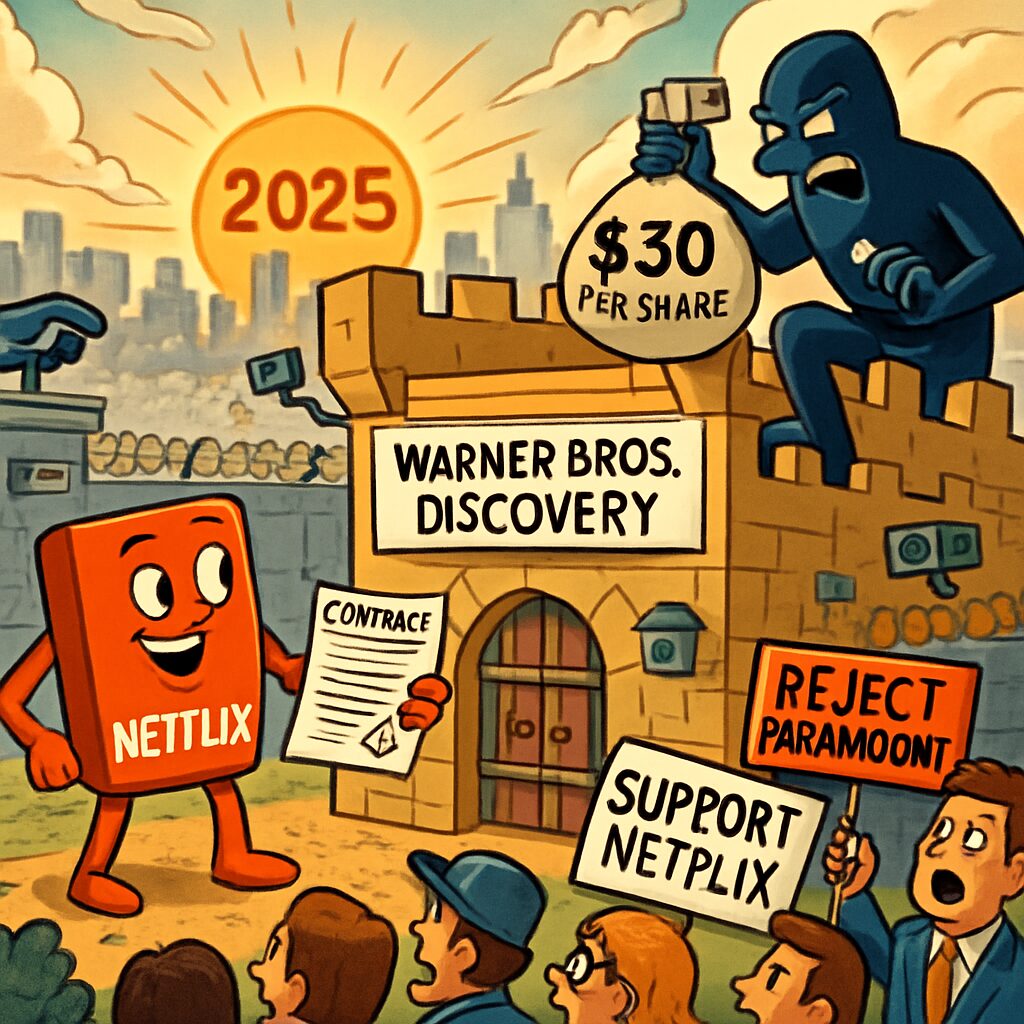
Warner Bros. Discovery has formally rejected Paramount Skydance’s hostile takeover bid, urging shareholders to support Netflix’s acquisition offer instead, a move that intensifies the battle for control in the rapidly consolidating media landscape.
On December 17, 2025, the Warner Bros. Discovery board unanimously recommended that shareholders reject Paramount’s $30-per-share tender offer for the entire company. In a letter to shareholders and an SEC filing, the board described the hostile bid as “illusory,” emphasizing that the existing agreement with Netflix provides superior and more certain value. This recommendation follows Paramount’s recent launch of the takeover attempt, which Warner Bros. has consistently opposed, setting the stage for a protracted corporate struggle.
The rejection stems primarily from financial and risk considerations. The board stated that Paramount’s offer “provides inadequate value and imposes numerous, significant risks and costs on WBD.” Key concerns include the financing of Paramount’s bid, with the board alleging that assurances of backing from CEO David Ellison and his father, Oracle co-founder Larry Ellison, were misleading. Additionally, national security issues have emerged due to Paramount’s involvement with sovereign wealth funds from Saudi Arabia, Qatar, and the United Arab Emirates. Paramount has clarified that these entities would hold no voting power, but the scrutiny has heightened political and regulatory attention.
Paramount has responded by affirming its commitment to the $30-per-share offer, insisting it is “superior” and fully backstopped by the Ellisons. In regulatory disclosures, Paramount defended its financing as “air-tight” and dismissed contrary suggestions as “absurd.” However, Warner Bros. Discovery’s letter refutes these claims, stating that the backing “does not, and never has” been guaranteed, highlighting the contentious nature of the negotiations and potential for further disputes.
Netflix has welcomed the board’s recommendation, with co-CEO Ted Sarandos describing the process as a “competitive process that delivered the best outcome for consumers, creators, stockholders and the broader entertainment industry.” Netflix’s deal, which involves acquiring Warner Bros.’s studios and streaming assets, is viewed as offering more stable value. To address industry concerns, Netflix has proactively engaged stakeholders, with Sarandos recently assuring that theatrical distribution for Warner Bros. films will continue under traditional windows, aiming to mitigate antitrust and competitive fears.
The next phase involves a shareholder vote, which board chair Sam DiPiazza indicated could occur in the spring or “early summer.” Paramount now has the opportunity to revise its offer with higher terms or more secure financing to sway shareholders. If Paramount returns with a more lucrative proposal, Warner Bros. Discovery might reconsider, and Netflix could counter with a higher bid, potentially leading to a prolonged bidding war that could extend into mid-2026.
Regulatory scrutiny is another critical factor. Warner Bros. Discovery is cooperating with regulators reviewing the Netflix transaction, while Netflix has taken steps to assuage antitrust concerns. The involvement of Middle Eastern funds in Paramount’s bid has drawn political attention, adding complexity to the regulatory landscape. Both deals will undergo thorough examination to assess impacts on market competition and content diversity.
This development underscores the intense rivalry in the media sector, where consolidation is reshaping content creation, distribution, and consumer access. The outcome could significantly influence the streaming landscape, affecting shareholder returns, industry employment, and the future of entertainment. As the battle unfolds, stakeholders will monitor shareholder decisions, regulatory rulings, and potential strategic shifts from all parties involved.

