

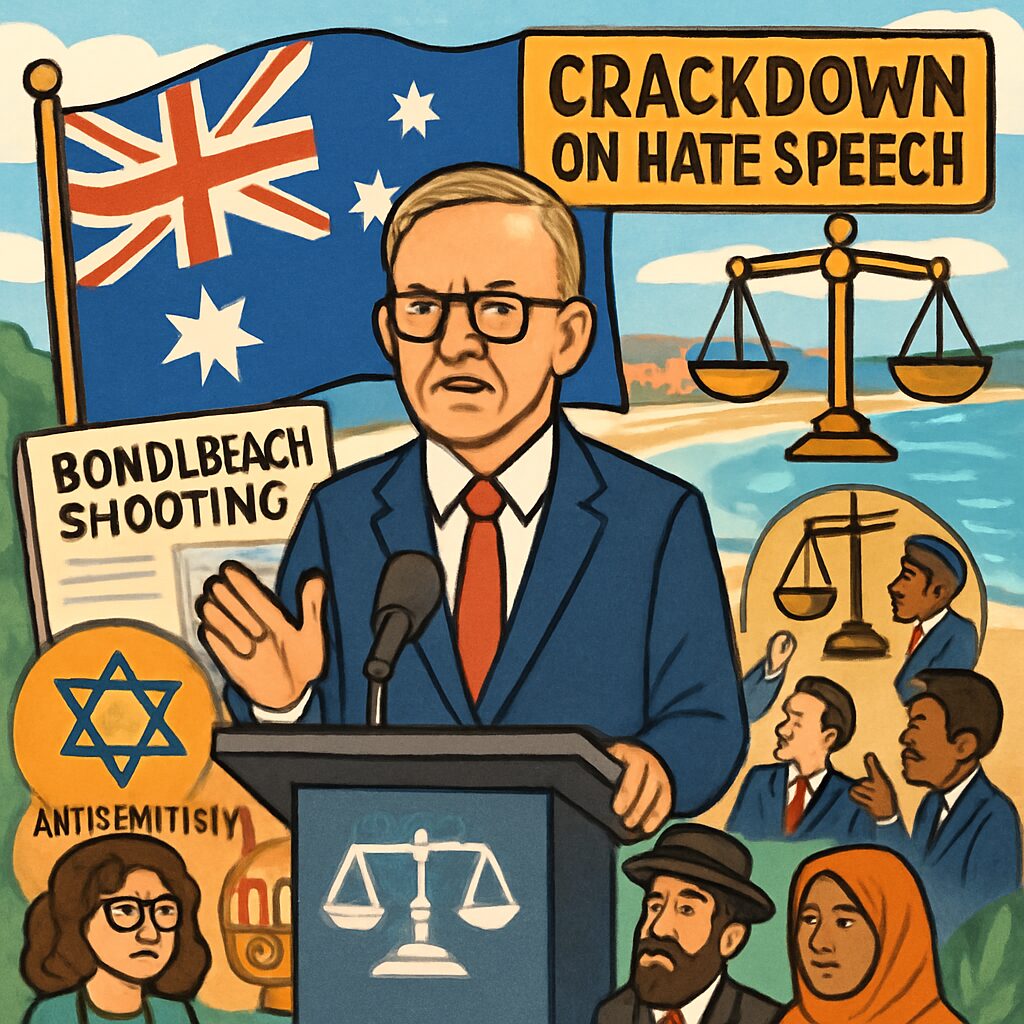
Australian Prime Minister Anthony Albanese has announced a significant crackdown on hate speech in the wake of a deadly terrorist attack at Bondi Beach, introducing new laws aimed at combating antisemitism and preventing further violence. The measures, unveiled on Thursday, come after a shooting on Sunday that targeted a Hanukkah celebration, killing 15 people and injuring many more, in an act inspired by Islamic State.
The attack, which occurred during a Jewish festival at Bondi Beach, marked one of the worst mass shootings in Australian history. Victims included two rabbis, a Holocaust survivor, and a 10-year-old girl named Matilda, whose funeral was held on Thursday. Authorities have linked the gunmen to extremist ideologies, highlighting the urgent need for action against hate speech and radicalisation.
In response, Prime Minister Albanese outlined a five-point plan that includes creating a new federal offence of “aggravated hate speech” specifically targeting preachers and leaders who promote violence. The plan also enhances penalties for hate speech that incites violence, introduces hate as an aggravating factor in sentencing for online threats and harassment, and grants the home affairs minister powers to cancel or refuse visas for individuals spreading hate and division. Additionally, a new taskforce will be established to address antisemitism in the education system, chaired by business leader David Gonski.
Albanese conceded that more could have been done to combat antisemitism following the Hamas attack on Israel on October 7, 2023, which led to a rise in anti-Jewish sentiment in Australia. “Look, of course more could have always been done. Governments aren’t perfect. I’m not perfect,” he said, accepting responsibility for past shortcomings. The government has pledged to adopt recommendations from antisemitism envoy Jillian Segal, whose July report called for stricter measures but faced criticism over free speech concerns.
Opposition leader Sussan Ley responded by accusing Albanese of delayed action and unveiled her own plan, which includes cutting funding to arts and research projects supporting antisemitic activities and pausing visas from regions like Gaza. Ley demanded that parliament be recalled next week to pass laws before Christmas, emphasizing the need for immediate steps to protect the Jewish community.
However, the proposed laws have sparked concerns about potential impacts on free speech. The Jewish Council of Australia expressed support for the crackdown but warned that measures like university scorecards could become forms of ideological policing, particularly if used to limit criticism of Israel. Similarly, Greens justice spokesperson David Shoebridge cautioned that banning organisations might fuel more division and stressed the importance of maintaining open debate in a democratic society.
Home Affairs Minister Tony Burke explained that the new laws aim to lower the threshold for prosecuting hate speech, addressing loopholes that have allowed individuals and groups to spread divisive rhetoric without crossing legal boundaries. “We’re shifting the threshold,” Burke said, noting that organisations like Hizb ut Tahrir and neo-Nazi groups have exploited current laws to promote hatred without facing consequences.
Looking ahead, the government plans to draft the legislation carefully to withstand legal challenges and seek bipartisan support. Albanese did not rule out recalling parliament over the summer but emphasized the complexity of the changes. The ultimate goal is to foster national unity and prevent future tragedies, but balancing security with civil liberties will be a critical challenge as Australia grapples with the aftermath of the Bondi shooting.

