

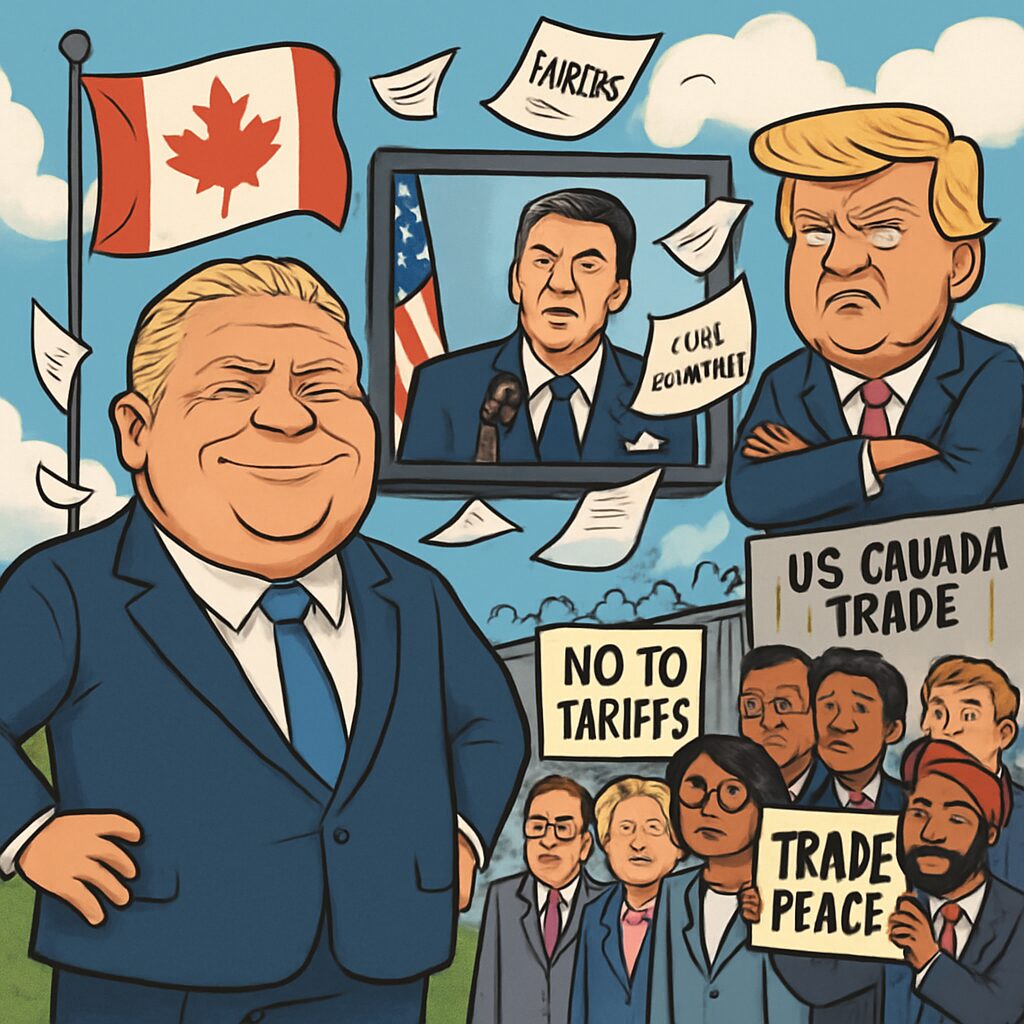

Ontario Premier Doug Ford has affirmed that his government’s controversial anti-tariff advertisement featuring Ronald Reagan successfully achieved its objective of igniting a widespread discussion on trade policies, even as it prompted U.S. President Donald Trump to halt trade negotiations and announce additional tariffs on Canadian goods. The TV spot, which has garnered an estimated one billion views and international attention, was designed to criticize Trump’s tariff stance and highlight historical opposition to such measures.
Ford’s comments came on Monday after President Trump suspended trade talks with Canada over the advert and declared that he would impose an additional 10% tariff on Canadian goods “over and above” existing levies. Trump, who is currently attending the ASEAN summit in Asia alongside Canadian Prime Minister Mark Carney, told reporters that he has no plans to meet with Carney and won’t be doing so “for a long time,” signaling a significant deterioration in bilateral relations. The suspension of talks and tariff threats mark a sharp escalation in tensions between the two nations.
The advertisement, sponsored by the Ontario government, excerpts a 1987 national radio address by Reagan in which he stated that tariffs “hurt every American.” It was intended to resonate with U.S. audiences and counter Trump’s protectionist policies, but the U.S. president labeled it “fraudulent” and accused Canada of attempting to interfere in an upcoming Supreme Court case regarding the legality of his tariffs. Trump’s reaction underscores the sensitivity of trade issues and the potential for diplomatic fallout from public campaigns.
Prime Minister Carney, while not directly criticizing Ford or the advert, emphasized that trade negotiations with the U.S. are the responsibility of the federal government. He revealed that the two countries were close to a trade deal and exchanging term sheets before the ads prompted Trump to walk away from talks. “Then there were the ads, and everything changed,” Carney noted, highlighting how the advertisement abruptly altered the diplomatic landscape and stalled progress on a potential agreement.
Ford disclosed that Carney and his chief of staff had seen the TV spot before its release, indicating some level of federal awareness. In the Ontario legislature, Ford hailed the advertisement as “the most successful in the history of North America” and stated that it has ignited conversations across the U.S. and globally about Trump’s tariffs. “President Trump wants to attack our country, but I’m never going to take a back seat to President Trump,” Ford asserted, reinforcing his commitment to challenging U.S. trade policies.
The premier’s stance has garnered support from other Canadian politicians. Patrick Brown, the mayor of Brampton in Ontario, expressed approval on Sunday, saying he is “glad our premier had the courage to call out the U.S. president on his inconsistencies.” Similarly, British Columbia Premier David Eby announced that his province plans to run its own anti-tariff advertisements next month in response to U.S. levies on lumber, suggesting a broader provincial pushback against American trade measures.
The U.S. has already imposed a 35% tariff on Canadian goods, though many are exempt under existing trade agreements, and specific sectors face higher duties, such as 50% on steel and aluminum and 25% on automobiles. Trump’s latest tariff hike, announced via a Truth Social post over the weekend, adds to these measures, though details on its implementation remain unclear. When asked about timing, Trump said, “I don’t know when it’s going to kick in, and we’ll see, but I don’t really want to discuss it,” leaving businesses and analysts uncertain about the economic impact.
The incident highlights the deepening tensions in U.S.-Canada trade relations and could have lasting implications for economic cooperation. With both leaders firm in their positions, the path to resuming negotiations appears uncertain, potentially affecting supply chains, consumer prices, and cross-border investments. The widespread attention to the advert may keep the issue in the public eye, influencing political discourse on trade policy and shaping future diplomatic efforts in the coming months.