

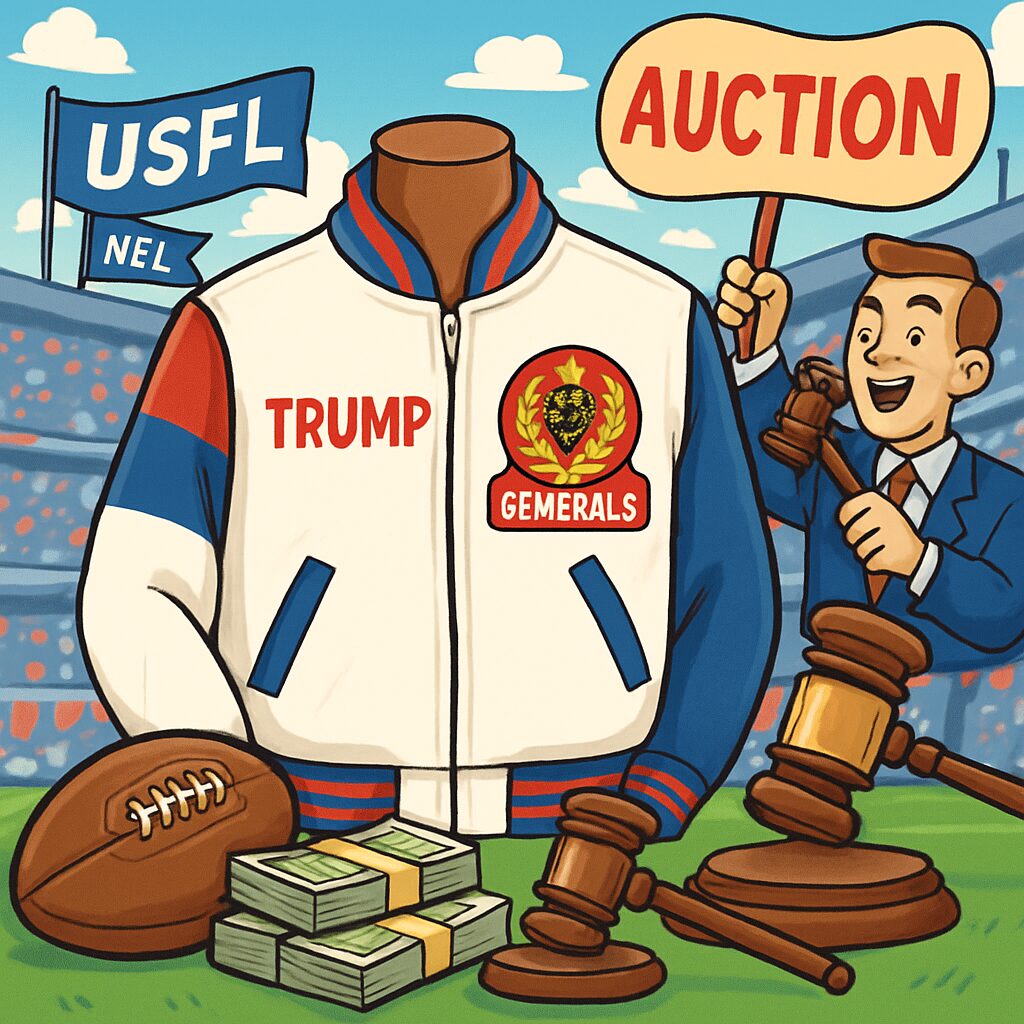

A jacket worn by Donald Trump during his ownership of the United States Football League’s New Jersey Generals is now up for auction, offering a rare piece of sports memorabilia from a pivotal moment in football history. The auction, handled by Grey Flannel Auctions, highlights Trump’s brief but influential role in the USFL during the mid-1980s, with bidding set to conclude on November 16.
The jacket itself is a white, red, and blue team sideline coat featuring the Generals logo patch and Trump’s name stitched in red on the chest, along with an original O’SHEA label inside the neckline. This item was sourced directly from the team’s legal counsel in New Jersey, adding authenticity to its provenance. It represents a tangible connection to Trump’s tenure as majority owner of the Generals in 1984, a period when he aimed to challenge the NFL’s dominance. The jacket’s design reflects the team’s colors and branding, making it a distinctive artifact for collectors and historians alike.
Trump’s involvement with the USFL was part of a broader effort to establish a spring football league that could compete with the NFL. He purchased the Generals and invested heavily, hoping to leverage his business acumen to grow the league. However, the USFL struggled financially from the outset, facing challenges in attracting viewers and securing lucrative television deals. Trump’s leadership style and ambitious plans often clashed with other team owners, leading to internal tensions. Despite these issues, the league featured high-profile players and moments that left a mark on professional football.
A key turning point came when Trump spearheaded a lawsuit against the NFL, alleging antitrust violations in an attempt to force a merger between the two leagues. The legal battle culminated in a symbolic victory for the USFL, with a jury awarding just $1 in damages, later tripled to $3 under antitrust laws. This outcome was widely seen as a defeat, as it provided no financial relief and exacerbated the league’s instability. Many analysts believe Trump’s aggressive tactics contributed to the USFL’s eventual collapse in 1986, after it had accumulated losses exceeding $163 million. The lawsuit’s failure underscored the difficulties of challenging established sports monopolies.
The USFL, though short-lived, featured several future Hall of Famers and notable athletes, including Jim Kelly, Steve Young, and Reggie White, who went on to achieve great success in the NFL. Herschel Walker, a former Generals running back and current U.S. ambassador, was one of Trump’s key acquisitions and remains a prominent figure linked to this era. These players helped elevate the league’s profile, drawing attention to its innovative rules and exciting gameplay. Their contributions are remembered as part of the USFL’s legacy, even as the league faded into obscurity. The auction of Trump’s jacket serves as a reminder of this talented roster and what might have been.
The upcoming auction has generated interest among memorabilia enthusiasts and political observers, given Trump’s subsequent rise to the presidency. Items associated with his pre-political career are often sought after, blending sports history with contemporary significance. Grey Flannel Auctions, known for handling high-profile sports collectibles, expects competitive bidding, with an opening bid set at $2,500. The jacket’s sale could set a precedent for the value of USFL-related artifacts, which are relatively scarce compared to NFL memorabilia. This event also sparks discussions about the intersection of sports, business, and politics in American culture.
As the November 16 bidding deadline approaches, potential buyers are evaluating the jacket’s historical and monetary worth. Its connection to a failed league and a controversial figure adds layers of narrative that appeal to diverse audiences. The outcome of the auction may influence how similar items are perceived in the collectibles market, potentially renewing interest in the USFL’s story. For historians, it represents an opportunity to preserve a fragment of sports history that illustrates both ambition and downfall. Ultimately, this auction not only markets a piece of clothing but also invites reflection on the volatile nature of sports ventures and the enduring allure of memorabilia tied to famous individuals.