

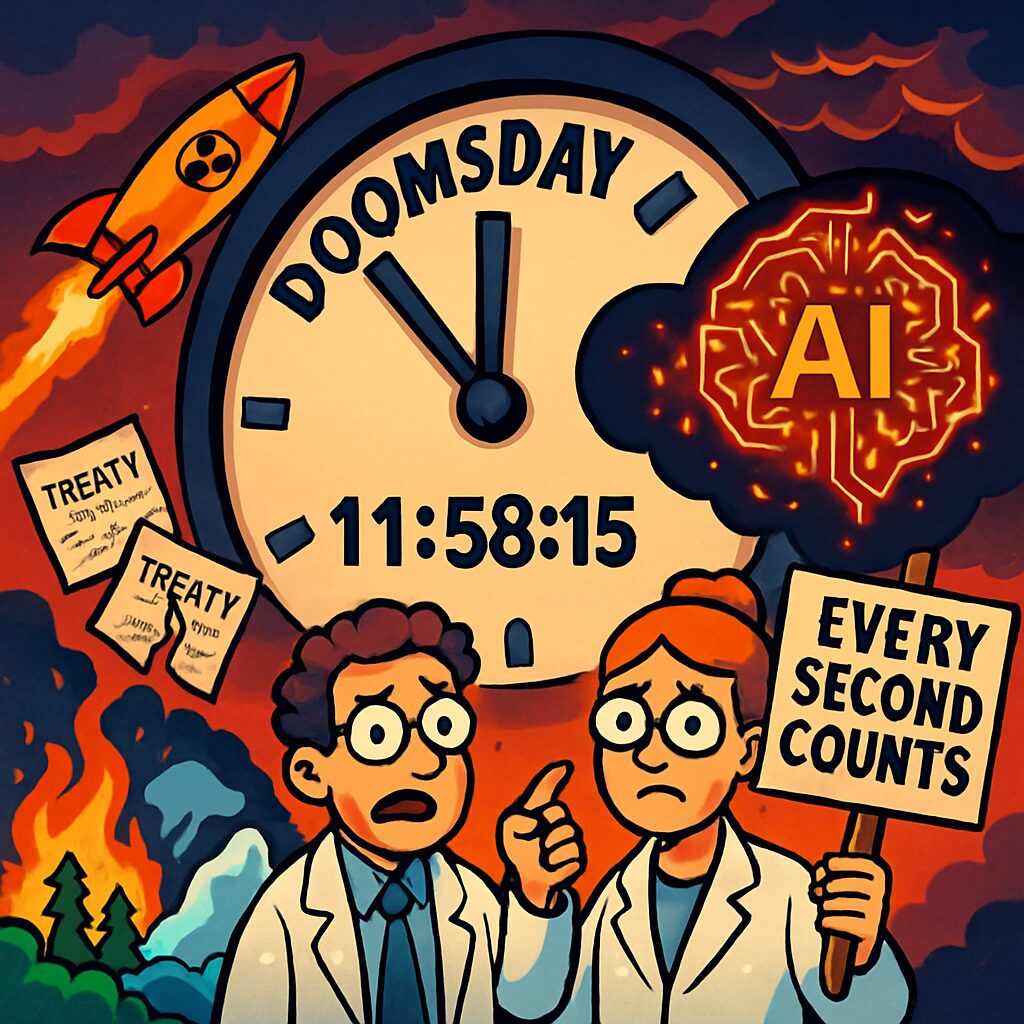
Atomic scientists have moved the Doomsday Clock to 85 seconds to midnight, the closest it has ever been to symbolic global catastrophe, citing escalating threats from nuclear weapons, climate change, and artificial intelligence. This adjustment, announced on Tuesday, underscores the urgent need for international action to address existential risks that endanger humanity.
The Bulletin of the Atomic Scientists, responsible for maintaining the clock, highlighted insufficient progress on mitigating these dangers as the primary reason for setting the time forward. Alexandra Bell, president and CEO of the Bulletin, stated that “every second counts, and we are running out of time,” emphasizing the critical window for intervention. The decision reflects growing concerns over geopolitical instability, particularly between nuclear-armed states, and the impending expiration of key arms control treaties.
Nuclear proliferation remains a top concern, with the New START Treaty between the U.S. and Russia set to expire next week, potentially triggering an uncontrolled arms race. Scientists warned that without renewed diplomatic engagement, the risk of conflict could escalate, pushing the world closer to midnight. Daniel Holz, chair of the Bulletin’s science and security board, noted that aggressive nationalistic policies in major countries have heightened adversarial tensions over the past year.
Climate change continues to pose a severe threat, with record-high atmospheric carbon dioxide levels and rising sea temperatures exacerbating extreme weather events. Holz pointed out that droughts, fires, floods, and storms are becoming more intense and erratic, directly impacting global security and stability. The scientists stressed that climate inaction could lead to irreversible damage, further endangering vulnerable populations worldwide.
Artificial intelligence emerged as a new risk factor, with its potential to supercharge disinformation and trigger an AI arms race. Nobel Peace Prize laureate Maria Ressa described the current era as an “informational armageddon,” where generative AI and social media platforms undermine factual discourse and democratic processes. The Bulletin expressed concern that AI could accelerate existing threats by complicating efforts to address nuclear and climate crises.
The Doomsday Clock was first introduced in 1947 during the Cold War as a metaphor for humanity’s proximity to self-destruction. Over its nearly eight-decade history, the clock has been adjusted more than two dozen times, with the farthest setting at 17 minutes to midnight in 1991 after the Cold War thawed. In recent years, it has steadily moved closer, reflecting persistent and emerging global challenges.
Despite the grim outlook, scientists affirmed that these threats are human-made and solvable through collective effort. Bell highlighted that past successes in turning back the clock resulted from collaborations between experts and public demand for action. She urged world leaders to prioritize diplomacy, risk reduction, and ethical governance to avert catastrophe.
Moving forward, the Bulletin calls for immediate international cooperation on nuclear disarmament, climate mitigation, and responsible AI development. The clock’s setting serves as a stark reminder that time is running out, but proactive measures can still steer humanity away from the brink and toward a safer, more secure future.

