

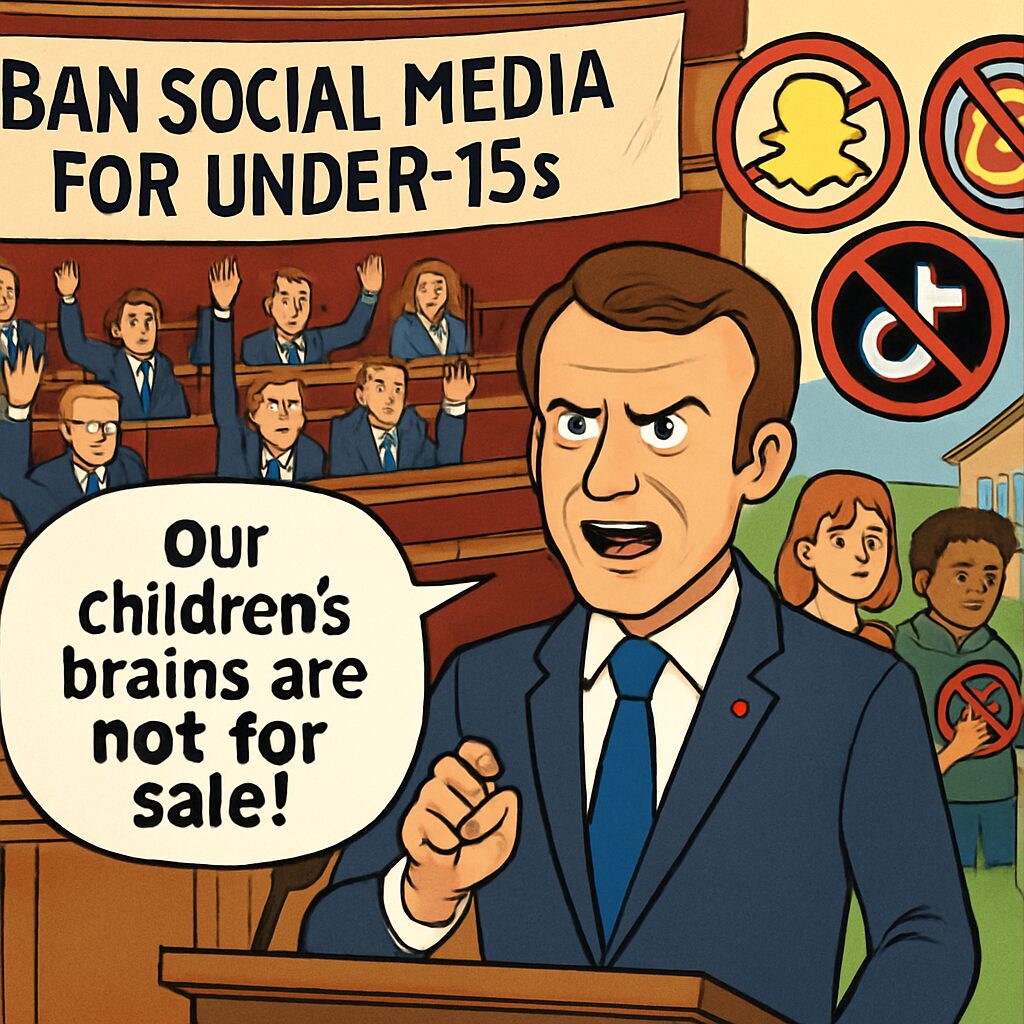
French lawmakers have approved a bill to ban social media for children under 15, marking a major legislative push to protect minors from online harms, with President Emmanuel Macron hailing it as a crucial step for youth well-being.
In a late-night session on Monday, France’s National Assembly voted overwhelmingly in favor of the proposal, with 130 supporting and 21 opposing, according to Al Jazeera, or 116 to 23 as per BBC reports. The bill now advances to the Senate for further approval, potentially making France the second country after Australia to impose such restrictions on social media access for young teenagers.
The legislation aims to prohibit under-15s from using platforms deemed harmful, such as Snapchat, Instagram, and TikTok, unless they obtain explicit parental consent for less risky sites. It also extends an existing ban on mobile phones in junior and middle schools to include high schools, reinforcing efforts to minimize digital distractions in educational settings.
Driven by mounting evidence linking social media to mental health issues like anxiety and depression, the move has garnered broad public support, with polls indicating 73% of French citizens back the ban. President Macron emphasized that “our children’s brains are not for sale,” criticizing tech companies for prioritizing profits over youth welfare.
This initiative is part of a global trend, with Australia implementing a similar ban for under-16s in December, and countries like the UK, Denmark, and Spain exploring comparable measures. The European Parliament has called for EU-wide age limits, though enforcement remains a challenge, as seen in Australia’s rollout difficulties.
Politically, the bill has united Macron’s government, overcoming initial divisions, and is set for fast-tracked approval to take effect by the next school year in September. Macron has urged accelerated procedures, highlighting the urgency of addressing what he termed a “health emergency” for young people.
However, implementing the ban requires robust age-verification systems that comply with EU law, a hurdle that previously stalled similar French legislation in 2023. Officials are considering mechanisms akin to those used for online pornography, but critics warn of privacy concerns and potential circumvention by tech-savvy youth.
If passed, this law could set a precedent for other nations grappling with social media’s impact on children, signaling a shift towards stricter digital regulation. It reflects growing societal demands for accountability from tech giants and underscores the balance between innovation and protection in the digital age.

