

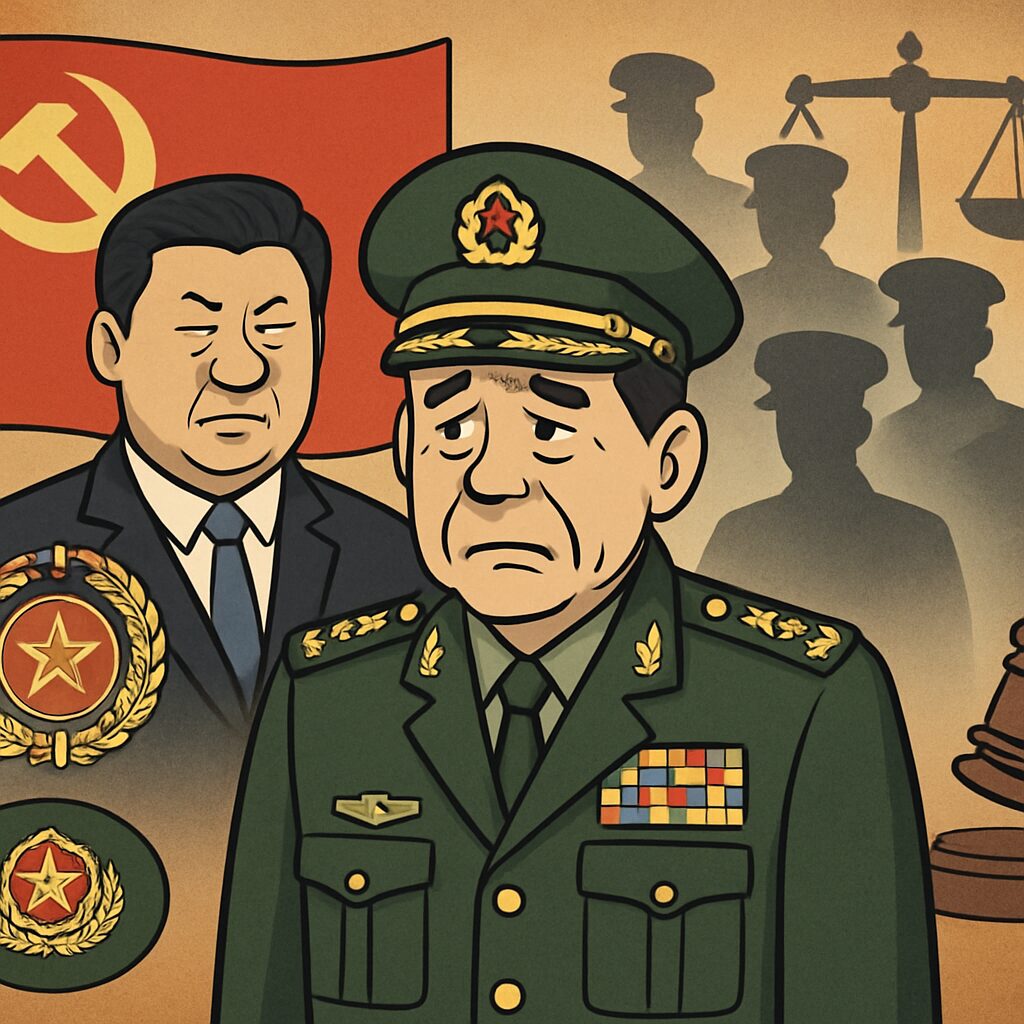
China has initiated an investigation into General Zhang Youxia, its highest-ranking military officer, over allegations of “grave violations of discipline and the law,” signaling a continued crackdown on the armed forces under President Xi Jinping. The move, announced by the defense ministry, also targets another senior officer, General Liu Zhenli, as part of a broader purge that has reshaped the country’s top military command.
General Zhang, 75, serves as the vice-chairman of the Central Military Commission (CMC), the Communist Party body that controls China’s military, and is widely regarded as President Xi’s closest ally in the armed forces. His investigation comes amid rumors of his absence from high-level party events, suggesting a sudden fall from grace. Zhang, who joined the People’s Liberation Army in 1968 and has combat experience, had been kept in office past the usual retirement age, underscoring his perceived loyalty until now.
The defense ministry provided no specific details on the accusations, but in China, such language often implies corruption charges. This investigation follows the expulsion of nine top generals in October, one of the largest public crackdowns in decades, and the removal of two former defense ministers in 2024 over similar allegations. Analysts view these actions as part of Xi’s long-running anti-corruption campaign, which has punished over 200,000 officials since he took power in 2012.
Alongside Zhang, General Liu Zhenli, the chief of staff of the CMC’s Joint Staff Department, is also under investigation. Their probes have reduced the CMC’s membership from seven to just two: Xi, who chairs the commission, and Zhang Shengmin, who handles disciplinary affairs. This consolidation of power highlights Xi’s efforts to tighten control over the military and eliminate potential rivals.
President Xi has consistently framed corruption as the “biggest threat” to the Communist Party, advocating for rigorous governance reforms. However, critics argue that the anti-corruption drive is often used as a tool to purge political opponents and ensure unwavering loyalty to his leadership. The current investigations into top generals suggest that no one is immune, even those previously seen as trusted allies.
The military purges are aimed at reforming the armed forces and aligning them more closely with Xi’s vision, as China seeks to modernize its military capabilities amid rising geopolitical tensions. This internal shake-up occurs against the backdrop of international scrutiny, with the U.S. recently acknowledging China as a significant military power in its National Defense Strategy, emphasizing the need for deterrence.
Looking ahead, the investigations could lead to formal charges, trials, or further reshuffles within the military hierarchy. The outcome will likely reinforce Xi’s authority but may also raise questions about stability and morale in the ranks. As the anti-corruption campaign persists, it underscores the ongoing transformation of China’s military into a more disciplined and loyal force under Xi’s unwavering command.

