

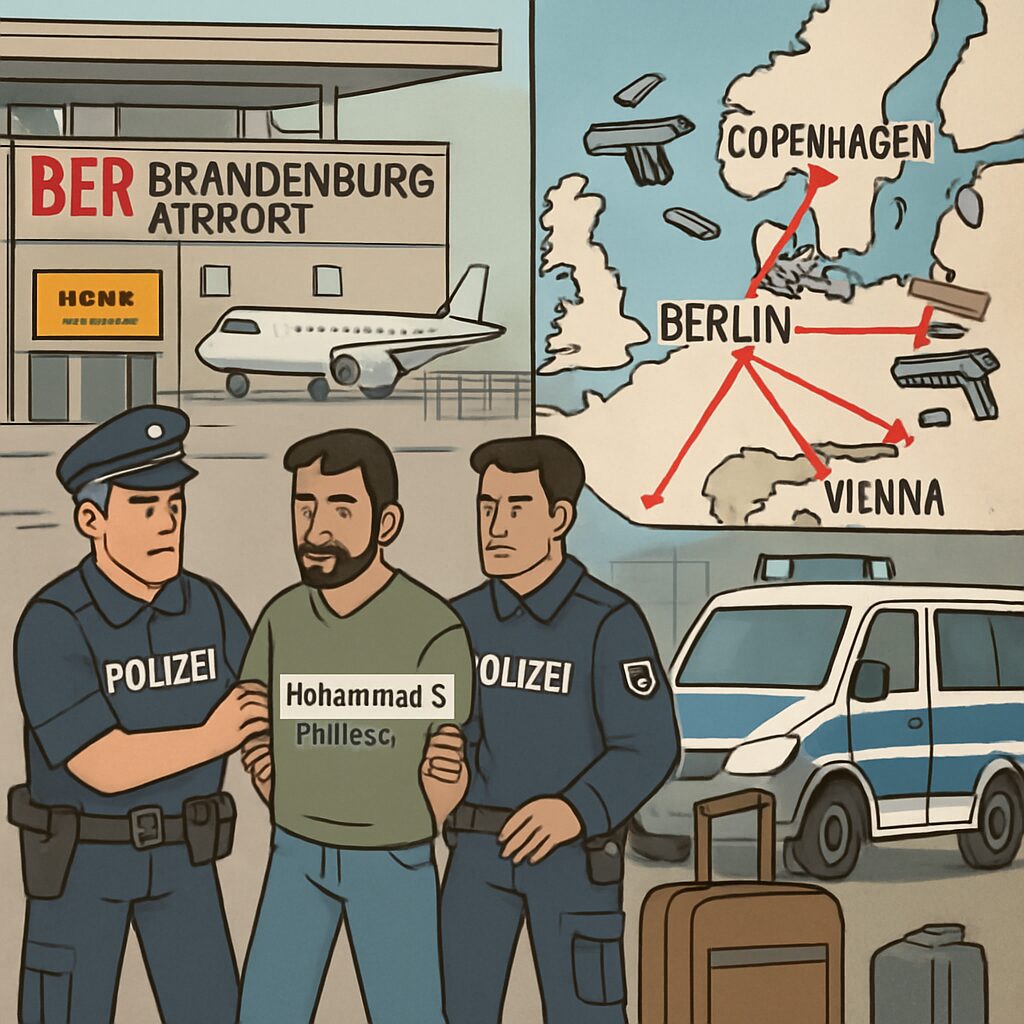
German authorities have arrested a suspected Hamas member accused of plotting attacks on Jewish and Israeli institutions in Europe. The detention at Berlin’s Brandenburg Airport marks the latest in a string of operations against Hamas operatives in Germany, underscoring persistent security threats.
On Friday evening, police apprehended the suspect, a Lebanese national referred to as Mohammad S, upon his arrival from Beirut. Federal prosecutors charge that he assisted in procuring 300 rounds of ammunition in August 2025 and participated in a scheme to target Jewish and Israeli sites. He is scheduled for a court appearance where a judge will rule on his pretrial detention.
The arrest is connected to earlier cases, including the October 2025 detention of three alleged Hamas members—Abed Al G, Wael FM, and Ahmad I—during a weapons handover in Berlin. At that time, authorities seized firearms and conducted raids in Leipzig and Oberhausen. Mohammad S is alleged to have collaborated with Abed Al G, highlighting a network of operatives.
In November 2025, another Lebanese-born suspect was arrested near the Czech border for acquiring an automatic weapon, eight pistols, and more than 600 rounds of ammunition in Berlin. The weapons were intended for attacks on Israeli or Jewish facilities, though prosecutors noted no specific plot had been devised. This suspect transported the arsenal to an accomplice already in custody.
Hamas, which governs Gaza and is weakened by Israeli military actions, is classified as a terrorist entity by numerous nations, including the U.S. and U.K. The group’s October 2023 assault on Israel triggered a war that has led to significant casualties in Gaza, with over 70,000 Palestinians reported killed.
International investigations have extended to Denmark, where police searched properties in Copenhagen, and to Austria, where a weapons cache was discovered in Vienna. Austrian officials linked the stash to Hamas’s foreign operations, and a man in London was arrested for moving weapons to Vienna. These developments point to a coordinated effort across Europe.
German authorities assert that the planned attacks aimed at Jewish and Israeli locations in Germany and beyond, reflecting broader tensions from the Israel-Hamas conflict. While no imminent threats were identified, the arrests demonstrate proactive measures to dismantle terrorist cells.
Looking ahead, the suspects face legal proceedings, with ongoing probes into their affiliations and activities. The cases emphasize the vigilance required to counter transnational terrorism and protect vulnerable communities in Europe.

