

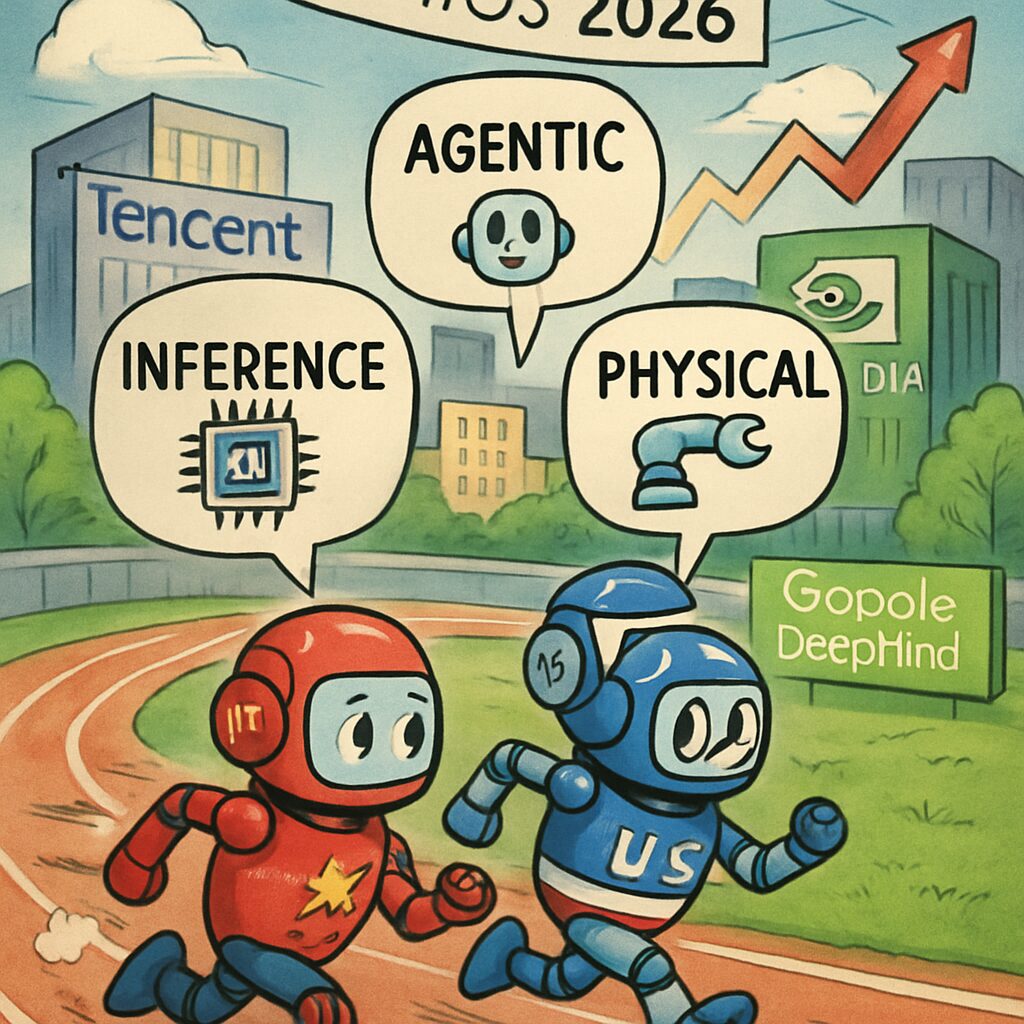
In the evolving landscape of artificial intelligence, recent discussions at the World Economic Forum in Davos and market analyses indicate that China is rapidly advancing, though not yet overtaking the U.S., with the competition pivoting towards practical applications and chip technology. As AI transitions from training to inference, China’s domestic chip market is experiencing explosive growth, positioning it as a key player in the global AI race.
At Davos 2026, AI dominated conversations among tech executives, with a shift from mere model development to enterprise adoption and future technologies like agentic and physical AI. Google DeepMind CEO Demis Hassabis noted that China’s AI models are just months behind their U.S. counterparts, highlighting the narrowing gap. This pragmatic approach reflects a move beyond the initial fear of missing out, as businesses now selectively integrate AI to enhance processes and drive value.
Enterprise AI adoption is becoming more targeted, with companies moving past pilot projects to full-scale implementations. Dowson Tong, CEO of Tencent’s cloud group, emphasized that customers are now more specific in their AI needs, signaling a mature market. EY’s Raj Sharma added that reimagining entire workflows with AI will unlock significant value, underscoring the strategic importance of AI in business operations.
Agentic AI, which involves AI systems performing tasks autonomously, remains a focal point, with varying levels of implementation across industries. Fabricio Bloisi of Prosus highlighted the potential for companies to be run by agents in the near future, though full autonomy is still on the horizon. This trend is complemented by physical AI, where AI takes physical forms like robotics, expected to become a multi-trillion-dollar market within years.
Geopolitical factors are increasingly influencing the AI landscape, with China’s advancements in AI and semiconductors drawing attention. The rapid progress in China’s tech sector is prompting discussions on global competitiveness and strategic dependencies. EY’s Sharma pointed out that geopolitical issues could either accelerate or hinder AI development, adding a layer of complexity to the race.
Simultaneously, the AI chip market is undergoing a significant transformation, with inference demand surpassing training. According to IDC China, inference cards accounted for over half of data center accelerator shipments in 2024, a trend driven by the deployment of generative AI models like DeepSeek. The market for AI inference chips in China is projected to reach 310.6 billion yuan by 2025, growing at a compound annual rate of nearly 95%.
This shift is creating opportunities for domestic chips, which are gaining market share by offering cost-effective solutions for specific applications such as transportation and energy. While Nvidia once dominated, domestic alternatives are now being embraced for their value and compatibility, reducing reliance on foreign technology. Industry insiders note that through optimization, domestic chips can outperform established players in niche fields.
The convergence of these trends suggests that the AI race is entering a new phase where innovation, market dynamics, and policy support will determine leadership. China’s aggressive push in AI inference and domestic chip development positions it as a formidable contender, though challenges in scalability and global integration remain. As AI continues to permeate various sectors, the ability to efficiently deploy and manage inference capabilities will be crucial for long-term success.

