

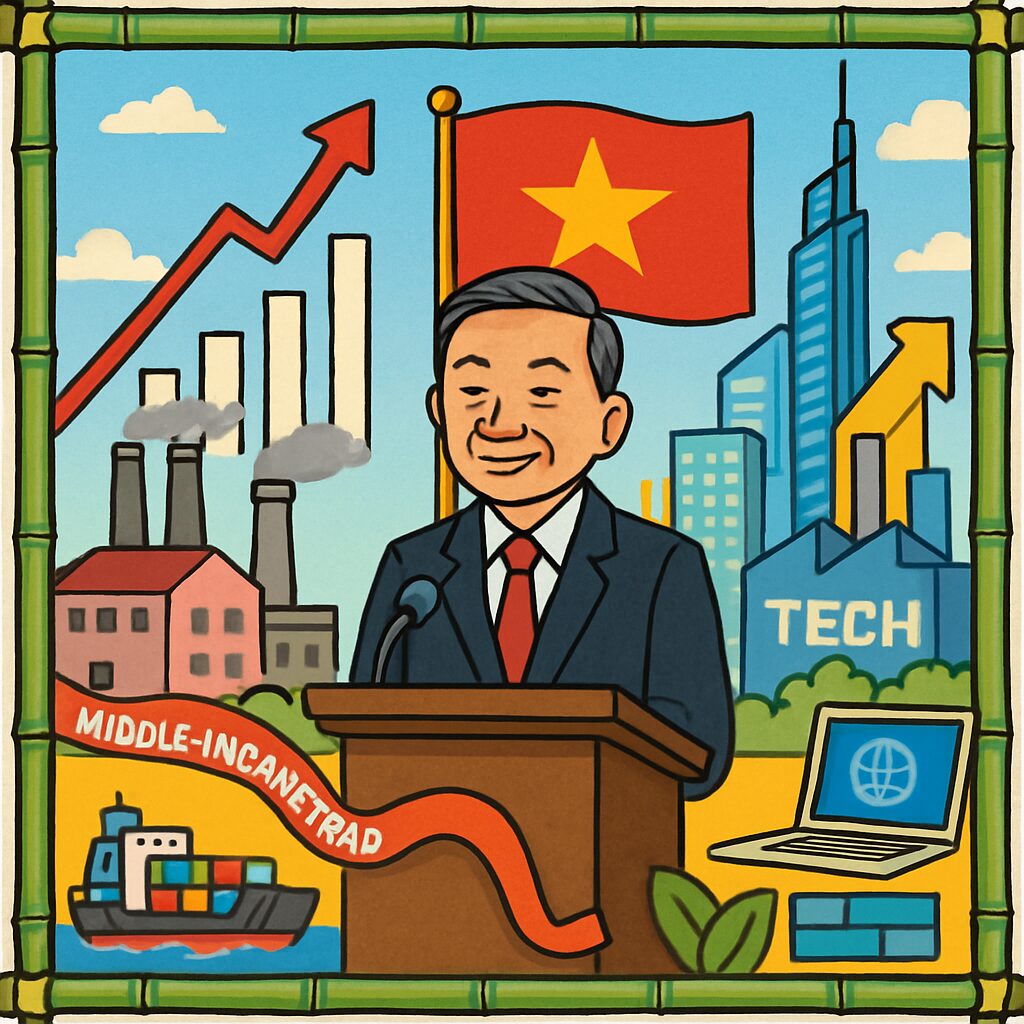
Vietnam’s Communist Party General Secretary To Lam was reappointed for another five-year term on Friday, pledging to implement bold economic reforms designed to elevate Vietnam to upper-income status by 2045. His leadership now focuses on transforming the country’s economy through increased private sector engagement and global competitiveness.
The 14th National Congress of the Communist Party concluded ahead of schedule on Friday, with nearly 1,600 delegates endorsing Lam’s continuation as party chief. This early conclusion is seen as a sign of consolidated support for Lam’s agenda, which aims to break Vietnam out of the “middle-income trap” that has hindered other Southeast Asian nations. Lam’s reappointment was widely expected, but the accelerated congress timeline underscores the urgency he attaches to economic revitalization.
Previously known for his role in anti-corruption efforts as head of the Ministry of Public Security, Lam has pivoted to championing market-oriented reforms since assuming the top party position. He has initiated a comprehensive administrative restructuring, reducing provincial divisions and cutting bureaucratic jobs, while pushing policies that elevate the private sector’s role in the economy.
A key milestone was Resolution 68, passed in May 2024, which explicitly designated the private sector as the primary engine of economic growth—a notable shift in Vietnam’s socialist framework. Lam’s targets include achieving double-digit annual growth, doubling private businesses by 2030, and fostering 20 globally competitive Vietnamese companies. He draws inspiration from South Korea’s chaebol model, aiming to create national champions capable of international success.
Despite these ambitions, significant hurdles remain. State-owned enterprises still dominate, accounting for 29% of GDP, and recent Resolution 79 has reinforced their status, suggesting ongoing internal party debates. Moreover, Vietnam’s economy is heavily dependent on foreign investment and export manufacturing, particularly in sectors like electronics, where companies like Samsung play a crucial role but contribute limited value-added domestically.
Lam’s strategy centers on companies such as FPT, a technology firm expanding globally, and Vingroup, Vietnam’s largest private conglomerate with interests from real estate to electric vehicles. However, Vingroup’s subsidiary Vinfast has faced challenges in penetrating U.S. and European markets, illustrating the difficulties of moving beyond low-cost manufacturing to innovation-driven growth.
External factors add complexity, especially potential U.S. tariffs under President Donald Trump, which could impact Vietnam’s export-dependent economy. Lam’s “bamboo diplomacy,” which seeks to maintain neutral relationships, will be tested in this volatile international landscape. Investors have expressed optimism about reform prospects but remain cautious about the feasibility of Lam’s growth targets.
Ultimately, Lam’s reappointment provides a political mandate to pursue his vision, but delivering on these promises will require navigating domestic resistance, fostering genuine competition, and adapting to global economic shifts. The next five years will be critical in determining whether Vietnam can achieve its ambitious rise to prosperity.

