

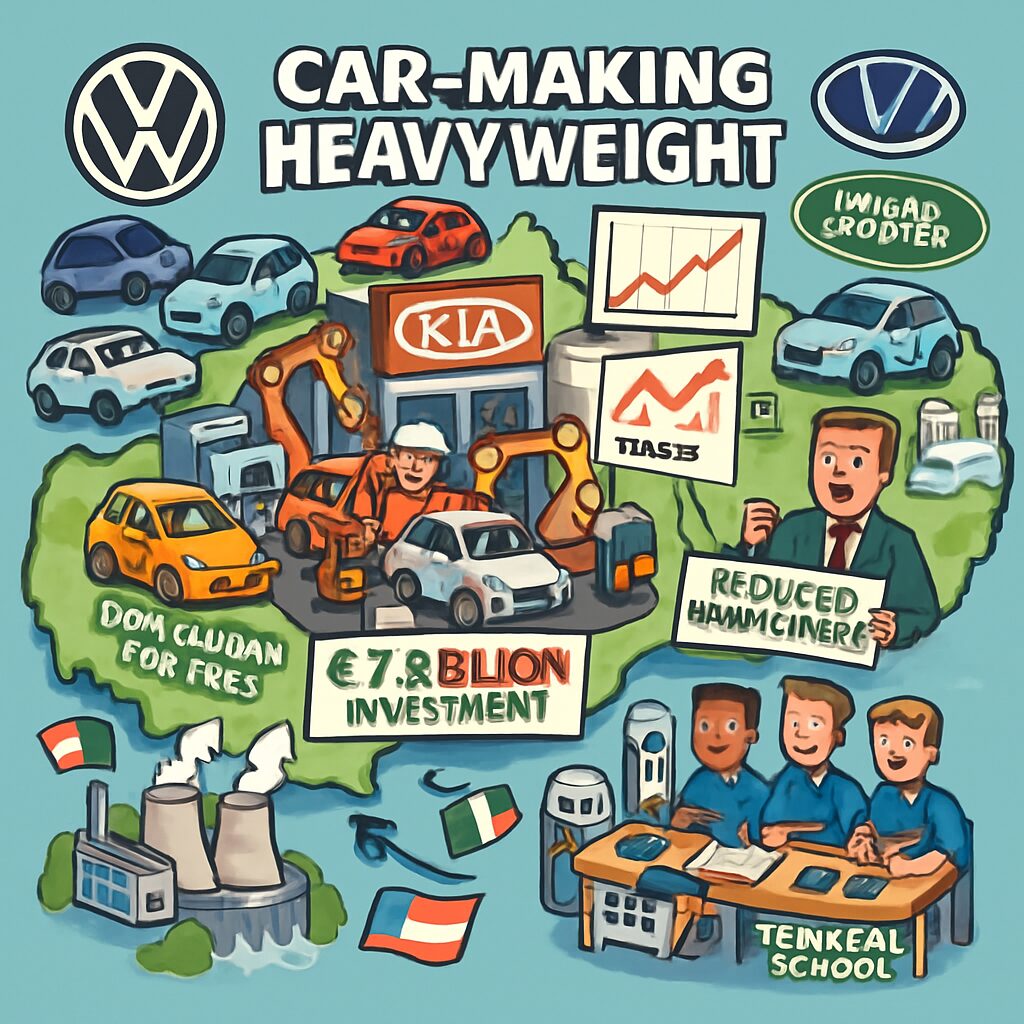
Slovakia, with a population of just 5.4 million, has become the world’s leading car manufacturer per capita, producing almost a million vehicles each year thanks to substantial investments from international automotive giants. This transformation has turned the country into a key hub for European car production, driven by factors like competitive labor costs and strategic location.
In Zilina, northern Slovakia, Kia operates a sprawling factory representing a €2.5 billion investment, capable of producing 350,000 cars annually. The facility employs 690 robots and 3,700 human workers who assemble vehicles at a rate of one per minute, with the plant serving as Kia’s primary European production base. Other major manufacturers in Slovakia include Volkswagen, Stellantis, and Jaguar Land Rover, while Volvo plans to open an electric car factory in 2027, further cementing the country’s automotive dominance.
Workers like Marcel Pukhon, 48, describe their roles as “dream jobs,” reflecting pride in contributing to Slovakia’s industrial success. Simona Krnova, 23, earns €1,300 monthly—above the national average of €1,403—and appreciates the social benefits, though she notes it isn’t her ideal career. Kia reports an average monthly salary of €2,400 at the plant, which is higher than Slovakia’s overall average but below the EU-wide €3,417, highlighting the cost advantages that attract foreign investment.
Slovakia’s automotive rise began after the 1989 Velvet Revolution, when Volkswagen invested in the Czechoslovak carmaker Skoda, fully acquiring it by 2000. Following the peaceful split of Czechoslovakia in 1993, other automakers entered the new Slovak market, leveraging labor costs that were initially 20% of Germany’s. Today, wages remain about 60% of Western levels, coupled with high productivity, making Slovakia a competitive manufacturing destination.
The country’s central European location provides excellent connectivity to major markets like the UK, Germany, and Italy, where Kia cars are top sellers. Additionally, Slovakia’s reliance on low-carbon energy from hydro, nuclear, and renewables enhances the appeal of its electric vehicles, qualifying them for government incentives such as the UK’s Electric Car Grant. A dense network of 360 supplier companies supports the industry, ensuring efficiency and reducing production costs.
Government incentives have played a crucial role, with Kia receiving a €29 million tax credit for transitioning to electric vehicle production, part of a €108 million upgrade. Local officials, like Zilina Mayor Peter Fiabane, credit Kia with significantly reducing unemployment and boosting the regional economy, directly employing over 20,000 people when including linked companies. Educational programs, such as Kia-sponsored dual studies at technical schools, help cultivate a skilled workforce.
Similar trends are evident across Eastern Europe, with countries like the Czech Republic, Poland, Hungary, and Romania attracting factories from Hyundai, Toyota, Audi, and others, all drawn by lower wages and industrial traditions. This regional shift has repositioned former Eastern-bloc nations as vital players in the global automotive supply chain, challenging traditional manufacturing hubs.
Looking ahead, Slovakia’s automotive success underscores a broader economic transformation, leveraging its strategic assets to sustain growth amid global competition. As the industry evolves towards electrification and automation, Slovakia’s established infrastructure and skilled labor pool position it to remain a heavyweight in car manufacturing, with implications for European economic dynamics and trade patterns.

