

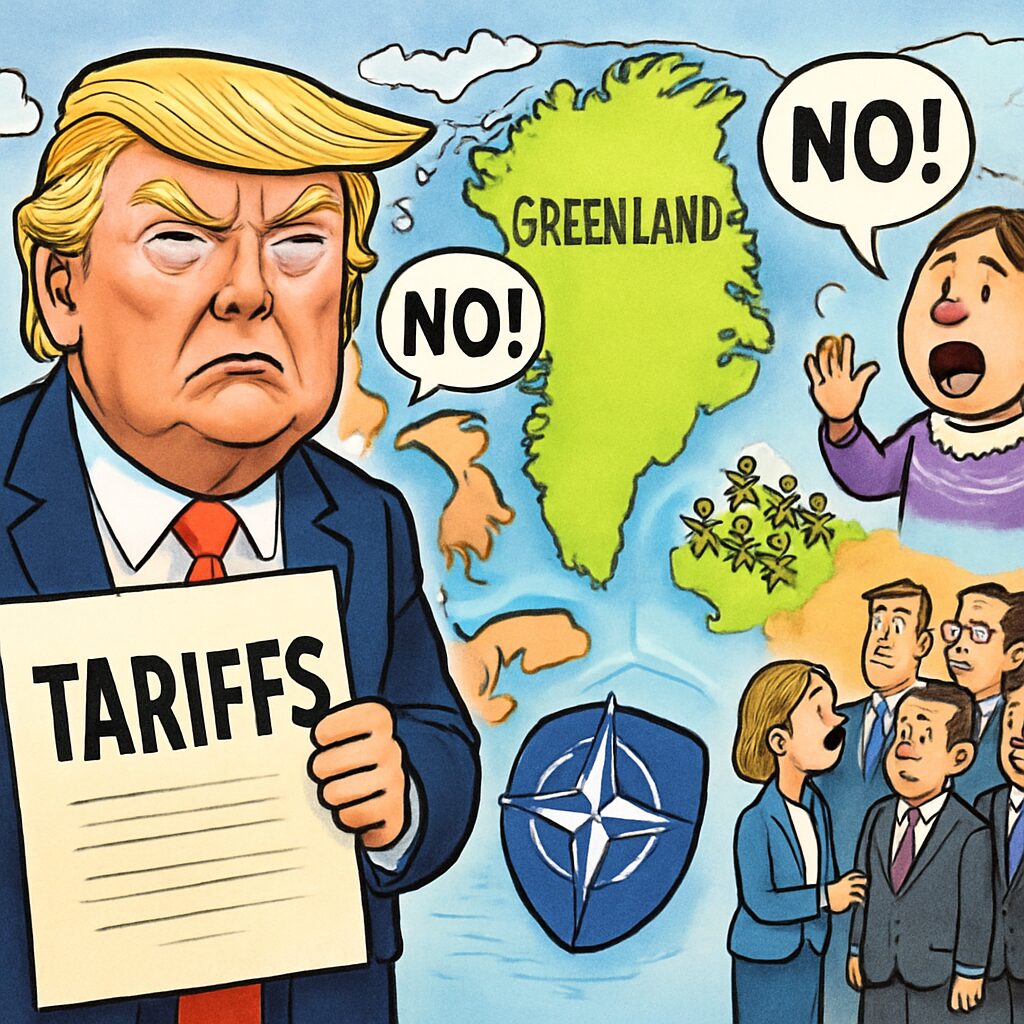
President Donald Trump has threatened to impose new tariffs on countries that do not support his ambition for the United States to acquire Greenland, asserting that control of the Arctic island is vital for national security. The remarks, made during a White House roundtable on rural healthcare, have escalated international tensions and drawn sharp criticism from allies.
Trump specifically stated, “I may put a tariff on countries if they don’t go along with Greenland, because we need Greenland for national security,” though he did not specify which nations might be targeted or the legal authority for such measures. This threat comes amid a renewed push by the Trump administration to secure Greenland, a semi-autonomous territory of Denmark, which holds strategic value due to its location between North America and the Arctic. The U.S. already operates the Pituffik base in Greenland, a missile-monitoring station with over 100 military personnel, but Trump argues that ownership is necessary to properly defend against potential threats from Russia or China.
Denmark and Greenland have firmly opposed any takeover, with Danish Prime Minister Mette Frederiksen warning that military action could spell the end of NATO, the trans-Atlantic defense alliance. Greenlandic leaders, including MP Aaja Chemnitz, have expressed hope for diplomatic solutions, emphasizing the need for allies and describing the situation as “a marathon, not a short sprint.” Other European countries have also voiced opposition, rallying to Denmark’s support and stressing that Arctic security should be a joint NATO responsibility.
In response to the escalating rhetoric, a bipartisan congressional delegation visited Greenland to “lower the temperature” and listen to local concerns. The group, led by Senator Chris Coons, included both Democrats and Republicans, such as Senators Thom Tillis and Lisa Murkowski, who are sponsors of bills related to the issue. Their aim was to bridge the gap between the White House’s stance and the positions of Greenland and Denmark, though significant differences remain.
European NATO allies have taken concrete steps by dispatching troops to Greenland in a reconnaissance mission. Countries including France, Germany, Sweden, Norway, Finland, the Netherlands, and the United Kingdom have sent a small number of personnel, with French President Emmanuel Macron announcing that “land, air, and sea assets” would soon follow. This deployment underscores the region’s growing importance and the allies’ commitment to collective security in the face of U.S. unilateral actions.
Public opinion in the United States shows division on the issue. A Quinnipiac University poll found that 86% of voters oppose military action to take over Greenland, and 55% are against any effort to buy the territory, indicating limited domestic support for Trump’s plans. This skepticism is echoed by some lawmakers, including Murkowski, who has backed legislation to block annexation, while others have introduced rival bills in support.
The tariff threat is part of a broader legal and diplomatic challenge. The Trump administration is awaiting a Supreme Court ruling on the legality of tariffs imposed in 2024, which could impact the feasibility of new duties. Diplomatically, high-level talks have been held, including a meeting between U.S. Vice-President JD Vance, Secretary of State Marco Rubio, and the foreign ministers of Denmark and Greenland, where Vance proposed finding a “middle ground.”
Looking ahead, the situation remains fluid, with Trump’s special envoy to Greenland, Jeff Landry, expressing optimism about a potential deal. However, the deep-seated opposition from multiple quarters suggests a protracted conflict. The outcome will likely hinge on continued diplomatic efforts, legal rulings, and the broader geopolitical dynamics in the Arctic, with implications for NATO cohesion and international trade relations.

