

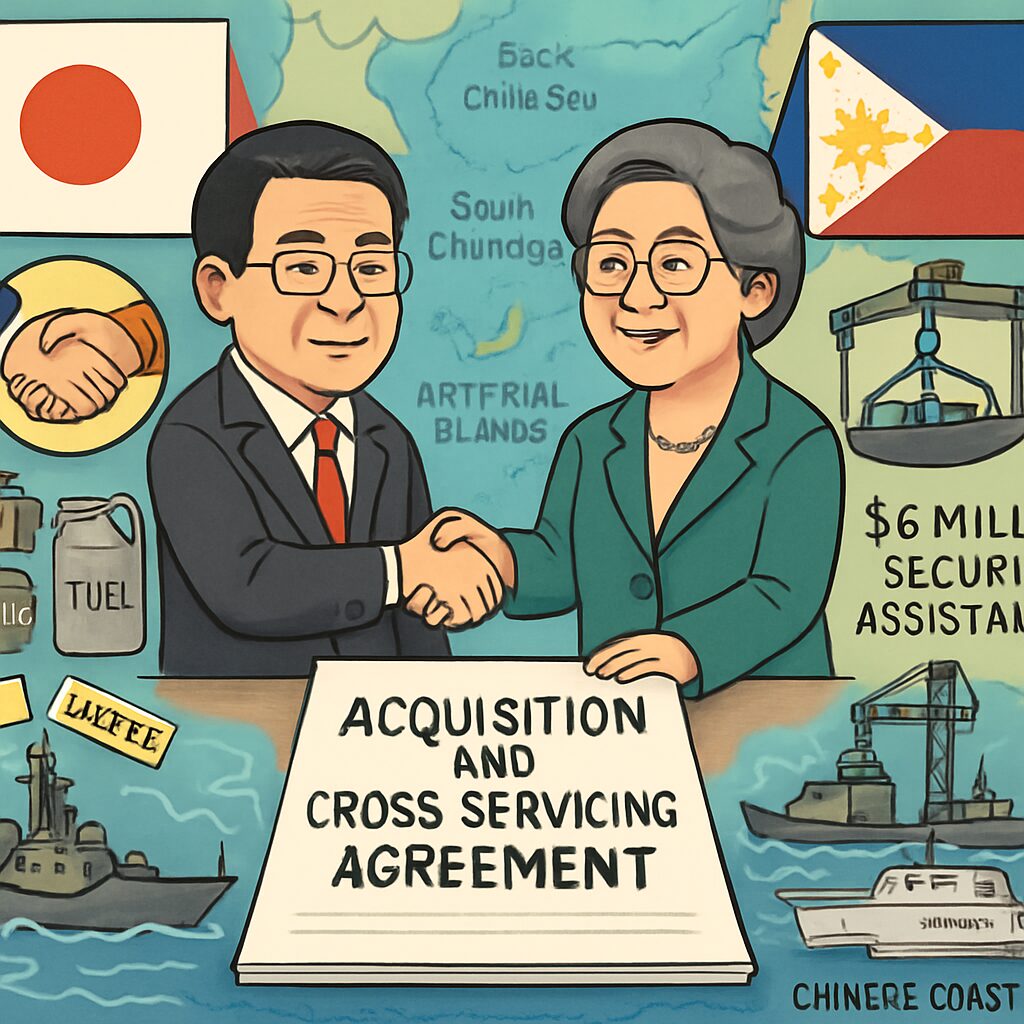
Japan and the Philippines have signed a new defense pact to enhance military cooperation and counter China’s increasing assertiveness in the Indo-Pacific region, marking a significant step in regional security dynamics. The agreement, finalized on January 15, 2026, in Manila, facilitates the tax-free exchange of supplies during joint training and includes additional security assistance from Japan, reinforcing a united front amid escalating maritime tensions.
The pact, known as the Acquisition and Cross-Servicing Agreement, was signed by Japanese Foreign Minister Toshimitsu Motegi and Philippine Foreign Secretary Theresa Lazaro. It allows for the provision of ammunition, fuel, food, and other necessities without tariffs when their forces conduct joint drills, aiming to improve interoperability and readiness. This move directly responds to China’s aggressive actions in disputed waters, where Beijing has fortified its claims through coast guard patrols and artificial island bases.
In addition to the supply agreement, Japan announced a $6 million Official Security Assistance package to fund the construction of facilities for rigid-hulled inflatable boats donated to the Philippines. This aid is designed to boost Manila’s naval capabilities, particularly in the South China Sea, where frequent clashes with Chinese vessels have occurred under President Ferdinand Marcos Jr.’s administration. The assistance also targets expanding internet access in southern provinces, addressing both security and development needs.
The signing comes against a backdrop of heightened tensions between China and both Japan and the Philippines. China claims nearly the entire South China Sea, despite a 2016 international court ruling invalidating its claims, and has increased military presence in the area. Similarly, in the East China Sea, China has routinely sent coast guard ships into waters surrounding islands claimed by Japan, prompting diplomatic protests and occasional military responses. These actions have strained relations and raised concerns about regional stability.
This new pact builds on previous agreements, such as the Reciprocal Access Agreement signed in mid-2024, which allows for the deployment of forces between the two countries for larger combat exercises, including live-fire drills. The cumulative effect of these deals deepens the security partnership between Tokyo and Manila, both of which are key treaty allies of the United States in Asia. This trilateral alignment aims to deter Chinese expansionism and uphold a rules-based international order.
The defense agreement must still be ratified by Japanese legislators before it takes effect, but it represents a proactive measure to bolster deterrence. Officials from both countries emphasized the importance of promoting the rule of law, freedom of navigation, and overflight in the South China Sea, implicitly criticizing China’s unilateral attempts to change the status quo by force. They also concurred on opposing coercion in the East China Sea, without directly naming Beijing.
Looking ahead, the enhanced cooperation is expected to provide a framework for joint responses to natural disasters and United Nations peacekeeping operations, in addition to military exercises. However, it may provoke a stronger reaction from China, which views such alliances as containment efforts and has previously imposed economic measures in response to similar moves. The pact also sets a template for other regional nations seeking to counter China’s influence.
In conclusion, the Japan-Philippines defense pact signifies a pivotal shift in Asian geopolitics, strengthening military ties to address shared security challenges while potentially escalating great-power rivalries. It underscores the growing importance of multilateral partnerships in maintaining regional peace and stability amidst China’s rising aggression.

