

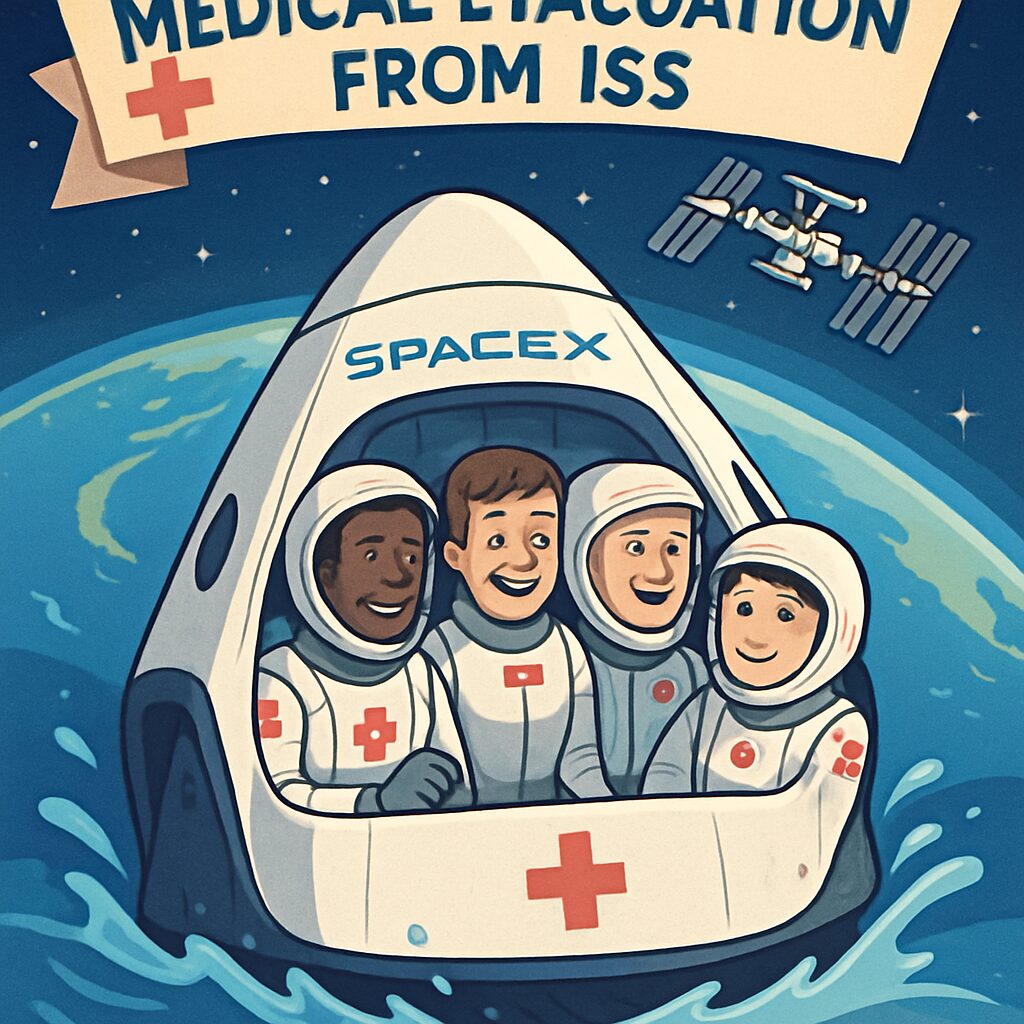
Four astronauts have safely returned to Earth after an unprecedented medical evacuation from the International Space Station, cutting their mission short by a month. This marks the first time in the ISS’s 26-year history that a health issue has necessitated an early return, underscoring the challenges of human spaceflight.
The SpaceX Dragon capsule, carrying American astronauts Mike Fincke and Zena Cardman, Russian cosmonaut Oleg Platonov, and Japanese astronaut Kimiya Yui, splashed down in the Pacific Ocean off the coast of California early on January 15, 2026. The crew, part of NASA’s Expedition 74 and SpaceX’s Crew-11 mission, had been on the ISS since August 1, 2025, and were originally scheduled to remain until mid-February.
NASA announced the early departure on January 8 after a crew member developed a “serious medical condition” that required attention on Earth. While the agency has not disclosed the identity or specifics of the illness, citing privacy, officials confirmed it was unrelated to space station operations and that the astronaut is now “fine” and in “good spirits.”
The decision to evacuate was made proactively, with NASA emphasizing that astronaut health is always the priority. In a news conference, NASA administrator Jared Isaacman stated that the agency erred on the side of caution, ensuring the crew member could receive comprehensive medical evaluation on the ground.
With the departure of Crew-11, the ISS is now left with a skeleton crew of three astronauts—NASA’s Chris Williams and Russian cosmonauts Sergey Kud-Sverchkov and Sergei Mikaev—until the arrival of the next crew in February. Despite the reduced manpower, the remaining team has committed to continuing scientific research and maintenance tasks onboard.
This incident is only the third time in history that a space mission has ended early due to health issues, with previous cases occurring during Soviet-era missions to Salyut 7 and Mir space stations. The evacuation tested NASA’s medical emergency protocols, which apparently functioned smoothly, though it raises questions about long-term medical support for deep-space missions.
Currently, the ISS has limited medical equipment, and astronauts are trained for minor issues, but there is no doctor on board. As space agencies plan for lunar bases and Mars expeditions, experts argue that incorporating medical professionals and advanced healthcare systems will be crucial for crew safety and mission success.
Looking ahead, the evacuated astronauts will undergo medical checks before returning to their home bases, while NASA and its partners review the response to this event. The successful handling of this emergency may inform future policies and technologies for managing health crises in space, as human presence beyond Earth continues to expand.

