

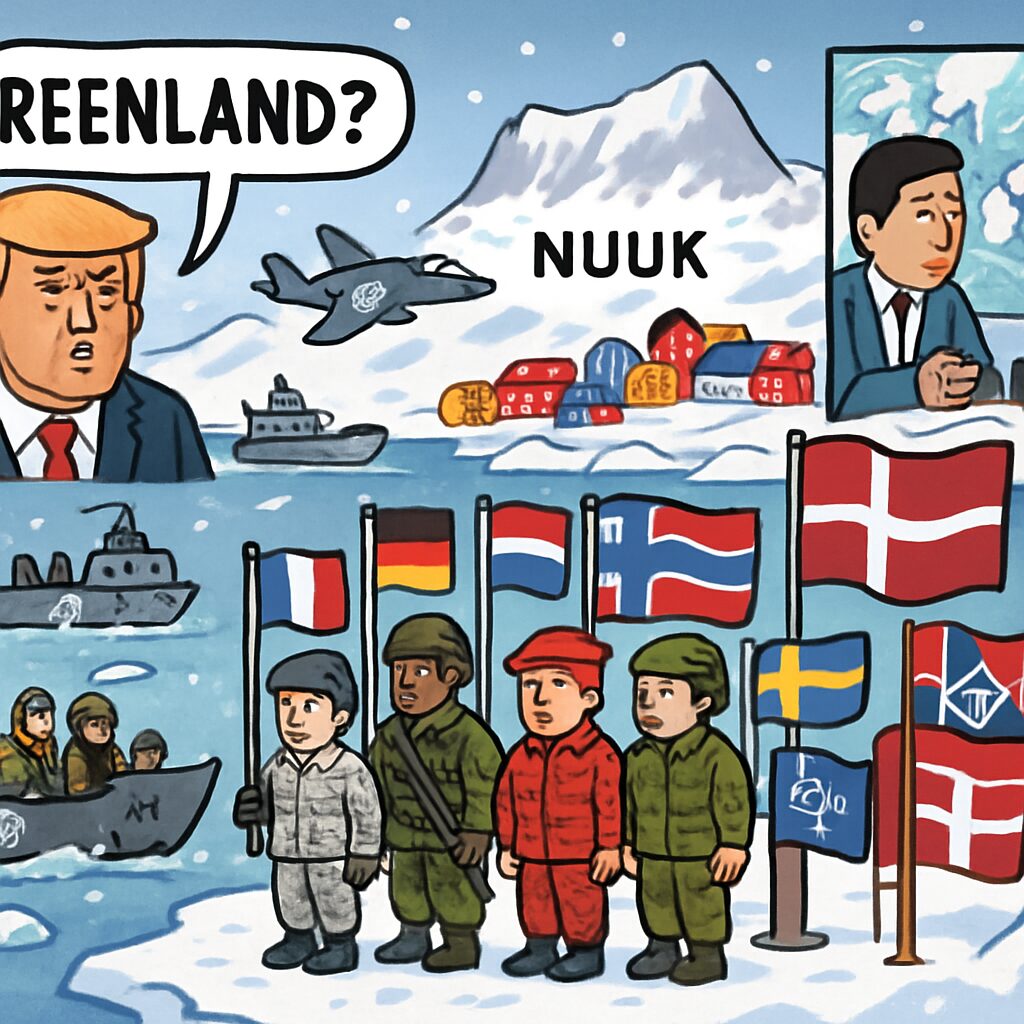
European NATO allies have initiated a military deployment to Greenland, sending troops and vessels in a coordinated response to U.S. President Donald Trump’s renewed push to acquire the Arctic territory for national security reasons, underscoring significant divisions within the alliance.
The deployment began on Thursday, January 15, 2026, with small contingents from France, Germany, the United Kingdom, the Netherlands, Finland, Norway, and Sweden arriving in Greenland’s capital, Nuuk. This move is part of Denmark-led Operation Arctic Endurance, aimed at bolstering NATO’s presence in the region. Officials describe it as a reconnaissance mission, with initial forces consisting of a few dozen personnel, signaling European solidarity without escalating tensions.
French President Emmanuel Macron announced that the initial contingent would be reinforced with land, air, and sea assets in the coming days, emphasizing Europe’s responsibility to Greenland as part of the European Union and a NATO ally. Similarly, Danish Defense Minister Troels Lund Poulsen stated the intention is to establish a more permanent rotational military presence with contributions from various NATO countries, enhancing training and exercises on the island.
The deployment comes hours after high-stakes talks in Washington between U.S., Danish, and Greenlandic officials, which ended with a ‘fundamental disagreement’ over Greenland’s future. Danish Foreign Minister Lars Løkke Rasmussen criticized Trump’s bid to buy Greenland, stating that while talks were constructive, the U.S. ambition remains on the table, but Denmark has its red lines. Trump, however, doubled down, telling reporters that the U.S. needs Greenland for national security and did not rule out the use of force, though he expressed hope for a negotiated solution.
White House Press Secretary Karoline Leavitt downplayed the European troop movements, asserting that they do not impact Trump’s decision-making process or his goal of acquiring Greenland. She mentioned that technical talks with Denmark will continue, but the U.S. stance remains firm. This has left European leaders scrambling to respond, with Poland’s Prime Minister Donald Tusk warning that any U.S. military intervention in Greenland would be a political disaster and could destabilize NATO.
Russia has expressed ‘serious concern’ over the developments, accusing NATO of increasing its military presence in the Arctic under false pretexts. The Russian Embassy in Belgium warned that ignoring Russia’s interests will have far-reaching consequences. Meanwhile, Greenland’s Prime Minister, Jens-Frederik Nielsen, reaffirmed that Greenland does not want to be part of the United States and would choose Denmark over the U.S. if forced to decide, highlighting the local population’s stance amidst the geopolitical crisis.
The broader implications involve NATO’s cohesion and Arctic security. The U.S. already has a military base in Greenland, but the European deployment is seen as a signal to Washington that its allies have a stake in the region. Analysts like Christoph Meyer from King’s College London note that Europe is in a frantic mode to cobble a response without overly antagonizing the U.S., balancing pushback with the need to maintain transatlantic relations.
Looking ahead, Denmark plans to host a Democratic-led U.S. delegation for further talks, while European troops are expected to participate in ongoing exercises. The situation remains fluid, with the potential for increased military activity in the Arctic. The outcome could shape not only Greenland’s future but also the dynamics of international alliances and security in the High North.

