

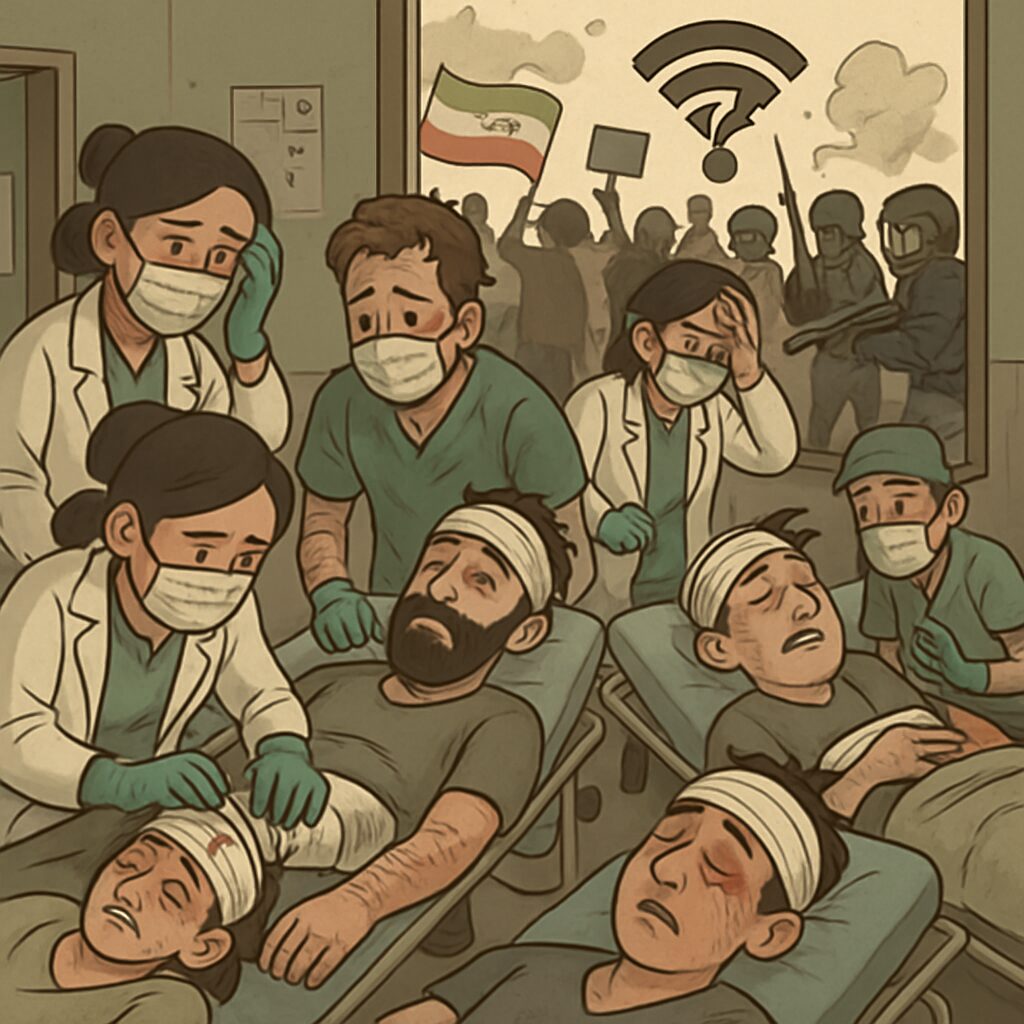
Executive summary: Iran is facing escalating anti-government protests that have now entered their second week, leading to overwhelmed hospitals in major cities as medics struggle to treat injured demonstrators amid a severe crackdown and internet blackout imposed by authorities. The unrest, rooted in economic despair, has evolved into a broader challenge to the Islamic Republic, drawing international concern and threats of U.S. intervention.
The protests began in late December 2025, initially sparked by Iran’s deepening economic crisis, with soaring inflation and a collapsing currency pushing basic goods out of reach for many citizens. What started as demonstrations in Tehran’s Grand Bazaar quickly spread to over 348 locations across all 31 provinces, reflecting widespread discontent that cuts across class and geography. This wave of unrest marks the most significant challenge to the regime since the 2022 ‘Women, Life, Freedom’ movement, indicating a persistent undercurrent of frustration with clerical rule.
Iran’s economic woes have been exacerbated by international sanctions tied to its nuclear program, the lingering damage from a brief war with Israel in June 2025, and long-standing corruption and mismanagement. The rial has plummeted to historic lows, fueling inflation that has crippled household budgets. Analysts describe a ‘general, very deep malaise’ that has turned economic grievances into broader anti-regime sentiment, with protests rapidly taking on political dimensions beyond initial triggers.
In response, the Iranian government has implemented harsh measures to quell the unrest, including a near-complete internet and telephone shutdown that began on January 9, 2026, and persisted for over 24 hours. NetBlocks reported a near-blackout in connection levels, aimed at stifling communication and documentation. Authorities have also arrested more than 2,200 people, according to human rights groups, and deployed security forces who have used live ammunition, pellet guns, and tear gas against demonstrators.
Hospitals in Tehran, Mashhad, and Karaj have been overwhelmed with injured protesters, as reported by the Center for Human Rights in Iran. A doctor in Tehran anonymously told TIME that at least 217 protester deaths were recorded across six hospitals in the capital, mostly from live ammunition. Eyewitness accounts and videos describe chaotic scenes, with security forces storming hospitals to arrest the wounded, highlighting the brutality of the crackdown. In Ilam province, a nurse recounted how forces ‘behaved with savage brutality’ during a hospital raid.
Casualty figures vary among rights groups, with the Norway-based Iran Human Rights NGO reporting at least 51 protester deaths, including children, and the U.S.-based Human Rights Activists News Agency citing 62 deaths and over 2,300 detentions. Iranian state media has acknowledged casualties without providing details, instead blaming ‘terrorist agents’ backed by the United States and Israel for inciting violence. The scale of repression has drawn sharp international condemnation.
Internationally, Germany, France, and the United Kingdom issued a joint statement condemning Iran’s ‘disproportionate and heavy-handed’ response and urging restraint. The European Union’s foreign policy chief criticized the internet shutdown as a sign of a regime ‘afraid of its own people.’ U.S. President Donald Trump has warned of potential military strikes if protesters are killed, though he ruled out deploying troops, adding a volatile layer to the crisis and raising fears of external intervention.
Iranian Supreme Leader Ayatollah Ali Khamenei has remained defiant, dismissing protesters as ‘vandals’ and ‘saboteurs’ seeking to please Trump, and vowing that the regime will ‘not back down.’ Foreign Minister Abbas Araghchi accused the U.S. and Israel of fomenting unrest, framing the protests as part of a foreign-backed campaign. The government’s stance, coupled with limited economic concessions like small food subsidies, suggests little willingness to address underlying grievances, risking further escalation.
The protests underscore profound discontent within Iran, with analysts noting that economic pressures and repression have created an ‘explosive cocktail.’ The ongoing internet shutdown and international threats could shape Iran’s trajectory, as domestic dissent and external pressures converge. With calls for continued protests and strikes from figures like exiled crown prince Reza Pahlavi, the unrest may persist or intensify, highlighting the regime’s fragile hold amid a crisis that shows no immediate signs of resolution.

