

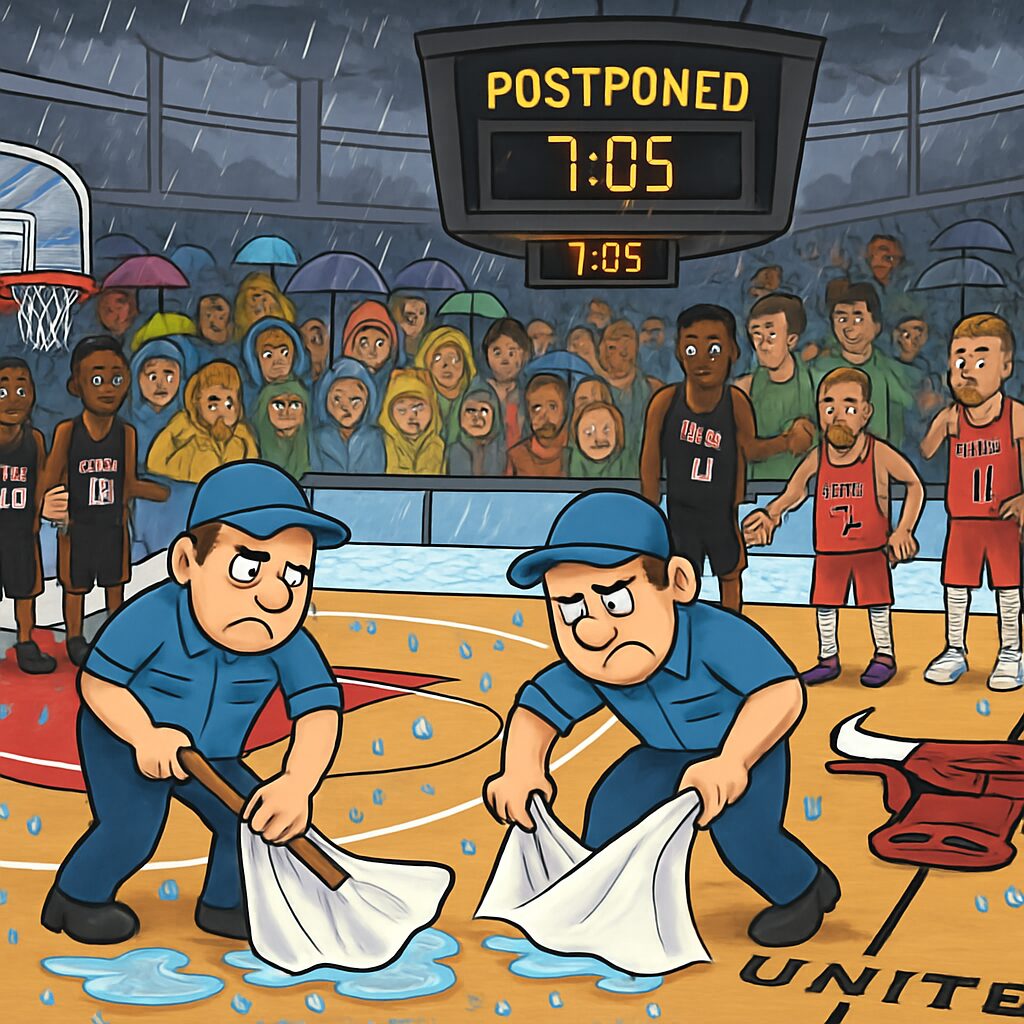
The NBA game between the Miami Heat and Chicago Bulls scheduled for Thursday night at the United Center was postponed due to dangerous condensation on the court, following an unseasonably warm and rainy day in Chicago that created moisture issues exacerbated by a prior ice hockey event at the arena. After nearly two hours of delays and unsuccessful attempts to dry the surface, officials declared the court unplayable, leaving fans disappointed and both teams uncertain about when the contest will be made up.
On a rainy Thursday in Chicago, temperatures soared into the mid-50s, creating high humidity inside the United Center. The arena had hosted a Chicago Blackhawks NHL game on ice the previous night, and the transition from a frozen surface to a basketball court proved problematic. Condensation formed on the hardwood, making it slippery and unsafe for players, who immediately noted the issue during pregame warmups.
Efforts to rectify the situation began soon after the scheduled 7:05 p.m. tipoff time was missed. Maintenance staff used mops and large towels to sweep the court, while arena officials turned up the air conditioning in an attempt to reduce moisture. Despite these measures, the condition persisted, leading to a prolonged delay that frustrated the assembled crowd.
Players from both teams expressed concern over the court’s safety, with Heat coach Erik Spoelstra stating that the players were complaining about it on both sides and that it was not playable. Bulls head coach Billy Donovan and Spoelstra were among those consulting with game officials and the NBA league office during the delay, highlighting the collective decision-making process.
After more than 90 minutes of futile attempts, the game was officially postponed at 8:53 p.m. local time, prompting boos from fans who had waited patiently. The announcement cited court conditions as the reason, and a rescheduled date was not immediately provided, adding to the uncertainty for both teams’ schedules.
This incident is not without precedent in the NBA. During the 2016-17 season, games in Minnesota and Philadelphia were postponed under similar circumstances, where warm weather in cold-weather cities following ice events led to condensation issues. Such occurrences highlight the challenges of multi-purpose arenas and rapid transitions between different types of events.
The postponement has immediate implications for the Heat and Bulls. Miami was on a four-game road trip, and this game was the second leg, potentially disrupting their rhythm and travel plans. Chicago, on a three-game losing streak, missed an opportunity to break their slide in front of a home crowd. With the Heat not currently scheduled to return to Chicago this season, finding a suitable makeup date could be logistically complex.
Looking ahead, the NBA and United Center management will need to assess procedures to prevent similar issues in the future, especially with variable weather conditions. For now, both teams await word on when the game will be rescheduled, while fans are left hoping for a swift resolution to this unusual sports postponement.

