

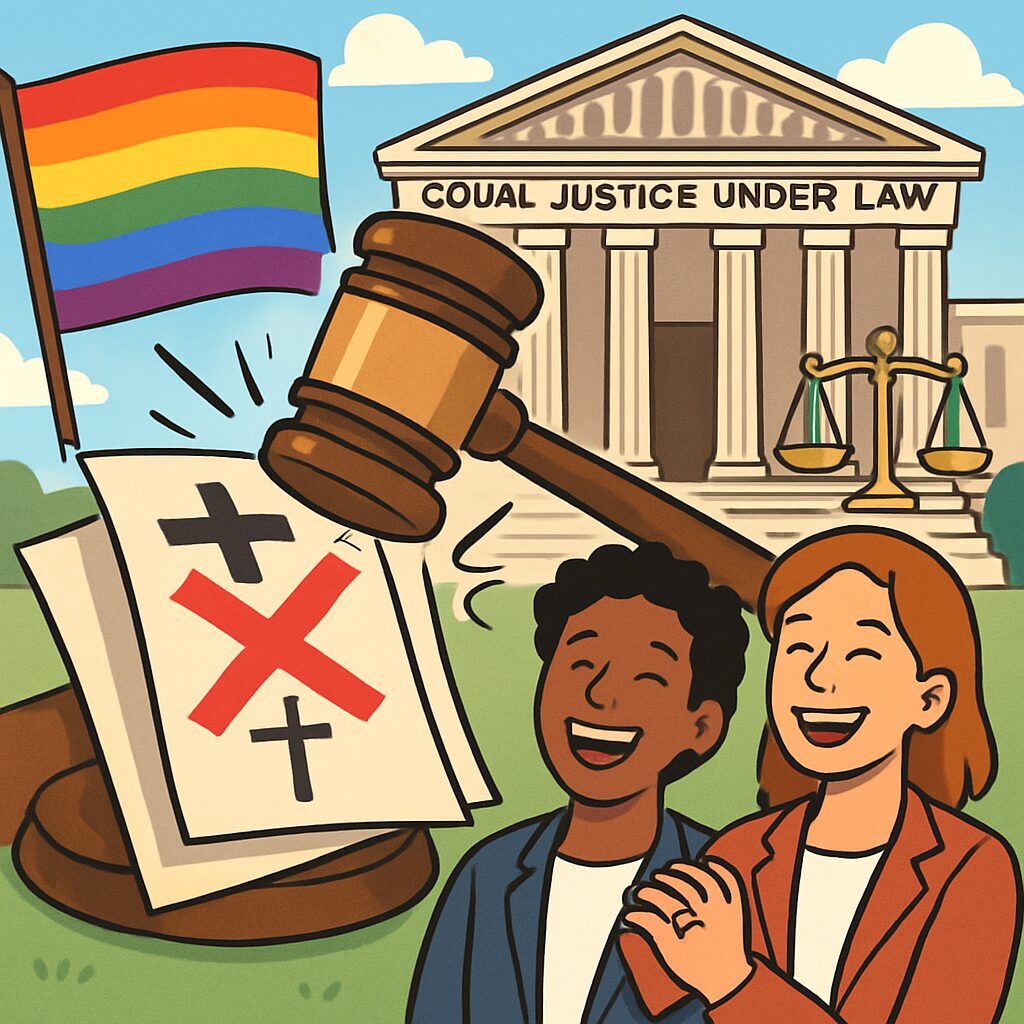
The US Supreme Court has rejected a challenge to its landmark 2015 ruling that legalized same-sex marriage nationwide, leaving the decision undisturbed. The court declined to hear an appeal from former Kentucky clerk Kim Davis, who was ordered to pay damages for refusing to issue marriage licenses to same-sex couples.
On Monday, November 10, 2025, the Supreme Court, without comment, turned away the appeal in the case involving Davis, who argued that issuing marriage licenses to same-sex couples violated her religious beliefs. The justices’ decision means that the lower court’s ruling requiring Davis to pay $360,000 in damages and attorney’s fees to the couple, David Ermold and David Moore, stands. This outcome reinforces the legal precedent set by Obergefell v. Hodges, which guaranteed the right to same-sex marriage across the United States. The court’s action signals a reluctance to revisit this contentious issue, despite its conservative majority.
Kim Davis, the former Rowan County clerk, gained national attention in 2015 when she defied the Supreme Court’s ruling by refusing to grant marriage licenses to same-sex couples. She cited her Apostolic Christian faith as the reason for her refusal, stating that it would be an “act of disobedience to God.” Her actions led to a civil rights lawsuit by Ermold and Moore, who accused her of violating their constitutional rights. Davis was ultimately jailed for six days for contempt of court after continuing to defy court orders.
The Obergefell v. Hodges decision in 2015 was a historic victory for LGBTQ+ rights, establishing that the fundamental right to marry is guaranteed to same-sex couples under the Fourteenth Amendment. Justice Anthony Kennedy, who has since retired, authored the majority opinion, emphasizing that gay people deserve “equal dignity in the eyes of the law.” The ruling faced dissent from conservative justices, including Chief Justice John Roberts and Justice Clarence Thomas, who argued that the court overstepped its bounds by redefining marriage.
In the recent appeal, Davis’s legal team, represented by the conservative group Liberty Counsel, argued that the same-sex marriage right was based on a “legal fiction” and sought to overturn Obergefell. However, federal courts consistently ruled against her, with Judge David Bunning stating that Davis could not use her religious beliefs to violate others’ constitutional rights while performing her official duties. The 6th US Circuit Court of Appeals upheld the lower court’s decision, leading to the Supreme Court’s rejection.
The court’s decision not to take up the case comes amid speculation that the conservative-majority court might reconsider Obergefell, especially after its 2023 ruling overturning the constitutional right to abortion. Justice Thomas has explicitly called for revisiting the same-sex marriage decision, but other conservative justices, such as Amy Coney Barrett, have suggested that reliance interests might protect Obergefell from being overturned. Chief Justice Roberts has remained silent on the issue since his dissent, while Justice Samuel Alito has criticized the decision but not advocated for its reversal.
Advocacy groups welcomed the Supreme Court’s move, with the Human Rights Campaign president Kelley Robinson stating that it “made clear today that refusing to respect the constitutional rights of others does not come without consequences.” The decision provides stability for same-sex couples who have married under Obergefell, ensuring that their rights remain protected. It also underscores the court’s current stance on maintaining established precedents in certain social issues, despite political pressures.
Looking ahead, the rejection of Davis’s appeal likely closes this chapter of legal challenges to same-sex marriage, but debates over religious liberty and LGBTQ+ rights continue. The Kentucky legislature previously removed clerks’ names from marriage licenses to avoid similar conflicts, and Davis lost her re-election bid in 2018. The Supreme Court’s action reaffirms the enduring impact of Obergefell, solidifying same-sex marriage as a settled law in the United States for the foreseeable future.

