

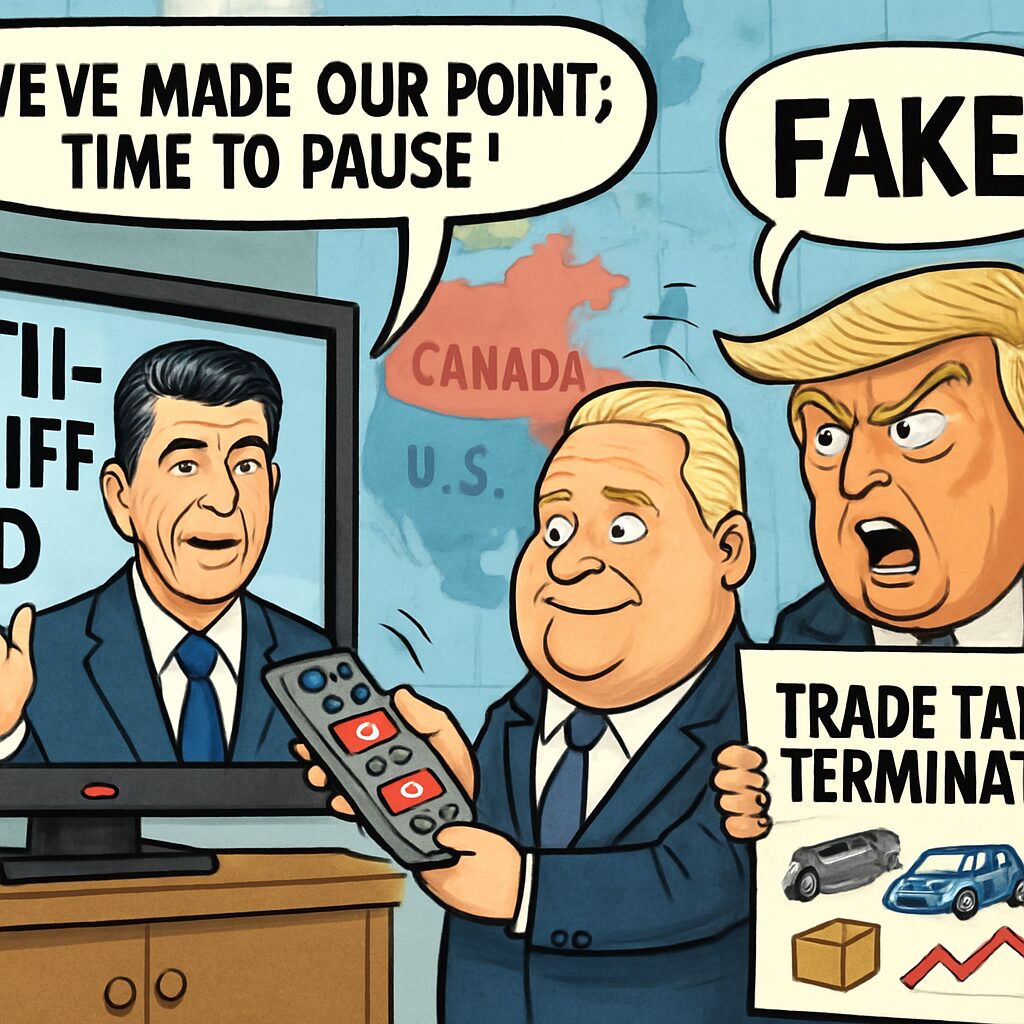

Ontario Premier Doug Ford has decided to pause an anti-tariff advertisement campaign that angered U.S. President Donald Trump, leading to the termination of trade talks between the two countries. The move, announced after consultations with Canadian Prime Minister Mark Carney, is intended to allow negotiations to resume, with the ad set to stop airing on Monday after running over the weekend.
The advertisement, which cost approximately $75 million Canadian, features edited clips from a 1987 radio address by former President Ronald Reagan, where he criticized tariffs as harmful to Americans. It was broadcast on U.S. television networks, including during the World Series, to influence public opinion against Trump’s tariff policies. The Ontario government defended the ad as a legitimate use of Reagan’s words to highlight the negative impacts of tariffs, though the Ronald Reagan Foundation condemned it for selective editing.
Trump responded vehemently on Truth Social, calling the ad “FAKE” and “egregious,” and declared an end to all trade negotiations with Canada. He also suggested that the ad was an attempt to sway an upcoming U.S. Supreme Court decision on tariffs, escalating tensions between the long-time allies. The abrupt termination of talks came as a blow to ongoing efforts to address trade disputes.
Ford stated that the ad had achieved its objective by reaching high-level U.S. audiences and sparking discussion about tariffs. After speaking with Carney, he agreed to pause the campaign to de-escalate the situation. “We’ve achieved our goal, having reached U.S. audiences at the highest levels,” Ford said, emphasizing that the intention was to initiate a conversation about the economy and tariff effects on workers and businesses.
Carney, who has been leading efforts to secure a trade deal, expressed Canada’s readiness to resume talks when the U.S. is prepared. He noted that U.S. trade policy has fundamentally changed and that Canada must focus on controlling what it can, including diversifying exports to reduce reliance on the U.S. market. Carney aims to double non-U.S. exports in response to the tensions, highlighting a strategic shift in Canadian trade policy.
The trade dispute has significant economic implications, with the U.S. imposing a 35% tariff on most Canadian goods and higher levies on specific sectors like metals (50%) and automobiles (25%). These measures have particularly hurt Ontario, home to much of Canada’s auto industry, and have fueled concerns about job losses and economic stability. Carney has made concessions, such as removing retaliatory tariffs, but insists on a deal that benefits Canada.
Reactions in Canada have been mixed, with some provincial leaders supporting Ford’s assertive approach, while experts warn it may have backfired by provoking Trump. The White House criticized Canada’s trade barriers and the ad campaign, indicating ongoing frustrations and a challenging path to resolution. This incident underscores the rocky road ahead for U.S.-Canada relations, with both sides needing to navigate complex diplomatic and economic landscapes to restore productive dialogue.