

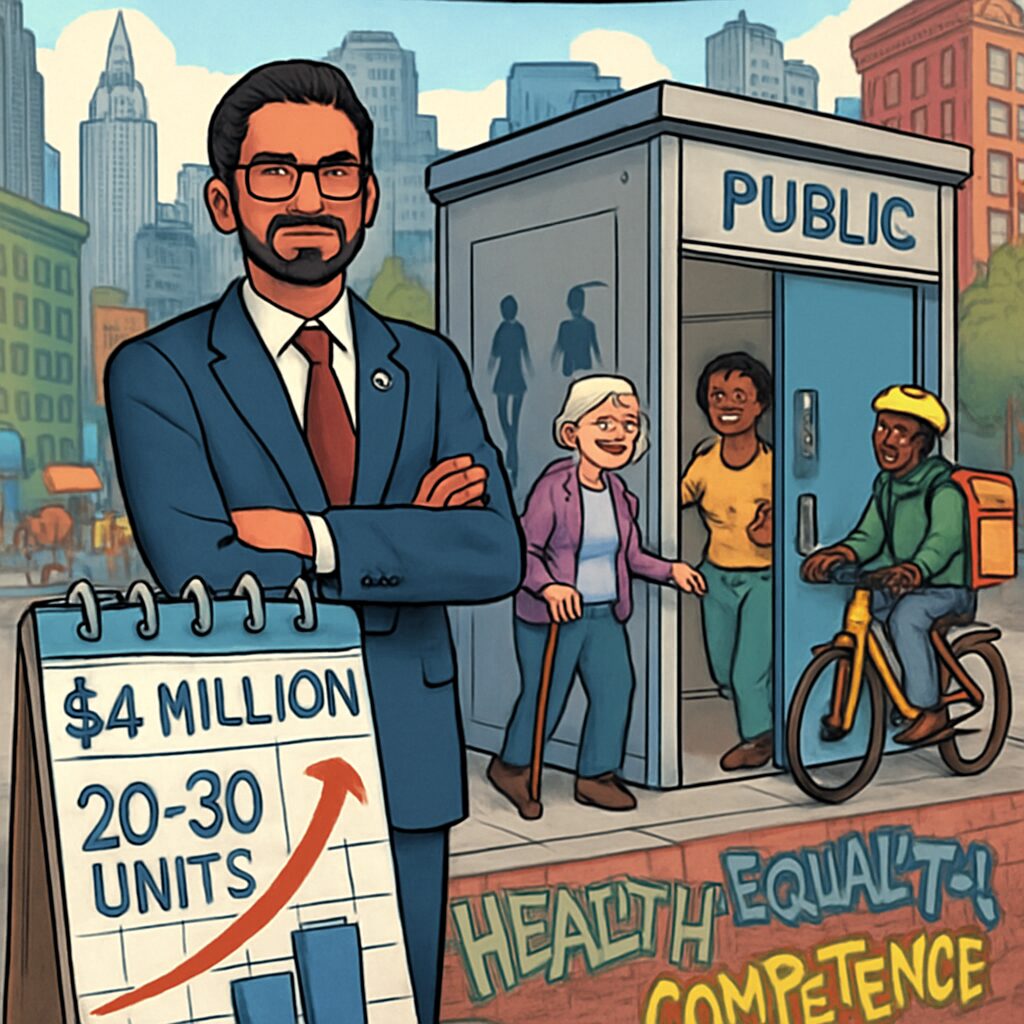
New York City Mayor Zohran Mamdani is confronting the city’s severe public bathroom shortage, framing it as a critical test of government competence and a symbol of broader failures in public infrastructure. His recent comments and a $4 million initiative aim to address this long-neglected issue, with coverage highlighting its significance for urban livability and public trust.
In a recent interview, Mamdani pointed to New York City’s dismal public bathroom access as emblematic of larger governmental shortcomings. With only one bathroom for every 8,500 residents, many in poor condition, the crisis forces reliance on private businesses, undermining public confidence.
Mamdani announced a $4 million plan to install 20 to 30 new modular public toilets across the city, starting with a recent opening in West Harlem. This effort, part of his early tenure, seeks to demonstrate that government can effectively solve everyday problems, from housing to transit.
The decline of public bathrooms in the U.S. dates back to budget cuts in the 1970s and 1980s, with cities like New York and San Francisco facing embarrassing failures in past attempts. Historically, public restrooms have been sites of social conflict, from civil rights struggles to debates over transgender access.
The shortage poses serious health risks, contributing to hepatitis A outbreaks in other cities and forcing delivery workers and those with medical conditions to resort to unsanitary alternatives. San Francisco’s experience with costly street cleanups underscores the economic toll.
Building traditional bathrooms is expensive and slow, often hindered by utility hookups and community opposition. Mamdani’s focus on modular units, which companies like Throne Labs offer for about $100,000 annually, represents a pragmatic approach to faster, cheaper deployment.
For Mamdani, a democratic socialist, fixing bathrooms is not just about convenience but about rebuilding trust in government’s ability to deliver public goods. He argues that failure in basic services erodes support for ambitious projects like affordable housing and climate action.
The city has issued a request for proposals for modular bathrooms, with the first installations expected soon. Mamdani emphasized that this is just the start, aiming to show that competent governance can make daily life easier for all New Yorkers.
If successful, this initiative could set a precedent for other cities grappling with similar issues, highlighting the importance of incremental progress in restoring public faith. Mamdani’s focus on unglamorous yet essential services may redefine urban priorities in an era of growing inequality.

