

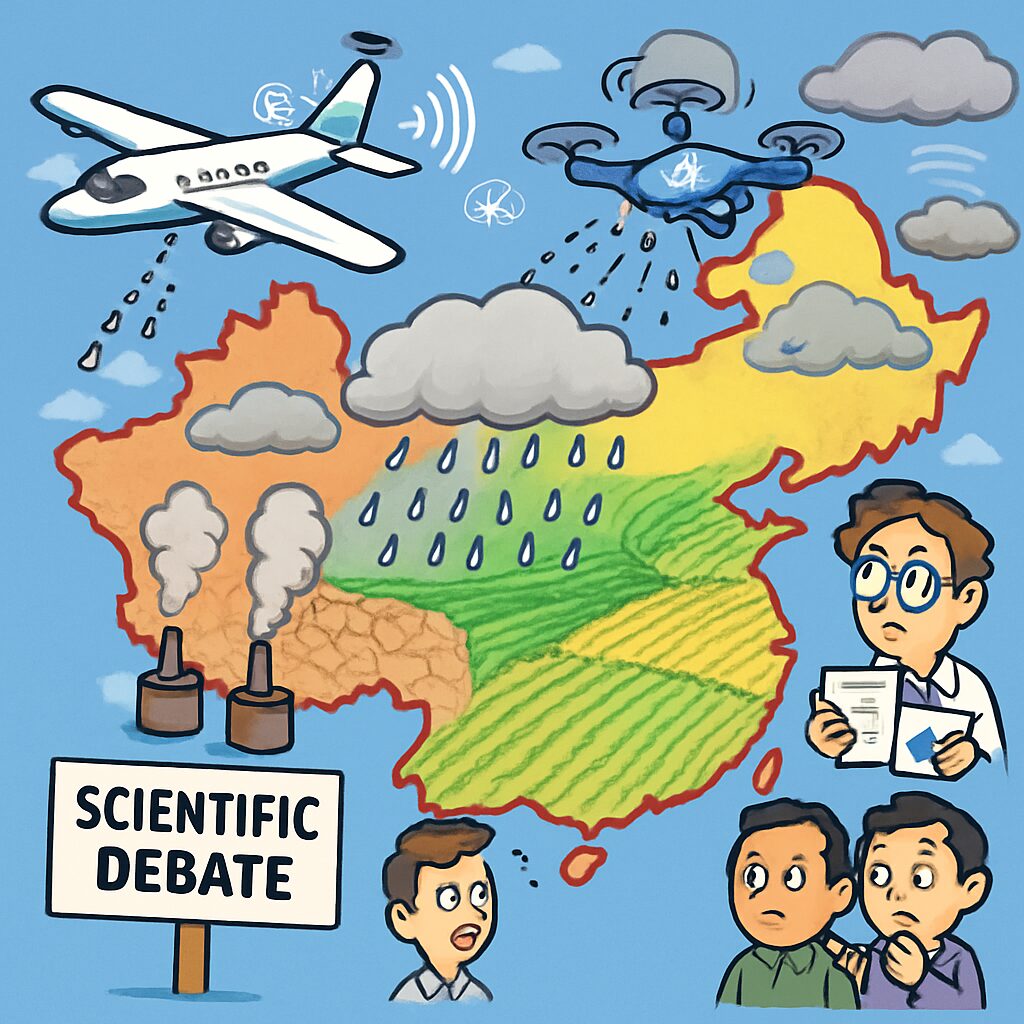
China is aggressively expanding its cloud seeding operations to control precipitation and alleviate droughts, but the technology remains controversial with limited scientific validation. This push reflects the country’s urgent need to secure water resources for agriculture and economic stability, yet it raises questions about environmental impacts and international relations.
In March 2025, China launched a massive cloud seeding initiative called the “spring rain” project, involving 30 aircraft and drones alongside over 250 ground generators to fire silver iodide pellets into the sky over drought-prone northern regions. The operation aimed to boost rainfall during the critical sowing season, with authorities claiming it produced an additional 31 million tonnes of precipitation. This effort is part of a broader strategy where weather modification now covers more than half of China’s land area, used not only for drought relief but also for event-specific weather control, such as during the 2008 Beijing Olympics.
Cloud seeding, discovered accidentally in the 1940s in the United States, involves introducing particles like silver iodide into clouds to encourage precipitation. China began experimenting with the technique in 1958 and has since developed the world’s largest weather modification program. Despite decades of use, the scientific community remains divided on its efficacy. Studies like the “Snowie” project in Idaho provided some evidence that cloud seeding can increase snowfall, but the effects are often modest and difficult to measure accurately due to natural variability in weather patterns.
Experts point out that claims of success from Chinese authorities are not always backed by independent data. Robert Rauber, a professor at the University of Illinois, noted that “the claims are not supported sufficiently by the data,” echoing concerns from other scientists about the lack of rigorous validation. The challenge lies in conducting controlled experiments in nature, as clouds cannot be replicated exactly, making it hard to distinguish seeded precipitation from natural rainfall.
Geopolitical tensions add another layer of complexity. China’s ambitious projects, such as the Tianhe (“sky river”) initiative to channel water vapor from the Tibetan Plateau, have raised alarms in neighboring countries like India. Elizabeth Chalecki, a researcher in international relations, warned that large-scale weather modification could lead to unilateral control of shared water resources, potentially destabilizing regional security. However, some analyses suggest that the transboundary impacts might be minimal, though the lack of international regulations poses risks.
Technological advancements are driving China’s cloud seeding efforts forward. The country has incorporated drones, AI, and improved radar to enhance the precision of silver iodide dispersal. Similar innovations are being explored in other nations, including the United Arab Emirates, which experiments with flare seeding and ion charges. Yet, independent research on these new methods is scarce, and scientists fear that climate change-induced droughts will spur adoption without adequate oversight.
The debate over cloud seeding underscores a broader dilemma: balancing immediate water needs with long-term scientific and ethical considerations. While China views weather modification as a vital tool for national development, experts advocate for more independent studies to determine when and where it works effectively. As water scarcity intensifies globally, the race to harness cloud seeding highlights the urgent quest for solutions, but also the importance of evidence-based policy and international cooperation to mitigate potential harms.

