

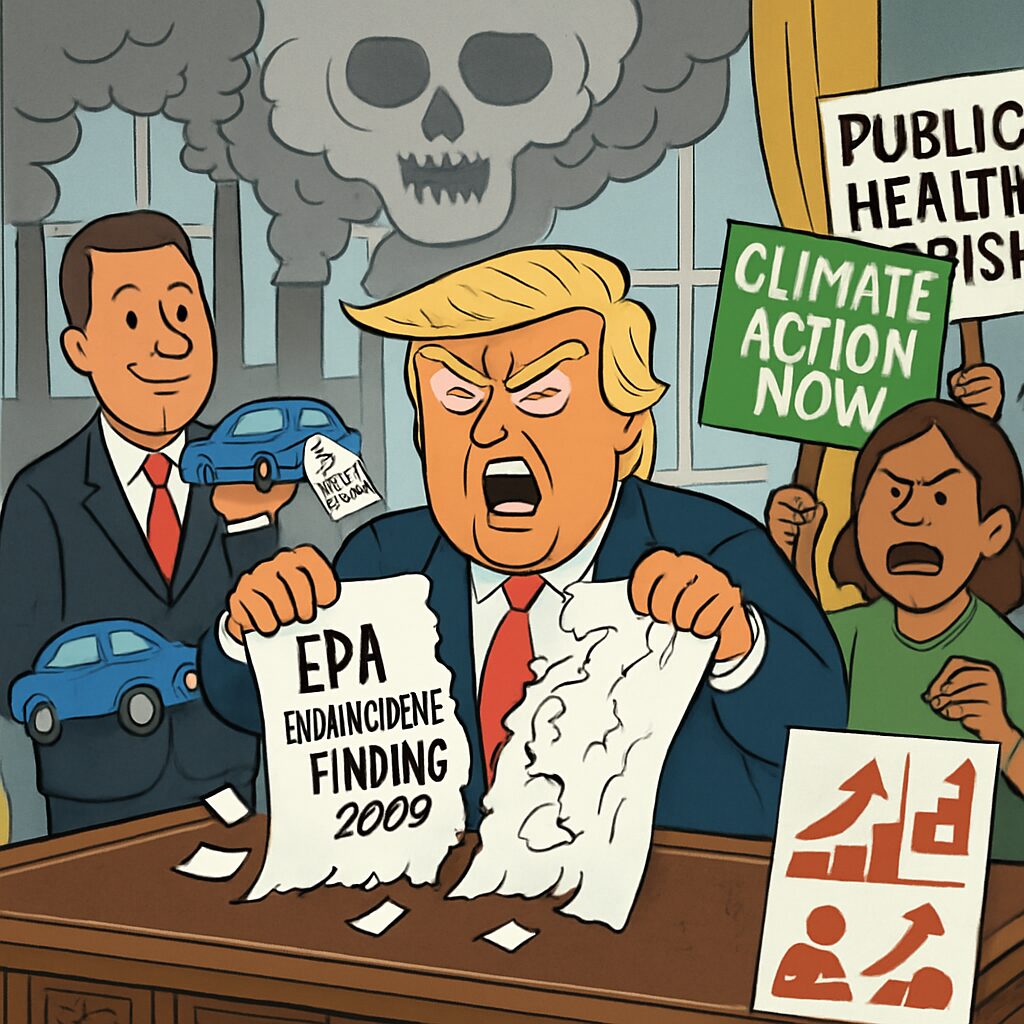
Executive summary: President Donald Trump has reversed the Obama-era ‘endangerment finding,’ a pivotal scientific ruling from 2009 that classified greenhouse gases as a threat to public health, thereby rolling back the legal foundation for federal climate regulations. This move, announced on Thursday, is described by the White House as the ‘largest deregulation in American history,’ aiming to reduce costs for automakers, while environmental groups decry it as a major setback for climate action and public health.
The 2009 endangerment finding, established by the Environmental Protection Agency (EPA), concluded that six key greenhouse gases, including carbon dioxide and methane, endanger human health and welfare. This finding became the cornerstone of federal efforts to curb emissions across various sectors, such as vehicles, power plants, and oil and gas operations. For over a decade, it provided the legal basis for regulations aimed at mitigating climate change, especially during periods when Congress was gridlocked on climate legislation. Experts note that rescinding it could unravel numerous environmental protections built upon this framework.
Trump announced the revocation in the Oval Office on Thursday, framing it as a correction to what he called a ‘disastrous Obama era policy’ that he claimed damaged the American auto industry and increased consumer prices. He argued that the ruling underpinned the ‘Green New Scam,’ referring to Democratic climate initiatives, and emphasized that the reversal would make cars cheaper by reducing regulatory burdens. White House press secretary Karoline Leavitt stated that the change would save automakers approximately $2,400 per vehicle and cut over $1 trillion in compliance costs, though critics question these figures.
Environmental and public health organizations have strongly condemned the decision, warning of severe consequences. Groups like the Environmental Defense Fund project that the rollback could lead to up to 58,000 additional premature deaths and 37 million more asthma attacks due to increased air pollution. They also estimate that Americans might incur around $1.4 trillion in extra fuel costs from less efficient vehicles. Former President Barack Obama, in a rare public comment, asserted that repealing the finding would make the country ‘less safe, less healthy and less able to fight climate change,’ benefiting the fossil fuel industry at public expense.
The legal ramifications are significant, as the endangerment finding has been instrumental in defending against climate-related lawsuits and enabling federal oversight of emissions. Its revocation is expected to spark numerous court challenges from states and environmental groups, who may argue that the administration is disregarding scientific consensus. Some legal experts speculate that the Trump administration may be seeking a Supreme Court ruling to permanently eliminate the finding, which would prevent future administrations from reinstating it without new legislation. This could set a precedent for how climate policy is handled in the U.S.
Economically, the move creates uncertainty for industries, particularly automakers. While some companies might welcome reduced regulations, others fear that producing less fuel-efficient vehicles could harm their competitiveness in global markets that prioritize emissions standards. Climate law expert Michael Gerrard noted that U.S. automakers could be ‘in a bind’ if foreign buyers reject American cars due to higher pollution levels. Additionally, the rollback might hinder innovation in clean technology and slow the transition to renewable energy sources.
Contextually, this action is part of a broader Trump administration agenda to dismantle climate policies, including previous relaxations of fuel economy standards. It aligns with efforts to challenge mainstream climate science, as seen in a controversial Department of Energy report that questioned the human impact on warming. However, that report has faced criticism for inaccuracies and a biased panel, and a federal judge recently ruled that its formation violated legal procedures, adding complexity to the administration’s justification.
Looking ahead, the revocation is likely to intensify political and legal battles over climate change in the U.S. Environmental groups are preparing lawsuits, potentially in state courts, to test the new regulatory landscape. The outcome could influence not only domestic policy but also America’s role in international climate agreements. As the debate unfolds, the public health implications remain a central concern, with advocates urging a focus on science-based solutions to address the ongoing climate crisis.

