

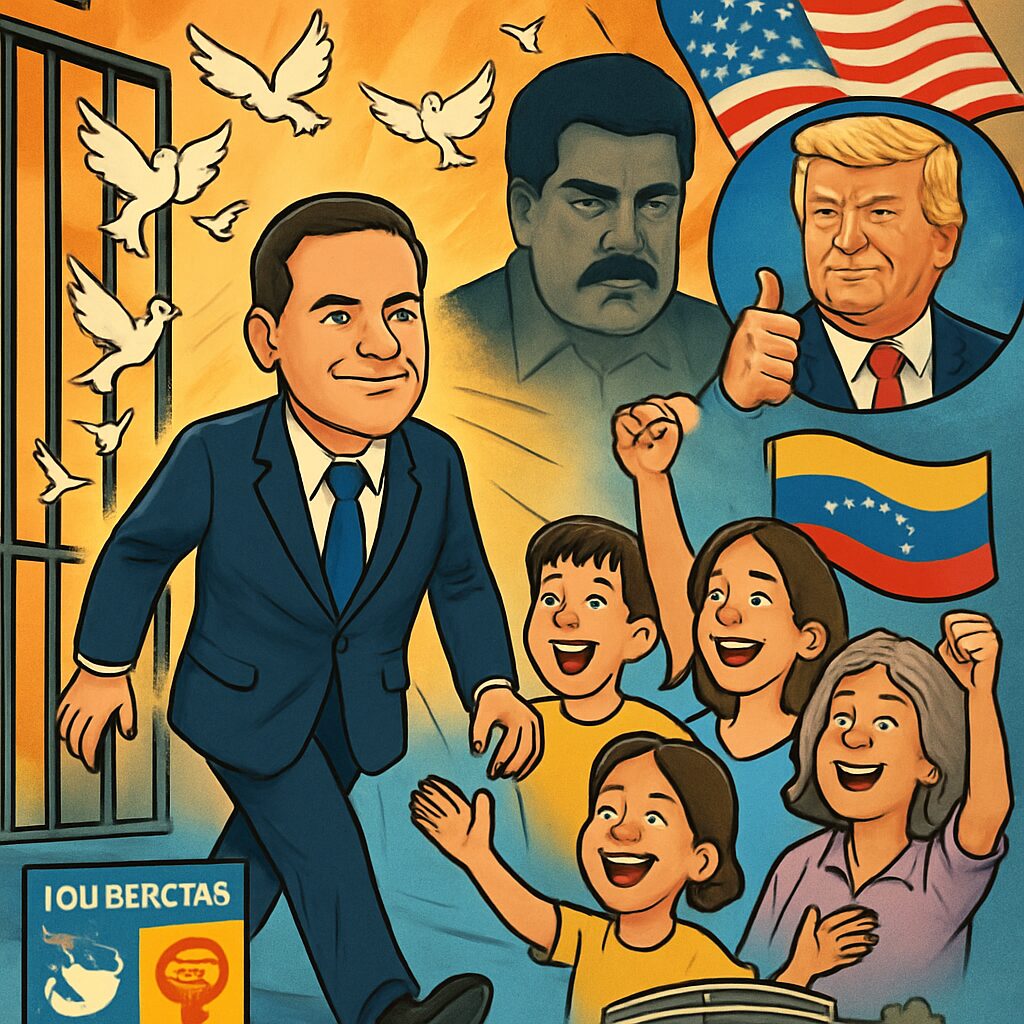
Venezuela has released high-profile opposition figure Juan Pablo Guanipa after eight months in detention, marking the latest in a series of political prisoner liberations under pressure from the United States following the capture of former President Nicolás Maduro.
Juan Pablo Guanipa, a prominent opposition politician and close ally of Nobel Peace Prize winner María Corina Machado, was freed on Sunday as part of a broader effort by the interim government in Caracas to comply with U.S. demands for the liberation of political prisoners. His release comes after nearly nine months in custody, during which he was accused of terrorism and treason for challenging the results of Venezuela’s widely disputed 2024 presidential election. Guanipa’s family and political movement have consistently denied these allegations, framing his detention as politically motivated to silence dissent.
The arrest of Guanipa in May 2025 followed months in hiding after he refused to accept the official election results that saw Nicolás Maduro re-elected. A former vice-president of the National Assembly and leader of the centre-right Justice First party, Guanipa had been a vocal critic of the Maduro regime, which has long been accused of using detentions to suppress opposition. Human rights group Foro Penal has verified 383 liberations of political prisoners since the government announced a new series of releases on January 8, with Guanipa among at least 30 freed on Sunday alongside others like Perkins Rocha and Jesús Armas.
Guanipa’s family expressed relief at his release but cautioned that hundreds of Venezuelans remain unjustly imprisoned. His son, Ramón Guanipa, shared on social media that the family would soon reunite, emphasizing the ongoing struggle for freedom for all political prisoners. Similarly, opposition leader Machado celebrated the release on X, calling for the immediate freedom of all detainees, while exiled figure Edmundo González Urrutia warned that releases alone do not equate to full freedom if legal proceedings and restrictions persist.
This development is directly linked to the U.S. capture of Maduro in January on drug trafficking charges, which led to the establishment of an interim government under Delcy Rodríguez. Rodríguez has been implementing changes to meet U.S. demands, including gradual prisoner releases and proposed reforms. Former U.S. President Donald Trump described the liberations as “a very important and smart gesture” from Venezuela, linking further cooperation on issues like oil deals to progress on human rights and democratic reforms.
The interim government has proposed an amnesty law that would grant clemency to those jailed for political activities, which passed an initial vote in the National Assembly this week. Rodríguez has also announced plans to convert the notorious Helicoide detention centre in Caracas into a sports and social services facility, signaling a potential shift in the country’s approach to detention and human rights. These moves aim to stabilize Venezuela and attract foreign investment amid economic challenges.
Looking ahead, the freedom of Guanipa and others is seen as a step toward reconciliation, but significant obstacles remain. The opposition continues to demand the release of all political prisoners and the restoration of democratic norms, while the interim government balances domestic stability with international expectations. The ongoing trial of Maduro in New York adds complexity to Venezuela’s path forward, with the world monitoring how the country navigates this turbulent period toward potential reforms and renewed engagement with the global community.

