

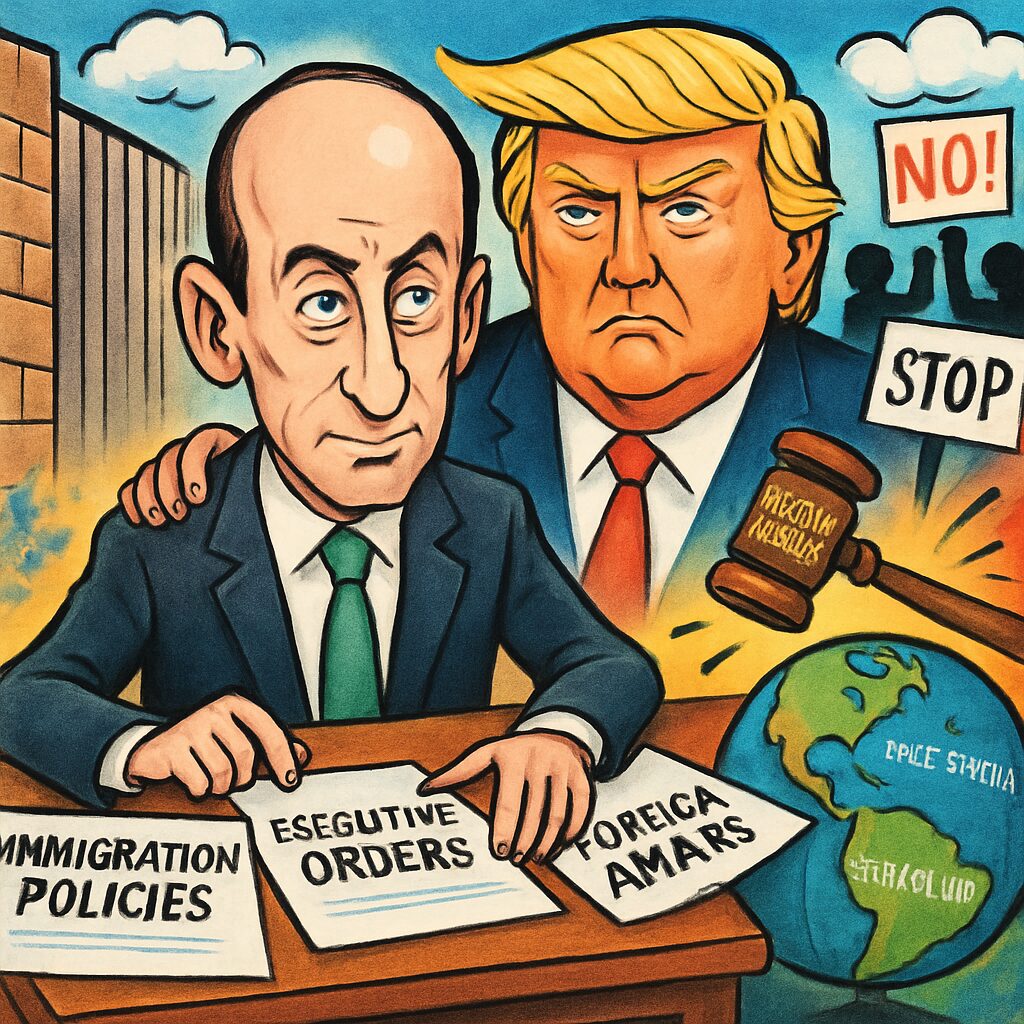
Stephen Miller, President Donald Trump’s deputy chief of staff for policy, has emerged as the driving force behind the administration’s most contentious initiatives, particularly on immigration, while extending his influence into foreign affairs. His unwavering loyalty and hardline stance have cemented his status as one of Trump’s most trusted aides, even as his actions spark widespread criticism.
Miller’s political journey began in liberal Southern California, where he developed conservative views early on. At Duke University, he gained attention by defending white lacrosse players falsely accused of rape, showcasing his penchant for controversy. He later worked for Tea Party figures like Michele Bachmann and Jeff Sessions, helping craft anti-immigration messaging that aligned with Trump’s 2016 campaign rhetoric.
In Trump’s first term, Miller was instrumental in shaping policies such as the ‘Muslim travel ban’ and the zero-tolerance policy that led to family separations at the border. These measures faced legal challenges and public backlash, but Miller learned from these experiences, refining his approach for a potential second term. After Trump’s 2020 loss, Miller strategized for a comeback, ensuring a more effective implementation of hardline agendas.
Upon Trump’s return to the White House, Miller was appointed deputy chief of staff for policy, overseeing a flood of executive orders. He championed the use of the Alien Enemies Act for rapid deportations and supported ending birthright citizenship, issues now before the Supreme Court. His role has expanded beyond immigration, making him a key player in foreign policy decisions.
Recently, Miller found himself in the spotlight after immigration officers shot and killed Alex Pretti, a nurse in Minneapolis. Initially, Miller accused Pretti of being a ‘domestic terrorist,’ but he later walked back those claims as video evidence contradicted his statements. This incident has intensified scrutiny of ICE tactics, with polls showing declining public approval of Trump’s immigration enforcement.
Miller’s influence extends globally, as seen in the administration’s military operations in Venezuela to oust Nicolás Maduro and his provocative comments on acquiring Greenland. He has asserted that world affairs are governed by ‘strength, force, and power,’ aligning with Trump’s ‘America First’ doctrine. This expansion of his portfolio has drawn criticism from veteran Republicans who question his expertise.
Democrats and some Republicans have condemned Miller, labeling him a bigot and blaming him for aggressive enforcement actions. Congressman Don Beyer called him ‘deranged and bloodthirsty,’ while Senator Thom Tillis urged him to stay in his lane. Despite this, Miller’s bond with Trump remains strong, with the president dismissing rumors of replacing him and praising his loyalty.
Looking ahead, Miller’s policies will face further tests, including Supreme Court rulings and the November midterm elections. His ability to navigate these challenges will determine his lasting impact on Trump’s legacy. As one of the few aides expected to remain with Trump beyond his presidency, Miller’s role as a central figure in shaping controversial policies seems secure for now.

