

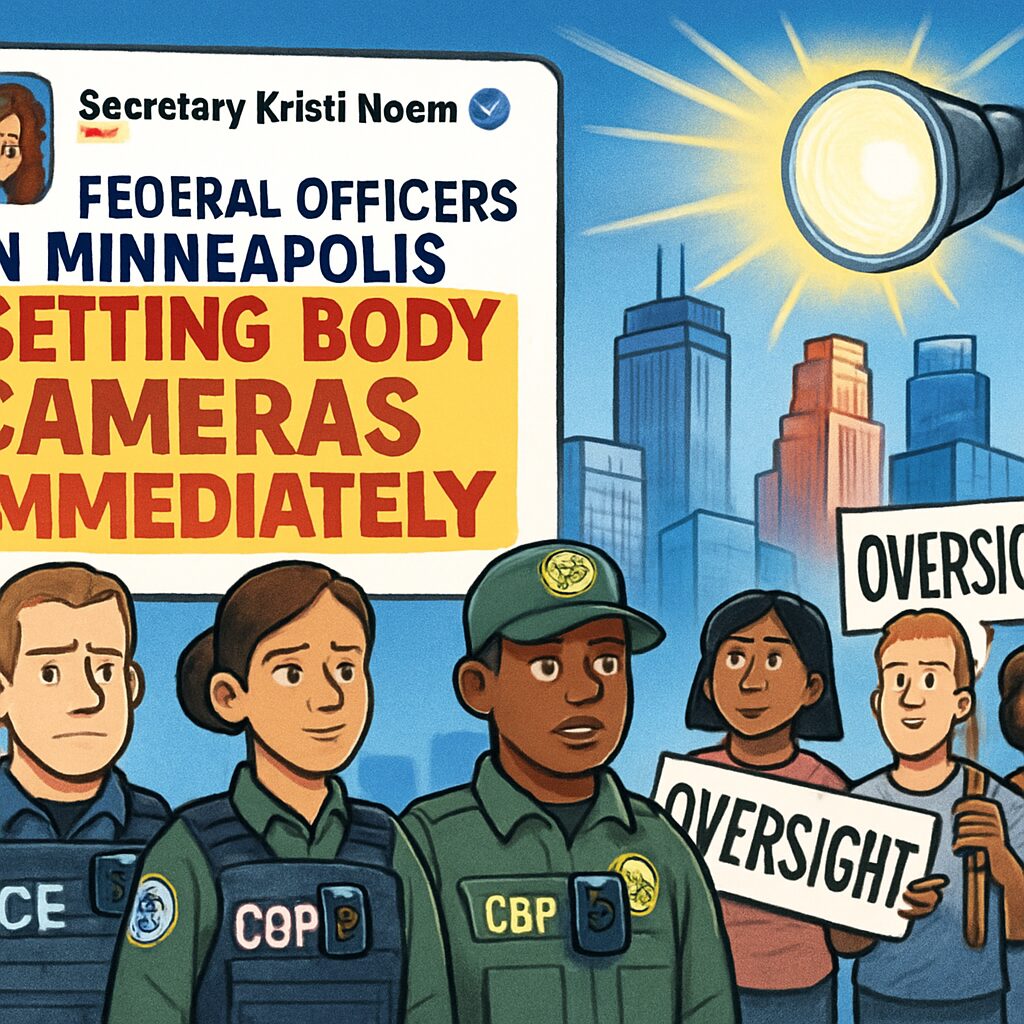
U.S. Department of Homeland Security Secretary Kristi Noem announced on social media platform X that federal law enforcement officers in Minneapolis will begin using body cameras immediately, a move aimed at enhancing transparency amid ongoing controversies over agent-involved shootings. “Effective immediately we are deploying body cameras to every officer in the field in Minneapolis,” Noem said in the post, adding that the rollout is contingent on funding availability.
This announcement comes in the wake of two high-profile fatal shootings by federal agents in Minneapolis earlier this year. On January 7, 2026, Immigration and Customs Enforcement (ICE) agents shot and killed Renee Nicole Good during an enforcement operation, sparking widespread protests and calls for greater oversight. Less than three weeks later, on January 26, Customs and Border Protection (CBP) agents fatally shot Alex Pretti, a local nurse, further intensifying demands for accountability and reform.
Prior to this decision, federal immigration agents operating in Minneapolis were not uniformly equipped with body-worn cameras, a fact highlighted in multiple news reports and criticized by advocacy groups. Articles from CNN and PBS NewsHour detailed how the absence of camera footage complicated investigations into the shootings, leaving gaps in public understanding and fueling distrust among Minneapolis residents.
The push for body cameras has been a central demand from local officials and community leaders. Minnesota Attorney General Keith Ellison and Minneapolis Mayor Jacob Frey have repeatedly called for federal agents to adopt transparency measures similar to those used by city police departments. In a lawsuit filed in January, state and city attorneys argued that the lack of body cameras violated residents’ rights and hindered independent oversight.
Secretary Noem’s announcement represents a significant policy shift for the Department of Homeland Security (DHS), which has faced mounting pressure to reform its practices. While DHS had previously announced plans to deploy body cameras in August 2025, the immediate implementation in Minneapolis signals a responsive move to recent events. However, the rollout may face logistical hurdles, including training requirements and equipment procurement.
The introduction of body cameras is expected to provide clearer evidence in future incidents, potentially reducing conflicting accounts and enhancing public trust. Legal experts suggest that footage could also protect agents from false accusations and improve training protocols. However, concerns remain about data storage, privacy issues, and the potential for selective recording.
Looking ahead, the effectiveness of this measure will depend on consistent usage and adherence to protocols. DHS has not specified a timeline for full deployment beyond the immediate start, and funding constraints could delay broader adoption. Meanwhile, investigations into the January shootings continue, with body camera footage from those incidents—if available—likely to play a key role in ongoing reviews.
In summary, the immediate deployment of body cameras to federal officers in Minneapolis marks a critical step toward greater accountability, though its long-term impact will hinge on implementation and sustained commitment to transparency.

