

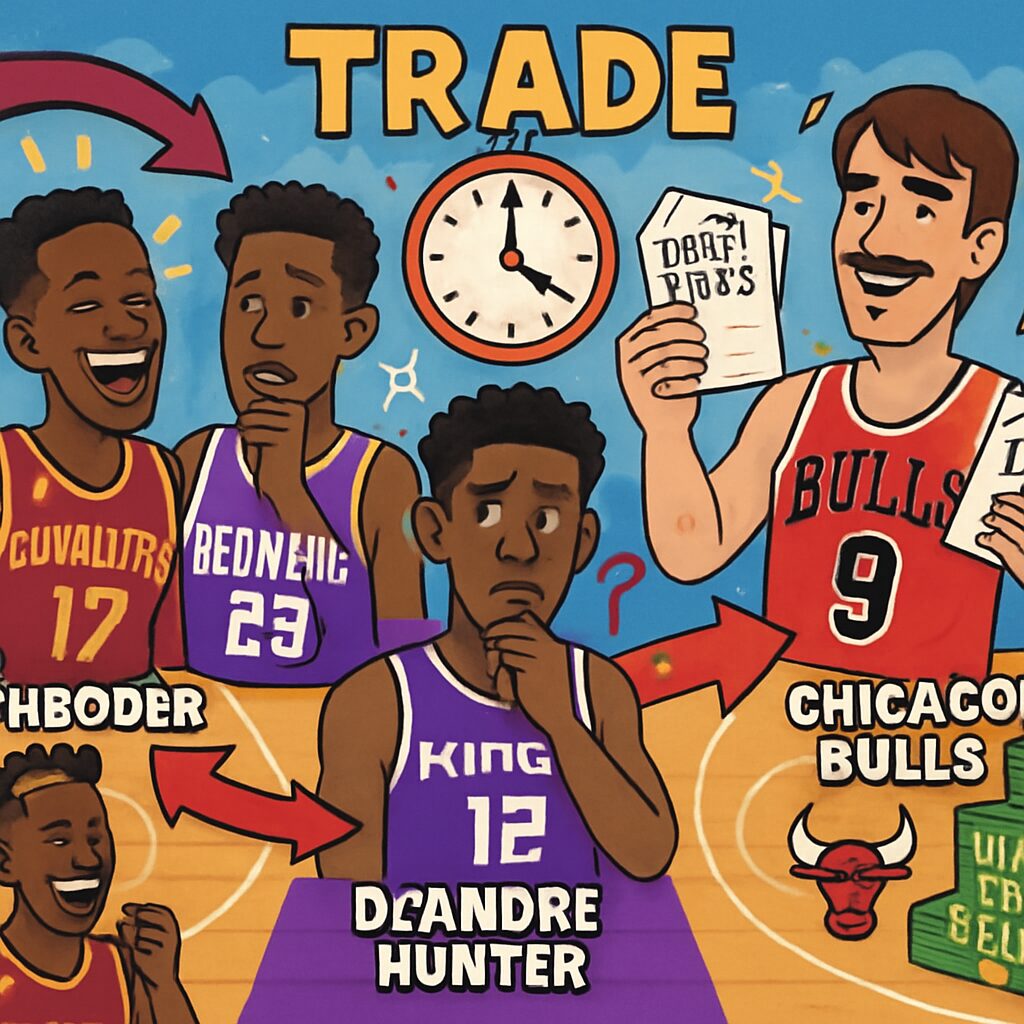
In a strategic move just before the NBA trade deadline, the Cleveland Cavaliers, Sacramento Kings, and Chicago Bulls executed a three-team trade that redistributes players and draft picks, with Cleveland seeking to enhance its playoff chances, Sacramento making a contentious acquisition, and Chicago capitalizing on salary absorption.
The deal, finalized on Saturday night and reported by ESPN’s Shams Charania, involves the Cavaliers receiving guards Dennis Schröder and Keon Ellis from the Kings. In return, the Kings obtain forward De’Andre Hunter from Cleveland, while the Bulls take on forward Dario Šarić and secure two second-round draft picks. This transaction comes at a critical time for the Cavaliers, who have faced challenges with bench production and defensive lapses, particularly in the backcourt, where injuries and inconsistent play have hampered their season.
For Cleveland, the addition of Keon Ellis is seen as a significant boost. Ellis, who impressed as a defensive stalwart for Sacramento, brings tenacity on the perimeter and reliable three-point shooting, addressing key weaknesses. Dennis Schröder, though inconsistent in recent seasons, offers experienced playmaking and scoring depth, which could stabilize the second unit. According to analyses from Yahoo Sports and CBS Sports, this trade also provides financial relief by moving Hunter’s contract, saving the Cavaliers approximately $50 million in luxury tax and potentially allowing them to avoid the restrictive second apron, which limits roster flexibility.
Sacramento’s involvement has sparked debate among analysts. The Kings traded away Ellis, a player they had at a minimal cost, for Hunter, whose performance has waned this year after a promising start with Atlanta. CBS Sports points out that Sacramento mismanaged Ellis’s contract by exercising a team option that made him an unrestricted free agent next summer, rather than retaining matching rights. Yahoo Sports adds that acquiring Hunter, a veteran in his prime, seems misaligned with the Kings’ apparent rebuild, as they hold the league’s worst record and are likely to pursue top draft picks.
The Bulls’ participation is largely facilitative, with Chicago absorbing Šarić’s $5.4 million expiring contract in exchange for two second-round picks. Both news outlets commend this as a shrewd move, as it costs the Bulls little beyond salary cap space they already had, and it nets them valuable draft assets without compromising future plans. This aligns with Chicago’s broader strategy of accumulating picks and maintaining financial flexibility amid a prolonged period of mediocrity, as they eye a future roster overhaul.
This trade underscores the heightened activity as the February 5 deadline approaches, with teams juggling immediate competitive needs against long-term sustainability. For the Cavaliers, currently positioned for a playoff run in the Eastern Conference, the reinforcements aim to solidify their rotation and address deficiencies that could be exploited in the postseason. The integration of Ellis and Schröder will be closely watched, as their effectiveness could determine Cleveland’s ceiling in the coming months.
Meanwhile, the Kings face uncertainty with Hunter’s fit. If he rebounds to form, he could provide much-needed wing depth, but it might inadvertently improve their record, complicating draft lottery odds. Sacramento may need to make follow-up trades to clarify their direction, especially with star players like DeMar DeRozan potentially on the move. The Bulls, on the other hand, continue a patient build, using their cap space to acquire assets that could be leveraged in future deals or drafts.
In conclusion, this three-team transaction highlights the diverse approaches in the NBA: Cleveland’s push for contention, Sacramento’s puzzling roster management, and Chicago’s asset accumulation. As the trade deadline nears, this deal may set a precedent for similar moves, with franchises carefully weighing risks and rewards in a league where financial constraints and competitive balance are ever-present factors.

