

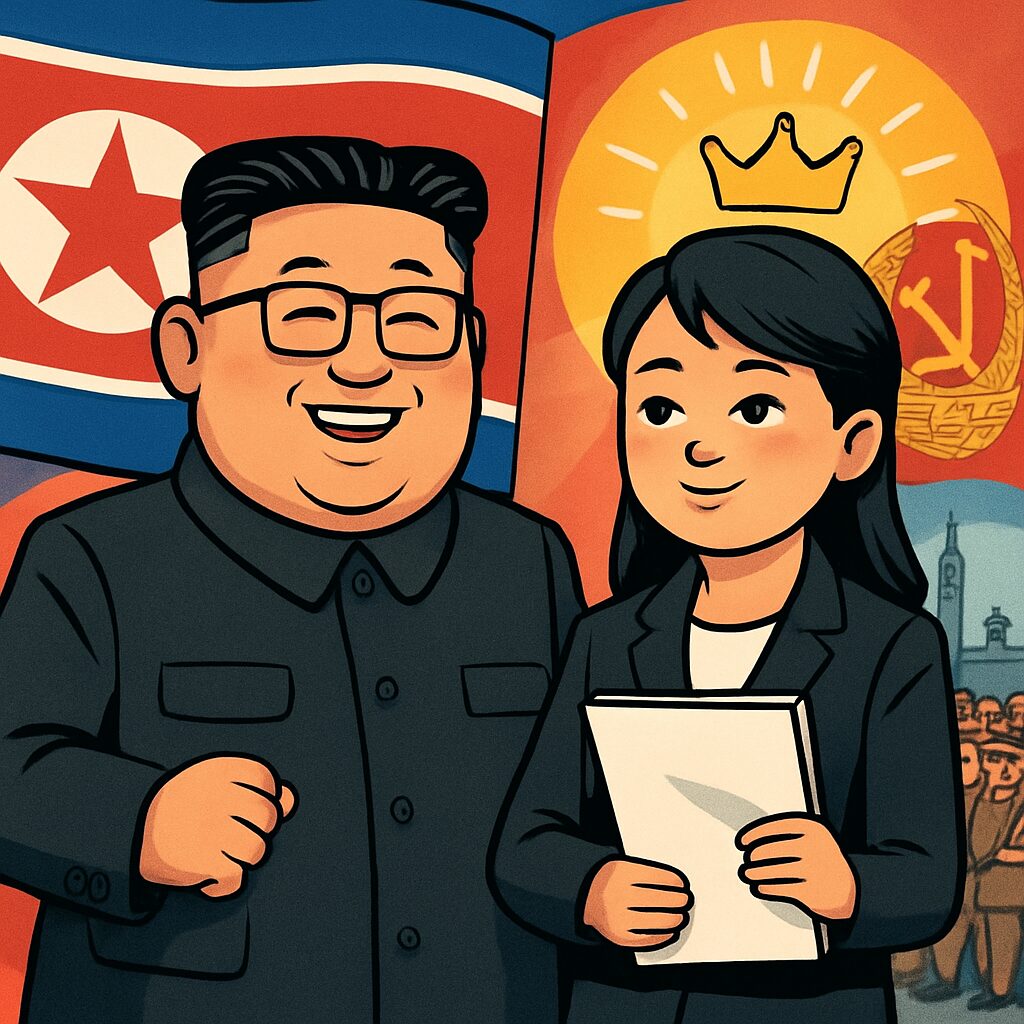
North Korean leader Kim Jong Un has designated his teenage daughter Kim Ju Ae as his successor, according to South Korea’s National Intelligence Service (NIS), signaling a potential shift in the dynastic leadership of the isolated state. The assessment was shared with lawmakers on Thursday, based on Kim Ju Ae’s increasingly prominent public appearances and indications that she is involved in policy decisions.
Kim Ju Ae, believed to be around 13 years old, first appeared on state television in 2022 during an intercontinental ballistic missile test. Since then, she has been pictured alongside her father at various high-profile events, including a visit to Beijing in September 2025 for China’s military parade. Her name was initially revealed to the West by American basketball player Dennis Rodman in 2013, but she remained out of the public eye until recent years.
South Korean lawmaker Lee Seong-kweun reported that the NIS now describes Kim Ju Ae as being in the stage of ‘successor designation,’ moving beyond previous characterizations of her as merely ‘trained’ for the role. The agency cited her attendance at significant events such as the founding anniversary of the Korean People’s Army and visits to key sites like the Kumsusan Palace of the Sun as evidence of her elevated status. Additionally, there are signs that she has begun to weigh in on state policies, further solidifying her position as the heir apparent.
The Kim family has ruled North Korea for three generations, with power passing from Kim Il Sung to Kim Jong Il and then to Kim Jong Un. While the NIS believes Kim Jong Un has an older son, this child has never been acknowledged or shown in North Korean media, making Kim Ju Ae the only publicly recognized offspring. Her selection as successor is notable in North Korea’s deeply patriarchal society, where female leadership has historically been dismissed as unlikely.
However, Kim Jong Un’s sister, Kim Yo Jong, currently holds a senior position in the Workers’ Party of Korea and is reported to have influence over her brother, providing a precedent for female authority within the regime. This suggests that Kim Ju Ae’s succession might not be entirely unprecedented, though it still represents a significant departure from traditional norms. The timing of the designation is also puzzling, given that Kim Jong Un is still relatively young and appears healthy, raising questions about the motivations behind naming a 13-year-old as heir now.
Attention is now focused on North Korea’s upcoming Workers’ Party congress, scheduled for late February, where the country is expected to outline its foreign policy and nuclear ambitions for the next five years. The NIS has stated that it will closely monitor Kim Ju Ae’s attendance at the event, including the level of protocol accorded to her, which could provide further insights into her official role. Her presence or absence, and how she is portrayed, will be key indicators of her solidified position within the leadership hierarchy.
Kim Ju Ae’s potential succession has broader implications for North Korea’s future direction. When Kim Jong Un took power, there were hopes that his Western education might lead to openness, but those expectations were not met. Similarly, Kim Ju Ae’s upbringing and eventual leadership could shape the country’s policies, though it remains uncertain what changes she might bring. As a teenager with little public record, her intentions and capabilities are largely unknown, leaving analysts to speculate based on her limited appearances and the regime’s opaque nature.
In conclusion, the designation of Kim Ju Ae as successor marks a critical juncture in North Korea’s leadership dynamics. As she continues to appear in state media and at official functions, her role will be closely watched by both domestic observers and the international community. The upcoming party congress may offer more clarity, but for now, Kim Ju Ae stands as the likely future leader of one of the world’s most secretive and nuclear-armed states.

