

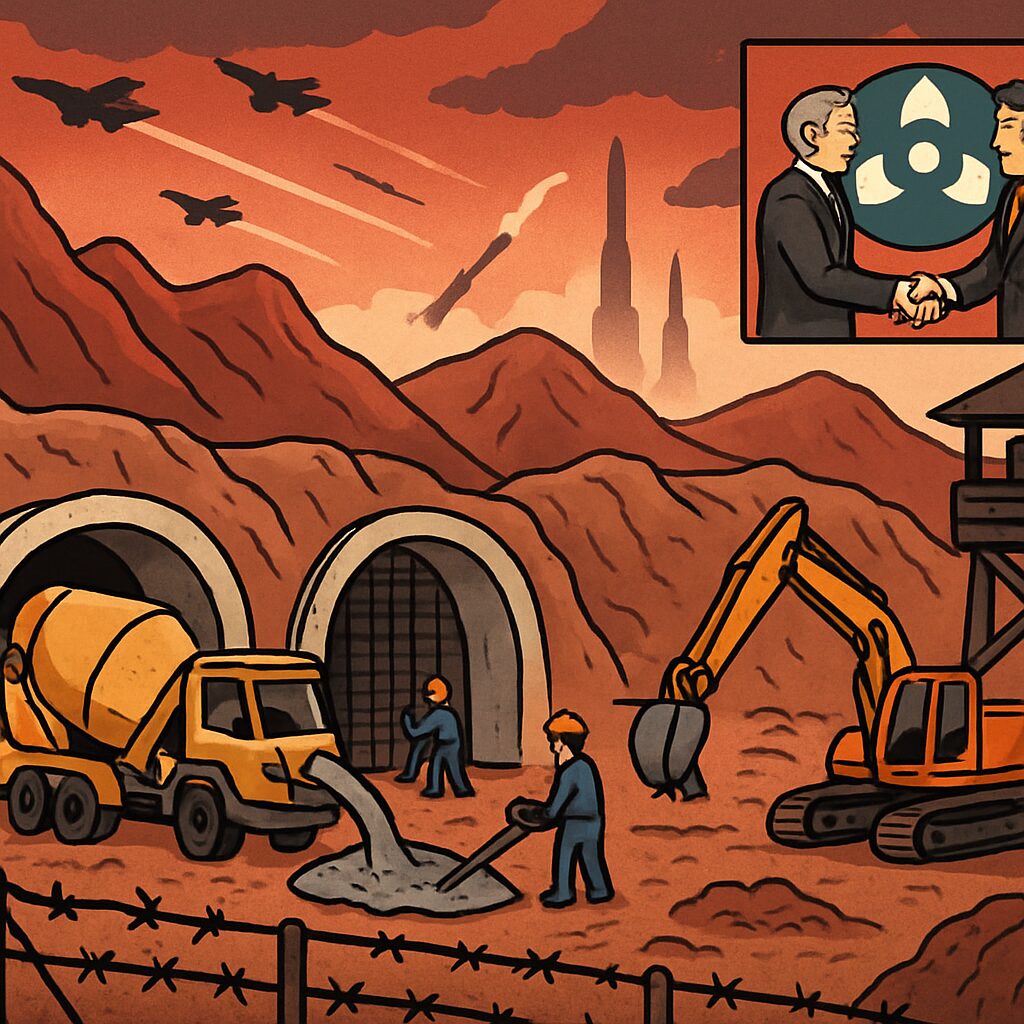
Satellite imagery analyzed by experts shows that Iran has been actively fortifying an underground complex near its Natanz nuclear facility, a move interpreted as preparing for potential U.S. or Israeli military strikes amid stalled nuclear negotiations. The activity, centered at Mount Kolang Gaz La, also known as Pickaxe Mountain, involves strengthening tunnel entrances with concrete and backfilling them with soil, according to reports from the Institute for Science and International Security (ISIS).
Images captured on February 10 reveal fresh concrete being poured on top of one tunnel entrance, with construction machinery visible at the site. At another entrance, rock and soil have been leveled and flattened, and a new concrete-reinforced structure has been added nearby. These measures are designed to enhance the tunnels’ resistance to aerial attacks, as noted by analysts from ISIS and other intelligence firms.
This fortification comes at a critical juncture, with tensions remaining high following U.S. and Israeli airstrikes on Iranian nuclear sites in June 2025. Talks between Iranian and U.S. officials are ongoing, but President Donald Trump has recently threatened further military action if a new nuclear deal is not reached. Iran insists its nuclear program is peaceful, but the U.S. has accused it of advancing towards weaponization.
Experts quoted in both BBC and The Jerusalem Post reports suggest that the underground complex may be intended to protect uranium enrichment activities or key nuclear equipment. The facility’s size and the protection offered by the mountain raise concerns that it could host sensitive operations, although its exact purpose remains unclear. ISIS president David Albright emphasized that the site is even more deeply buried than the Fordow facility, making it a challenging target for destruction.
Despite the extensive construction, the think tank assesses that the facility is likely not yet operational, as indicated by the presence of heavy machinery and materials. However, the recent activities, including the movement of smaller vehicles, suggest that Iran may be in the process of outfitting the interior for future use. This aligns with Iran’s stated goal of rebuilding its nuclear capabilities after the 2025 strikes.
Similar defensive enhancements have been observed at other nuclear sites, such as Isfahan, where tunnel entrances have been sealed with earth to dampen the effects of potential strikes. At Natanz itself, repair work and the addition of roofs over damaged areas indicate a broader effort to harden Iran’s nuclear infrastructure against attacks. These actions reflect Tehran’s assumption that further military confrontations are possible.
The implications of this fortification are significant for international security and diplomacy. Rafael Grossi, head of the International Atomic Energy Agency, has warned that a window of opportunity for a new nuclear deal exists but could close abruptly. With Iran estimated to have 400 kilograms of highly enriched uranium, the stakes are high for preventing nuclear proliferation. The ongoing construction underscores the urgency of diplomatic efforts to address Iran’s nuclear ambitions and reduce regional tensions.
In summary, Iran’s efforts to fortify its underground nuclear facilities highlight the precarious state of nuclear negotiations and the persistent threat of conflict. As both sides posture, the international community watches closely, hoping for a peaceful resolution to avert further escalation in an already volatile region.

