

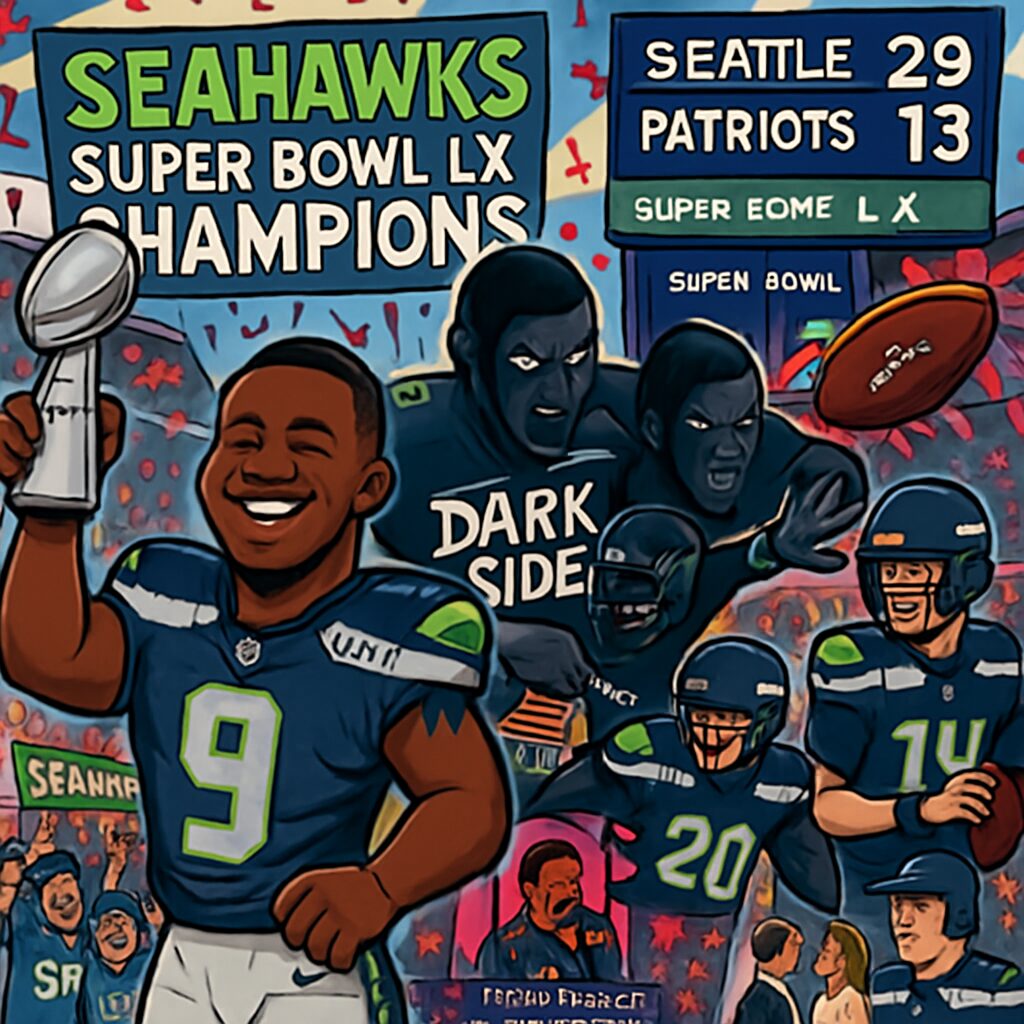
The Seattle Seahawks defeated the New England Patriots 29-13 to win Super Bowl LX on February 8, 2026, an event that transcends football to become a defining cultural moment in American life. Led by a dominant defense and Super Bowl MVP running back Kenneth Walker III, the Seahawks secured their second Lombardi Trophy in a game watched by millions, blending athletic excellence with widespread fan engagement and entertainment.
The championship unfolded at Levi’s Stadium in Santa Clara, California, where the Seahawks’ defense, nicknamed the “Dark Side,” stifled the Patriots’ offense with six sacks and three turnovers. Quarterback Drake Maye, the regular-season MVP runner-up, was pressured relentlessly, leading to critical mistakes that shifted momentum in Seattle’s favor. This defensive prowess set the stage for a controlled offensive performance, allowing the Seahawks to maintain a lead throughout the contest.
Offensively, Seahawks quarterback Sam Darnold, a first-round pick turned journeyman, managed the game effectively, completing 19 of 38 passes for 202 yards and a touchdown without turnovers. His steady hand, combined with Walker’s 135 rushing yards at an average of 5.0 yards per carry, provided the balance needed to capitalize on opportunities. Walker’s efforts earned him MVP honors, underscoring his pivotal role in the victory.
The Seahawks’ defense forced key turnovers, including a strip sack by linebacker Derick Hall in the third quarter—his first since 2024—and interceptions by linebacker Uchenna Nwosu and safety Julian Love in the fourth quarter. These plays sealed the win, as the Patriots were held scoreless until late in the game when Maye connected with wide receiver Mack Hollins for a 35-yard touchdown, but it proved too little, too late.
Beyond the game itself, Super Bowl LX drew over 90,000 visitors to the Bay Area, with fan experiences like the Super Bowl Fan Experience at San Francisco’s Moscone Center emphasizing the event’s status as a cultural holiday. Even those not typically engaged with football participate through parties, commercials, and social gatherings, reflecting the Super Bowl’s deep integration into American society.
The halftime show featured Bad Bunny, who made history as the first Latino and Spanish-speaking artist to headline, and included a surprise wedding ceremony, adding to the spectacle’s entertainment value. His performance received widespread acclaim on social media, with athletes and celebrities praising the show, highlighting how the Super Bowl blends sports with pop culture to captivate a broad audience.
This Super Bowl marked a rematch between the Patriots and Seahawks, echoing past championships and underscoring the NFL’s narrative-driven appeal. The game’s high viewership and economic impact, including extensive betting and advertising, reinforce its significance, with events like these driving discussions about sports, community, and national identity.
In the aftermath, attention turns to the Seahawks’ legacy and the Patriots’ future, with implications for team dynamics and the upcoming NFL season. The victory cements Seattle’s place among elite franchises, while New England faces offseason questions after falling short, yet the broader takeaway remains the Super Bowl’s unique ability to unite diverse audiences through shared experiences and celebration.

