

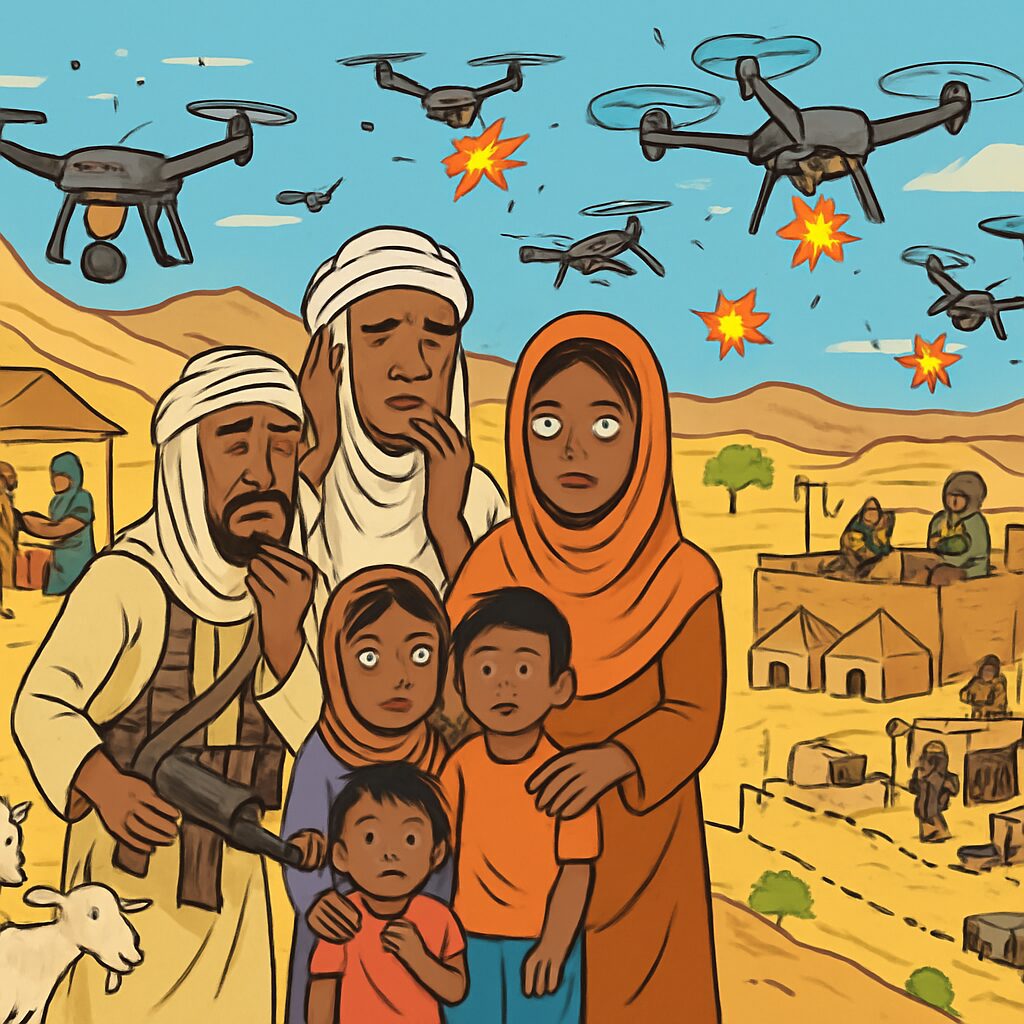
Jihadist groups in West Africa are increasingly deploying commercially available drones to conduct strikes and surveillance, marking a significant evolution in regional conflict that allows militants to wage a “war from the skies” with minimal cost and risk. This shift, driven by affiliates of al-Qaeda and the Islamic State, is transforming battlefield dynamics and raising alarms among security experts.
The al-Qaeda-linked Jama’at Nusrat al-Islam wal-Muslimin (JNIM) has carried out at least 69 drone attacks in Mali and Burkina Faso since 2023, according to data from the Armed Conflict Location & Event Data Project (Acled). Islamic State groups, including the Islamic State West Africa Province (Iswap) and the Islamic State Sahel Province (ISSP), have executed around 20 strikes, primarily in Nigeria and neighboring countries. These figures highlight how readily accessible technology is being repurposed for insurgent tactics, with drones becoming a key tool in prolonged conflicts across the Sahel and Lake Chad regions.
Recent incidents underscore the growing sophistication of these attacks. On January 29, Iswap launched a coordinated assault using multiple armed drones and ground fighters on a military base in Nigeria’s Borno state, killing nine soldiers. The same day, ISSP targeted the international airport in Niger’s capital, Niamey, and nearby military bases, with reports suggesting a possible drone strike that, if confirmed, would represent ISSP’s first use of an explosive-laden drone in Niger. These events signal an expansion of militant capabilities and a trend toward more complex, multi-pronged operations.
The drones used are typically off-the-shelf quadcopters, inexpensive and commercially available, which militants rig with explosives for strikes or employ for reconnaissance missions. Despite strict government controls on drone imports in countries like Nigeria, jihadists exploit porous borders and smuggling networks to acquire them. Malik Samuel, a researcher at Good Governance Africa, notes that foreign fighters have trained local groups to adapt these drones, transforming consumer gadgets into potent weapons, a shift from earlier tactics like roadside bombs and suicide belts.
Tactical advantages for militants are clear: drones reduce casualties by enabling remote attacks, lower operational costs, and allow precise targeting of military assets that were previously hard to reach. Security analyst Audu Bulama Bukarti emphasizes that this development is “deeply concerning” as it enhances the effectiveness of extremist groups. For instance, JNIM has employed first-person view (FPV) drones, similar to those used in Ukraine, to drop improvised explosives with high accuracy, as seen in an attack in Burkina Faso’s Djibo town last February, marking a significant escalation in precision warfare.
While most drone strikes target military and allied forces, civilians have also been affected, raising humanitarian concerns. Acled analyst Héni Nsaibia reports that JNIM has hit markets in communities perceived as pro-government, and Iswap caused civilian casualties in northern Cameroon in June 2025, when two pastoralists were killed. This underscores the potential for increased harm to non-combatants as drone usage escalates, complicating efforts to protect vulnerable populations in conflict zones.
To counter this threat, experts urge West African armies to adopt proactive measures. Taiwo Adebayo of the Institute for Security Studies advocates for preemptive strikes on drone assembly and launch sites, along with the acquisition of counter-drone technology, such as jamming devices and air defence systems. Without such steps, militants could enhance their capabilities, leading to more devastating assaults that exacerbate instability in the region and potentially spill over into neighboring countries.
The proliferation of drone warfare in West Africa represents a new frontier in jihadist strategy, driven by innovation and external influences. As groups continue to refine their techniques, the challenge for regional governments will be to rapidly develop defences and foster international cooperation. The ongoing conflict highlights the urgent need for investment in counter-terrorism technologies to safeguard against this evolving menace and prevent a further deterioration of security in one of the world’s most volatile regions.

