

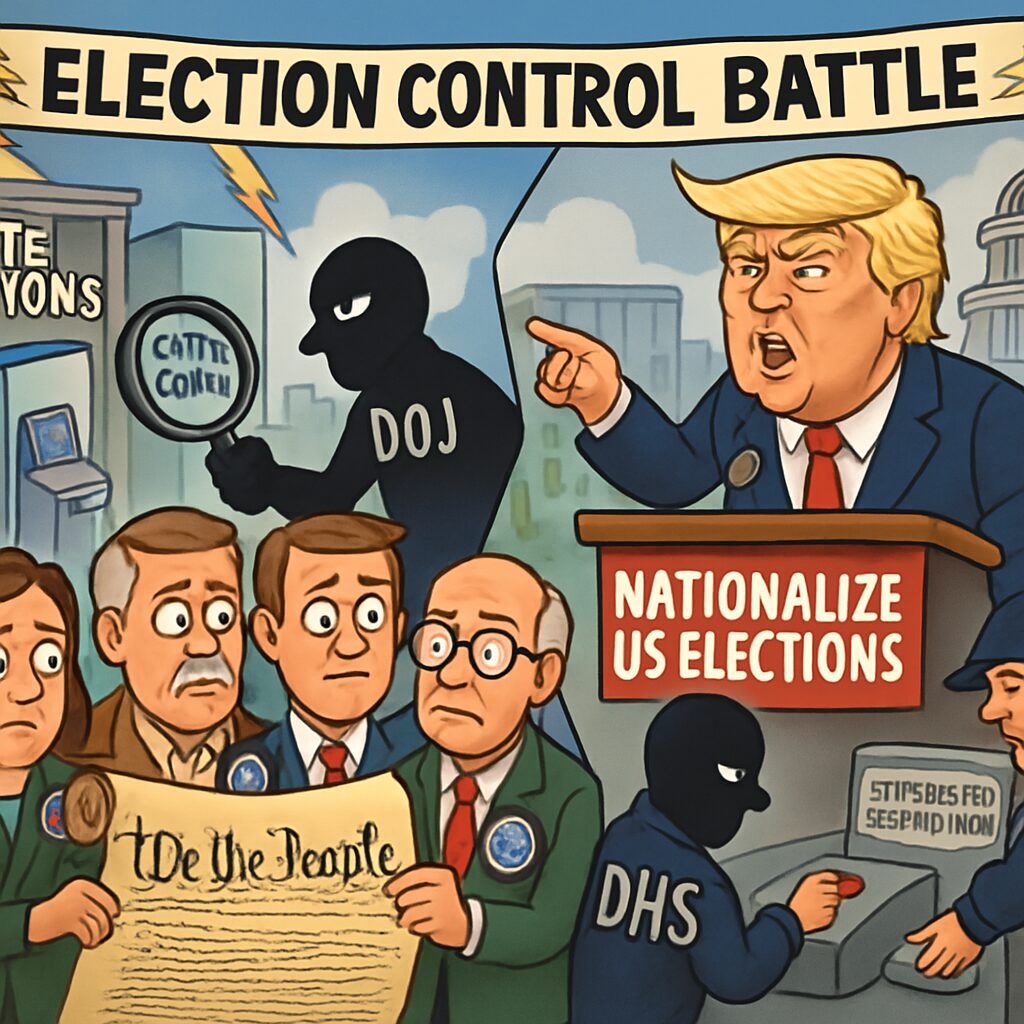
President Donald Trump’s recent advocacy for the Republican Party to “nationalize” U.S. elections has triggered significant alarm among state and local election officials, who are bracing for potential federal intrusion into traditionally state-run voting processes. This call, made during a podcast interview and reiterated in public remarks, represents a dramatic escalation in the administration’s efforts to centralize election control, raising profound constitutional questions and fears of electoral tumult ahead of the 2026 midterms.
Trump’s comments, in which he urged Republicans to “take over the voting in at least 15 places,” were delivered on the podcast of former FBI official Dan Bongino and later defended by the White House as support for voter ID legislation. However, the president’s broader rhetoric suggests a desire for federal hands-on management of elections, contradicting the U.S. Constitution’s clear delegation of election administration to states. State officials from both parties have swiftly condemned the idea, with Maine Secretary of State Shenna Bellows declaring “hell no” and promising to mail a pocket Constitution to the White House.
The constitutional framework for U.S. elections is rooted in state authority, with the federal government having limited oversight roles. Trump’s push to nationalize voting mechanisms challenges this bedrock principle, prompting legal experts and election administrators to warn of a fundamental violation. Oregon Secretary of State Tobias Read expressed concern that the administration is “increasingly desperate” and that officials must “be prepared for everything,” highlighting the pervasive anxiety among those tasked with safeguarding democratic processes.
In response to Trump’s calls, the Department of Justice has intensified its efforts to obtain unredacted voter rolls from states, suing 24 states and the District of Columbia under the guise of searching for noncitizen voters. Simultaneously, the Department of Homeland Security is pressuring states to use citizenship verification tools, actions that critics argue risk voter privacy and could be used to disenfranchise eligible citizens. These moves are seen as part of a broader strategy to federalize election oversight, with recent FBI raids in Georgia adding to the tension.
The FBI’s seizure of ballots from a Fulton County, Georgia, elections warehouse has particularly alarmed officials, as it occurred in a state central to Trump’s false claims of 2020 election fraud. Fulton County Commissioner Robb Pitts denounced the raid as “an assault on your vote,” while Director of National Intelligence Tulsi Gabbard confirmed her presence, stating it was related to election security. This incident underscores the tangible fears of federal overreach and its potential to disrupt local election administration.
Despite Trump’s assertions, some Republican election officials have broken ranks, opposing nationalization on states’ rights grounds. Missouri Secretary of State Denny Hoskins and Georgia Secretary of State Brad Raffensperger have publicly resisted federal demands, emphasizing adherence to state law and the Constitution. This internal GOP dissent reflects the deep-seated conservative commitment to decentralized governance, even as Trump challenges party orthodoxy with his centralized ambitions.
Looking ahead, election officials are preparing for various scenarios, including the possibility of federal law enforcement presence at polling places during the midterms. Ingham County, Michigan, Clerk Barb Byrum noted that emergency plans now include “the president of the United States meddling in elections,” a stark shift from traditional threats like natural disasters. Organizations like the Center for Election Innovation & Research are recruiting lawyers to provide pro bono assistance, ensuring that local administrators have legal support to resist undue federal pressure.
The implications of Trump’s call are far-reaching, threatening to erode public trust in elections and destabilize the 2026 midterms. As states brace for continued federal pressure, the battle over election control is set to intensify, with profound consequences for American democracy. The coming months will test the resilience of state-level election systems and the nation’s commitment to constitutional norms, making this a pivotal moment in U.S. political history.

