

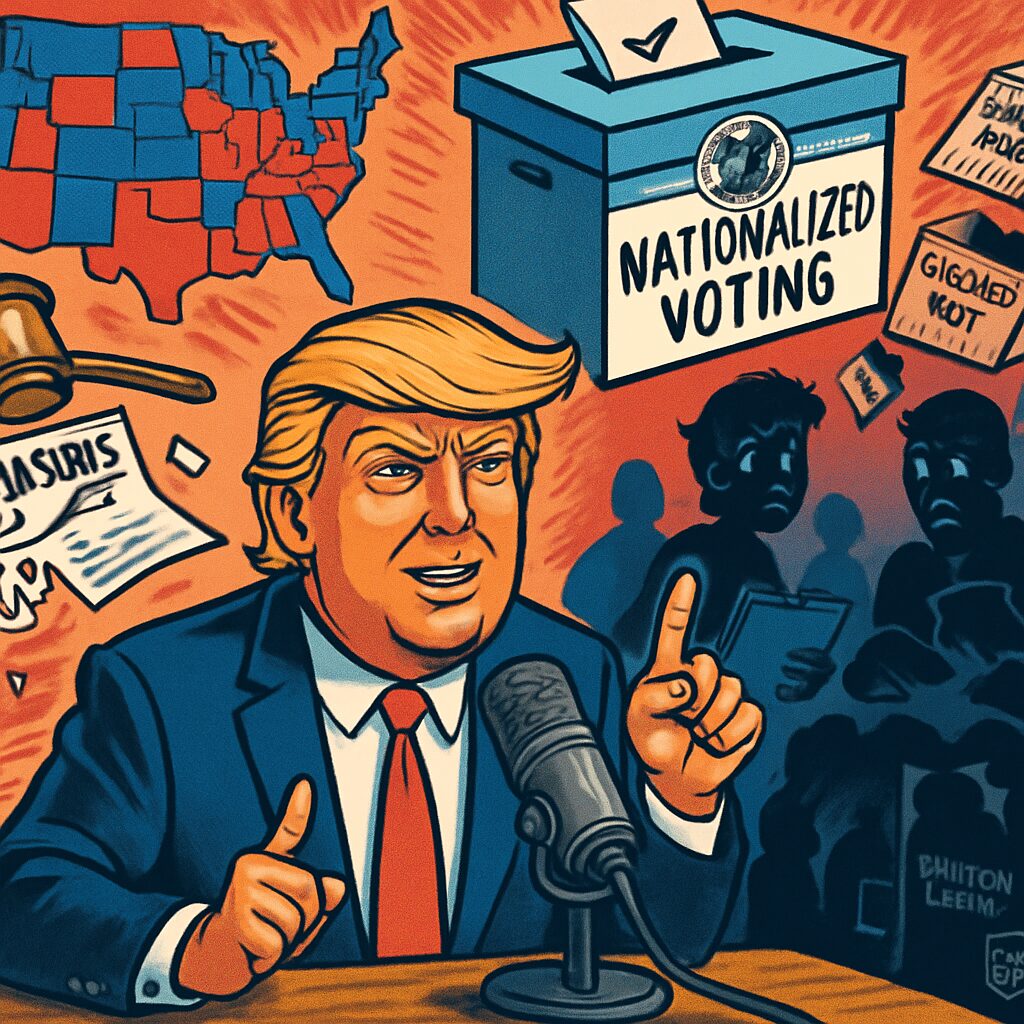
President Donald Trump has called on Republicans to “nationalize” elections, urging a federal takeover of voting processes in at least 15 states during a podcast appearance, while repeating disproven claims of voter fraud. This dramatic escalation challenges state control over elections and has sparked legal and political debates.
Trump made the remarks on Monday in an interview with former FBI Deputy Director Dan Bongino, stating that “Republicans ought to nationalize the voting” and “take over the voting in at least 15 places.” He argued that some states are “so crooked” and falsely claimed he won the 2020 election in states where official results show he lost. The comments reflect Trump’s long-standing but unsubstantiated allegations of widespread illegal voting, which he has used to justify aggressive election measures.
The proposal to nationalize elections would involve shifting authority from state governments to the federal level, a move that contradicts the U.S. Constitution’s allocation of election administration to states, with limited congressional oversight. Legal experts note that Article 1 grants states primary control over the “times, places, and manner” of elections, though Congress can impose federal regulations. Trump’s suggestion comes amid ongoing Justice Department lawsuits demanding voter rolls from states and an FBI raid last week in Fulton County, Georgia, where hundreds of boxes of election materials were seized.
In the podcast, Trump referenced the Georgia raid, suggesting that “interesting things” would emerge from the seized ballots. The raid, which involved Director of National Intelligence Tulsi Gabbard, has raised questions about federal overreach and potential investigations into foreign interference in the 2020 election. Fulton County officials have announced plans to sue the Justice Department to challenge the seizure’s legality and recover the ballots, highlighting tensions between state and federal authorities.
Trump’s call for nationalization aligns with broader efforts by his allies to restrict voting access. In Congress, House Republicans have introduced the MEGA Act, which would ban universal mail voting and ranked choice voting, among other measures. However, federal courts have already blocked parts of Trump’s executive orders aimed at election changes, such as requiring proof of citizenship for voter registration. A recent ruling by U.S. District Judge Colleen Kollar-Kotelly emphasized that the Constitution does not allow the president to unilaterally alter federal election procedures.
The White House has defended Trump’s stance, with spokesperson Abigail Jackson stating that the president “cares deeply about the safety and security of our elections” and supports legislative proposals like the SAVE Act for photo ID requirements and restrictions on mail-in voting. Despite this, critics warn that nationalizing elections could undermine democratic norms and lead to increased partisan control over voting processes, potentially disenfranchising voters.
Trump’s remarks also tie into his broader narrative on immigration, as he falsely claimed that undocumented immigrants are “brought to our country to vote” for Democrats. He specifically mentioned Minnesota, alleging it is a “rigged state” due to Somali communities, despite losing the state in all his presidential bids. These assertions have been repeatedly debunked, as noncitizen voting in federal elections is illegal and there is no evidence of significant fraud.
Looking ahead, the push to nationalize elections is likely to face significant legal and political hurdles. With ongoing court challenges and state resistance, Trump’s proposal may remain largely symbolic. However, it signals a continued focus on election integrity as a central theme for Republicans, potentially influencing future policy debates and the 2026 midterm elections. The outcome could reshape the balance of power between state and federal governments in administering elections.

