

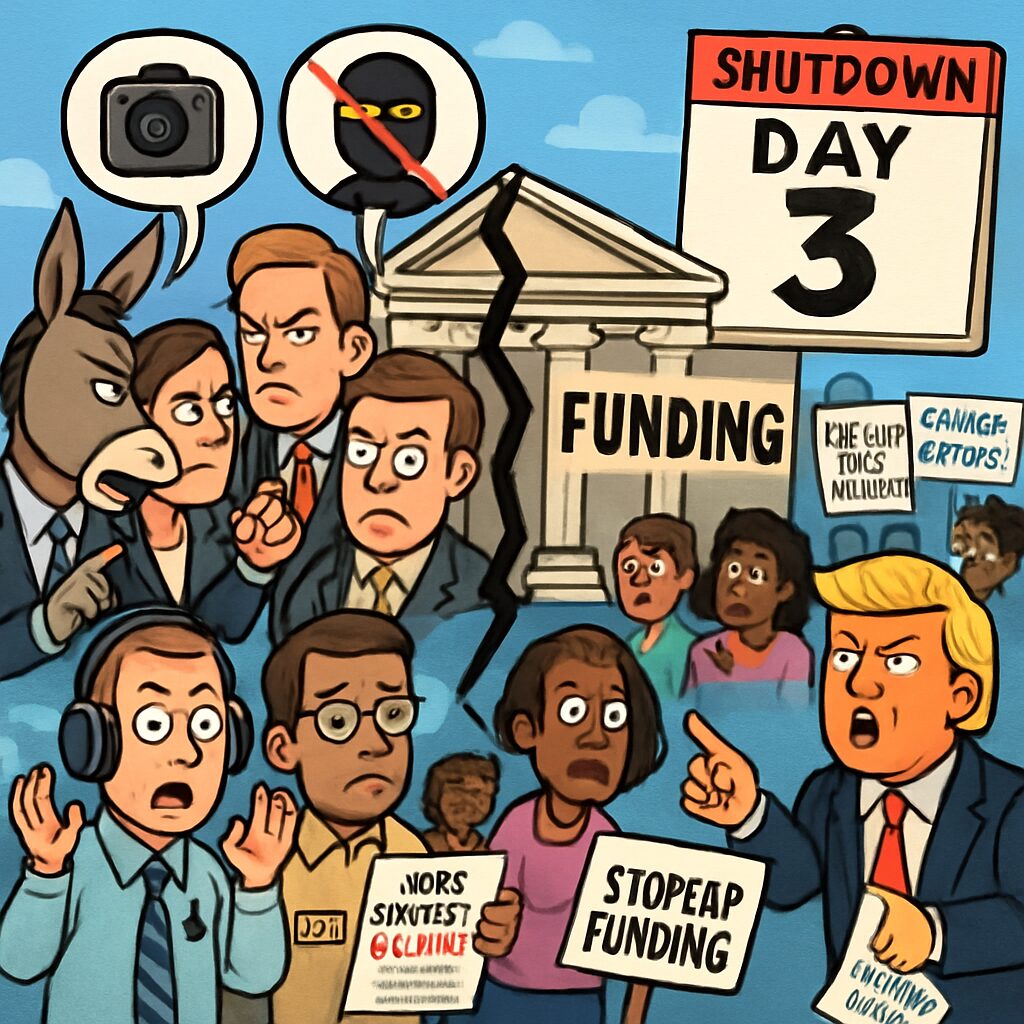
A partial U.S. government shutdown has entered its third day as congressional deadlock over Department of Homeland Security funding and immigration reforms persists. Democrats are demanding changes to immigration enforcement protocols following fatal shootings by federal agents in Minneapolis, while Republicans push for a quick resolution to avoid prolonged disruptions.
The shutdown commenced at midnight on Saturday when funding expired for several federal agencies, including the DHS, after the Senate advanced a package of five spending bills but deferred long-term DHS funding. Senate Democrats and Republicans agreed on a two-week stopgap measure for DHS, providing additional time to negotiate disputes over immigration policies. Key Democratic demands include requiring Immigration and Customs Enforcement (ICE) agents to wear body cameras that are always on and prohibiting the use of masks during operations, measures aimed at increasing transparency and accountability.
The funding package must now secure approval from the House of Representatives, where Republican leaders have scheduled a vote for Tuesday. House Speaker Mike Johnson expressed confidence that the legislation would pass, citing ongoing discussions with Democrats. However, some Democrats, such as Representative Ro Khanna of California, have publicly opposed the stopgap funding, arguing that it perpetuates harmful immigration practices without necessary reforms.
President Donald Trump has called on lawmakers to send the bill to his desk “without delay,” emphasizing the need to avoid a “long, pointless, and destructive Shutdown.” His statements underscore the political pressure to resolve the impasse, which stems from broader tensions between the administration and congressional Democrats over immigration enforcement and border security.
The partial shutdown has already begun to affect government services, with thousands of Federal Aviation Administration and air traffic control workers facing furloughs or unpaid work. Additionally, the Bureau of Labor Statistics’ monthly jobs report will be delayed, depriving policymakers, investors, and the public of critical economic data during a period of uncertainty.
The funding standoff is directly linked to protests in Minneapolis against Operation Metro Surge, a Trump administration immigration crackdown that resulted in the fatal shootings of two U.S. citizens, Renee Nicole Good and Alex Pretti. Democrats have tied DHS funding to demands for stricter oversight of immigration agencies, highlighting concerns over civil liberties and accountability in enforcement actions.
As the House prepares for the pivotal vote, the outcome remains uncertain due to the Republican Party’s narrow majority. With only a one-vote margin, GOP leaders must navigate internal divisions and potential Democratic opposition to pass the funding package. This situation illustrates the challenges of governing in a polarized political environment where compromise is elusive.
If the House approves the package, it will proceed to President Trump for signature, potentially ending the shutdown within days. However, underlying disagreements over immigration policy are likely to persist, suggesting that future funding battles and government disruptions could recur unless a more comprehensive bipartisan agreement is reached.

