

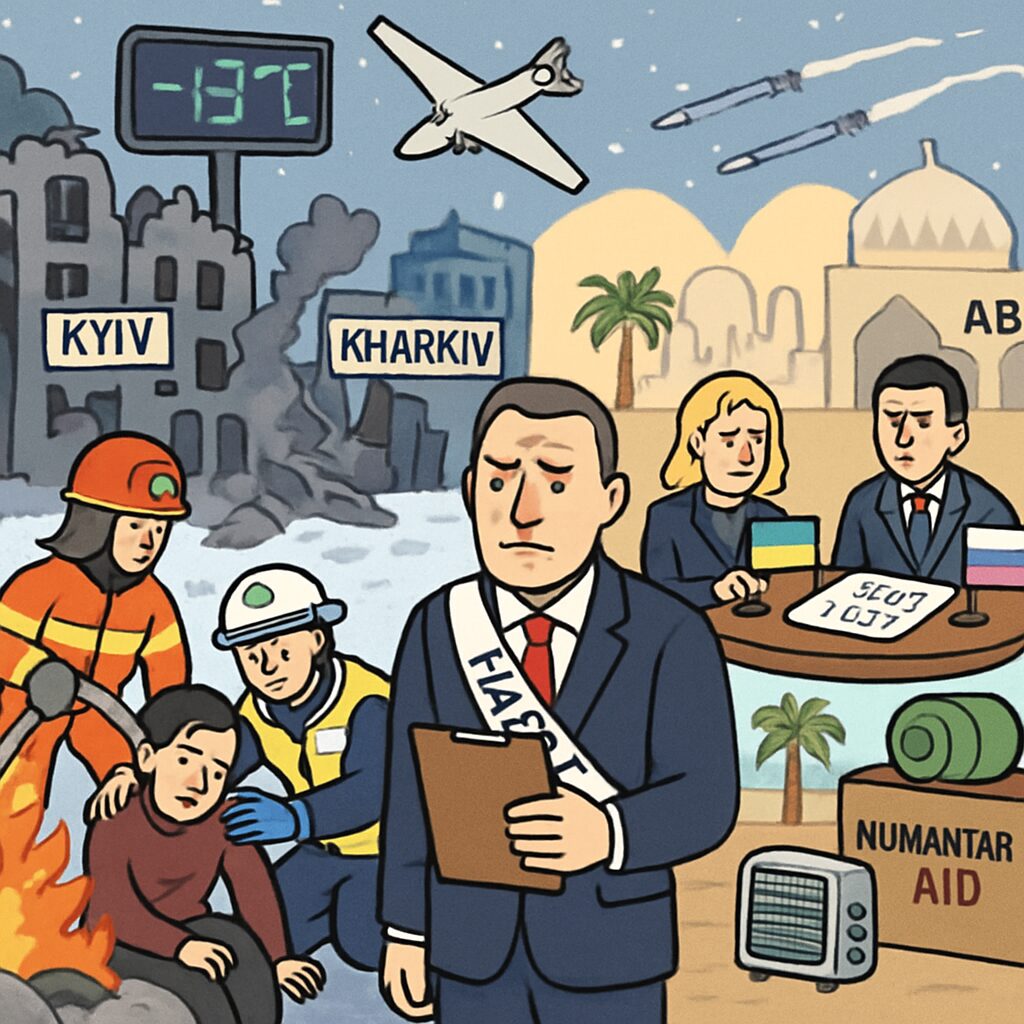
On January 24, 2026, Russian forces launched deadly drone and missile strikes on Kyiv and Kharkiv, killing at least one person and injuring over a dozen others, as US, Ukrainian, and Russian negotiators prepared for the second day of peace talks in Abu Dhabi. Ukraine has condemned the attacks as brutal, underscoring the fragility of the peace process amid ongoing violence.
In Kyiv, the capital city, the strikes began in the early hours and continued until morning, with local authorities reporting one person killed and at least 15 wounded. Mayor Vitali Klitschko stated that fires broke out in several buildings hit by drone debris, and heat and water services were interrupted in parts of the city. The attacks exacerbated an ongoing energy crisis, with about 1,940 residential buildings without heating and an estimated 600,000 residents having temporarily left due to power outages.
Kharkiv, located near the Russian border, was targeted by approximately 25 drones over two and a half hours, injuring at least 14 people. Mayor Ihor Terekhov reported that the drones struck a dormitory for displaced persons, a hospital, and a maternity hospital, highlighting the assault on civilian infrastructure. The northeastern city has been a frequent target throughout the war, suffering repeated attacks that have devastated its urban areas.
The peace talks in Abu Dhabi represent a significant diplomatic effort, with the United States playing a key mediating role under President Donald Trump’s administration. Negotiations resumed on Saturday after an initial day of discussions, with all parties expressing a tentative commitment to finding a peaceful resolution. However, the timing of the Russian strikes has raised doubts about Moscow’s sincerity in the peace process.
Ukrainian officials have vehemently condemned the attacks, labeling them as brutal and unprovoked aggression. President Volodymyr Zelenskyy’s government emphasized that such violence undermines trust and complicates the negotiation efforts. The strikes have been portrayed as a deliberate attempt to pressure Ukraine and test its resilience amid the talks.
The broader context includes a severe mid-winter energy crisis in Kyiv, where temperatures have dropped to -13°C (9°F), leaving many without heat or power for extended periods. Emergency workers have been struggling to restore services, and the city has faced multiple mass attacks this year that have crippled its infrastructure. This humanitarian situation adds urgency to the need for a ceasefire.
Internationally, the United States has been pushing for a peace settlement, with Trump advocating for a plan that could involve territorial concessions and security guarantees. The involvement of the UAE as a neutral venue reflects global efforts to facilitate dialogue. However, Russia’s insistence on controlling the Donbas region remains a major sticking point, as evidenced by its continued military actions.
Looking ahead, the second day of talks will be closely watched to see if progress can be made despite the violent backdrop. Analysts suggest that the attacks may be a tactic to gain leverage, but they also risk derailing the negotiations entirely. The international community, including NATO and the UN, has called for restraint, emphasizing that a durable peace requires an end to hostilities and a commitment to diplomacy.

