

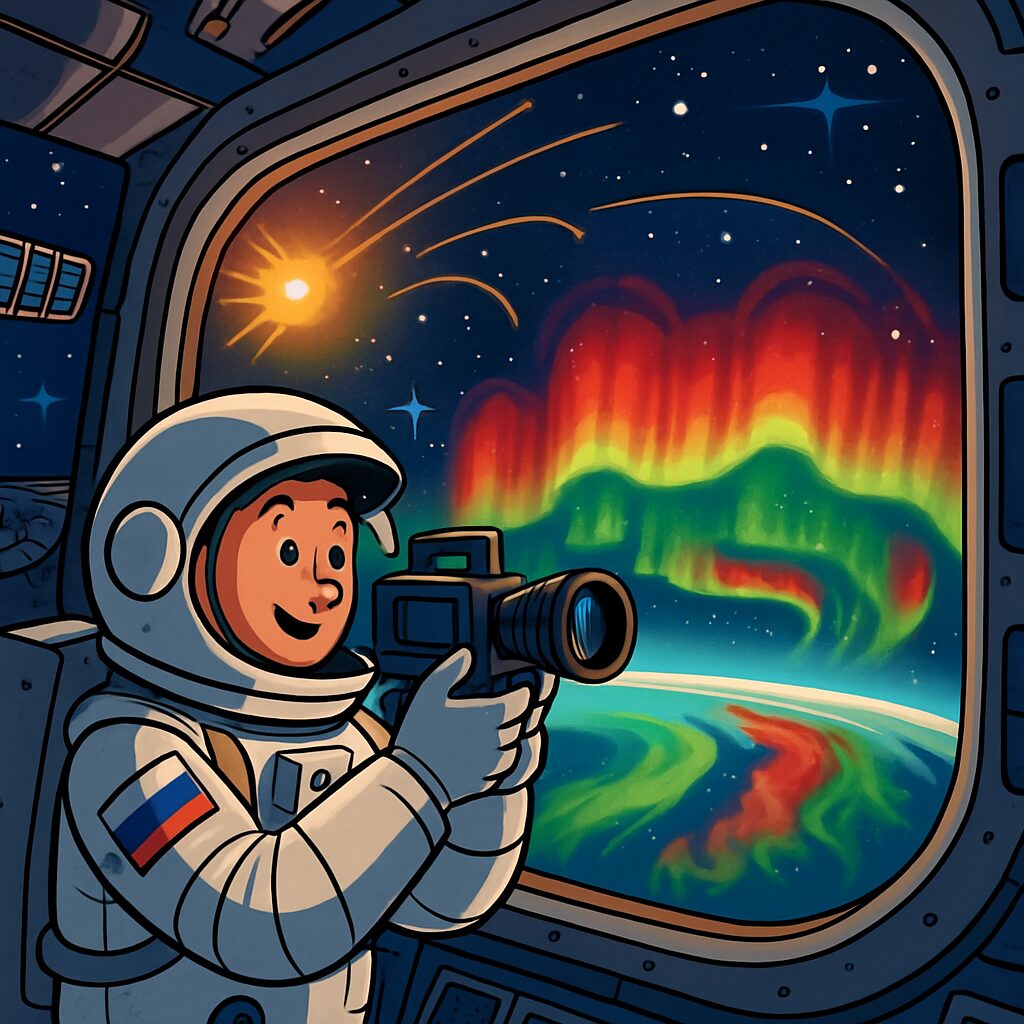
A Russian cosmonaut aboard the International Space Station has captured breathtaking video of aurora lights dancing over Earth, filmed during one of the most powerful solar storms in over two decades. The footage, shared by Cosmonaut Sergey Kud-Sverchkov, offers a rare space-based perspective of the vibrant green and red displays illuminating the planet’s curvature. This event was driven by a severe geomagnetic storm, classified as one of the most intense since October 2003 by the National Weather Service’s Space Weather Prediction Center. Solar storms emit high-speed charged particles that collide with Earth’s magnetic field, creating the spectacular auroras visible from both ground and orbit. The current solar cycle, known for increased activity, has led to frequent flares and coronal mass ejections, posing radiation risks to astronauts and satellites. On the ISS, crew members may take precautions such as sheltering in shielded areas during peak solar events, yet Kud-Sverchkov managed to safely record the aurora, providing valuable data for space weather research. Auroras are typically observed from Earth’s surface, but captures from space are less common and yield unique insights into their structure and intensity, enhancing scientific understanding of magnetospheric interactions. The timing of this capture coincides with heightened solar activity, with experts warning of more frequent and intense storms in the coming years, which could impact satellite operations, communication networks, and power grids on Earth. International collaboration on the ISS enables continuous monitoring of such phenomena, with agencies like NASA and Roscosmos using observations to improve forecasting and mission safety protocols. As solar cycles peak, ongoing vigilance and documentation from orbit remain crucial for advancing space science and public engagement. The video has been widely reported by reliable outlets like BBC and Guardian News within the last 24 hours, highlighting its significance in both scientific and public domains.
Russian cosmonaut captures stunning aurora over Earth


RELATED ARTICLES