

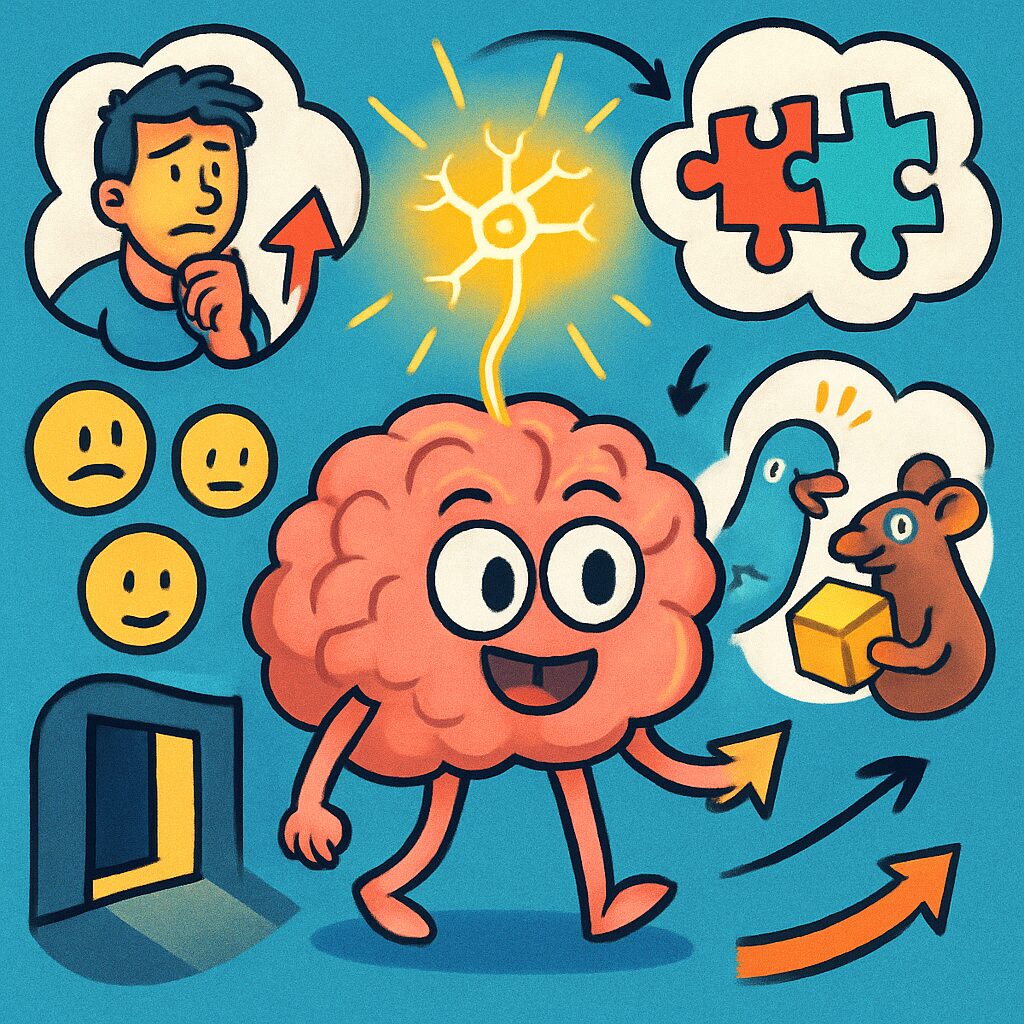
Dopamine, frequently dubbed the ‘pleasure chemical,’ is profoundly misunderstood in popular discourse; it primarily functions as a neurotransmitter that drives motivation and learning by signaling unexpected successes rather than generating happiness. This insight, drawn from recent neuroscience research, challenges common beliefs and sheds light on why humans are perpetually restless and driven to seek novelty.
The misconception stems from dopamine’s association with reward pathways, but studies show it doesn’t cause pleasure itself. Instead, dopamine motivates action by reinforcing behaviors that lead to surprises. For instance, in conditions like encephalitis lethargica, where dopamine production is severely impaired, individuals enter a state of lethargy and inaction, highlighting dopamine’s role in propelling us beyond basic reflexes. Without it, the brain stagnates in a ‘dark room’ of non-experience, devoid of the drive to explore or achieve.
Dopamine’s true function is more nuanced: it acts as a ‘figure this out’ signal, compelling the brain to resolve discrepancies between expectation and reality. When an unexpected success occurs, dopamine is released, strengthening neural connections associated with that success. This mechanism is crucial for skill formation, such as in dance or music, where dopamine helps encode successful movements into ‘muscle memory’ via the basal ganglia. It’s not about enjoying the reward but about optimizing future actions based on past surprises.
Research on animals supports this view. Experiments with rats and pigeons demonstrate that dopamine release peaks with unexpected rewards, not with the rewards themselves. This explains why unpredictable environments, like those in gambling or social media, are so addictive: they constantly deliver surprises that trigger dopamine, fostering obsessive behavior. In contrast, predictable rewards lead to habituation and reduced motivation, as the brain no longer experiences the ‘better than expected’ signals that dopamine provides.
The relationship between dopamine and the cerebral cortex is key to understanding human motivation. The cortex seeks to align reality with expectations, but dopamine introduces a push towards action by marking unexpected successes. This creates a feedback loop where the cortex is driven to minimize dopamine by figuring things out, often through changing reality rather than accepting it. This dynamic underpins our constant search for novelty and our aversion to boredom, which are evolutionarily advantageous traits.
Evolutionarily, dopamine’s role in promoting restlessness and dissatisfaction has survival benefits. Organisms that are content with their current state are less likely to explore new opportunities or adapt to changing environments. Dopamine ensures that individuals remain motivated to seek more, whether it’s food, mates, or knowledge, thereby enhancing long-term survival. This perspective reframes human dissatisfaction not as a flaw but as a feature of our biological design.
In practical terms, understanding dopamine’s true function can inform approaches to mental health and productivity. Recognizing that dopamine drives us towards uncertainty and challenge can help in designing better learning environments or combating addictions. Instead of seeking constant pleasure, embracing the dopamine-driven pursuit of meaningful surprises may lead to more fulfilling lives. This shift in understanding encourages a move away from simplistic ‘dopamine fasting’ trends towards evidence-based strategies for motivation and well-being.
Overall, the revelation that dopamine is more about motivation and learning than pleasure offers a clearer lens through which to view human behavior. It explains why we are never fully satisfied and always striving for more, a trait that has propelled our species forward. By debunking myths, this research invites a deeper appreciation of the brain’s complexities and the chemical forces that shape our daily lives.

