

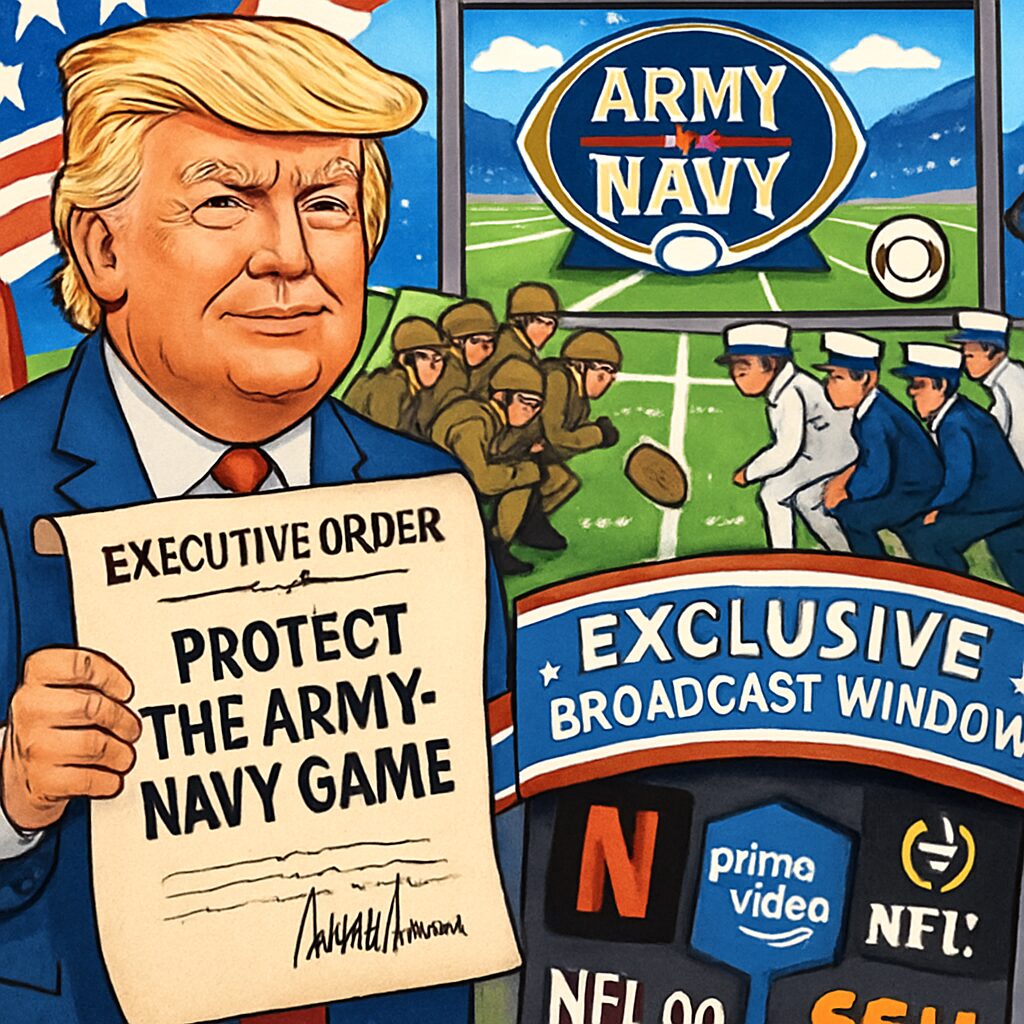
President Donald Trump has pledged to sign an executive order aimed at safeguarding the annual Army-Navy football game from competing broadcasts, declaring that the second Saturday in December should be exclusively dedicated to this patriotic tradition.
Trump announced the move on Truth Social, stating that he intends to secure an exclusive four-hour broadcast window for the Army-Navy Game to prevent other postseason college football games from airing simultaneously. He emphasized the game’s significance as a symbol of American patriotism, courage, and honor, framing it as a national event that must be protected from commercial interests. The Army-Navy Game, first played in 1890, pits the United States Military Academy at West Point against the United States Naval Academy at Annapolis, celebrating the rivalry and camaraderie between the armed forces. Trump has attended the event six times, including the most recent game in December, where he participated in the ceremonial coin toss.
CBS holds the exclusive broadcast rights to the Army-Navy Game through 2038, and the network’s parent company, Paramount, has ties to Trump’s inner circle through billionaire Larry Ellison. This connection adds a layer of complexity to the executive order, which could benefit CBS by ensuring no competition during the game’s timeslot. However, the enforceability of such an order is questionable. The Federal Communications Commission regulates broadcast television but does not have authority over cable or streaming services, which could circumvent the restriction. Legal experts suggest that antitrust laws and existing broadcast agreements might pose challenges to implementation.
Trump’s announcement comes amid discussions about expanding the College Football Playoff, which could increase the number of games competing for attention in December. By intervening, Trump is positioning himself as a defender of tradition against the influence of big television money and playoff expansion. This move is consistent with Trump’s history of engaging with media and broadcasting issues during his presidency. He has previously weighed in on television licensing and major media deals, often framing them as matters of public interest and national importance.
The executive order has yet to be signed, and details on its specific provisions and timeline remain unclear. Stakeholders, including broadcast networks and college football organizers, are likely to assess the potential impacts on scheduling and revenue. In closing, Trump’s vow to protect the Army-Navy Game highlights the intersection of sports, media, and politics, underscoring his ongoing influence on cultural and regulatory landscapes. As the situation develops, it will test the boundaries of executive power in shaping broadcast traditions.

