

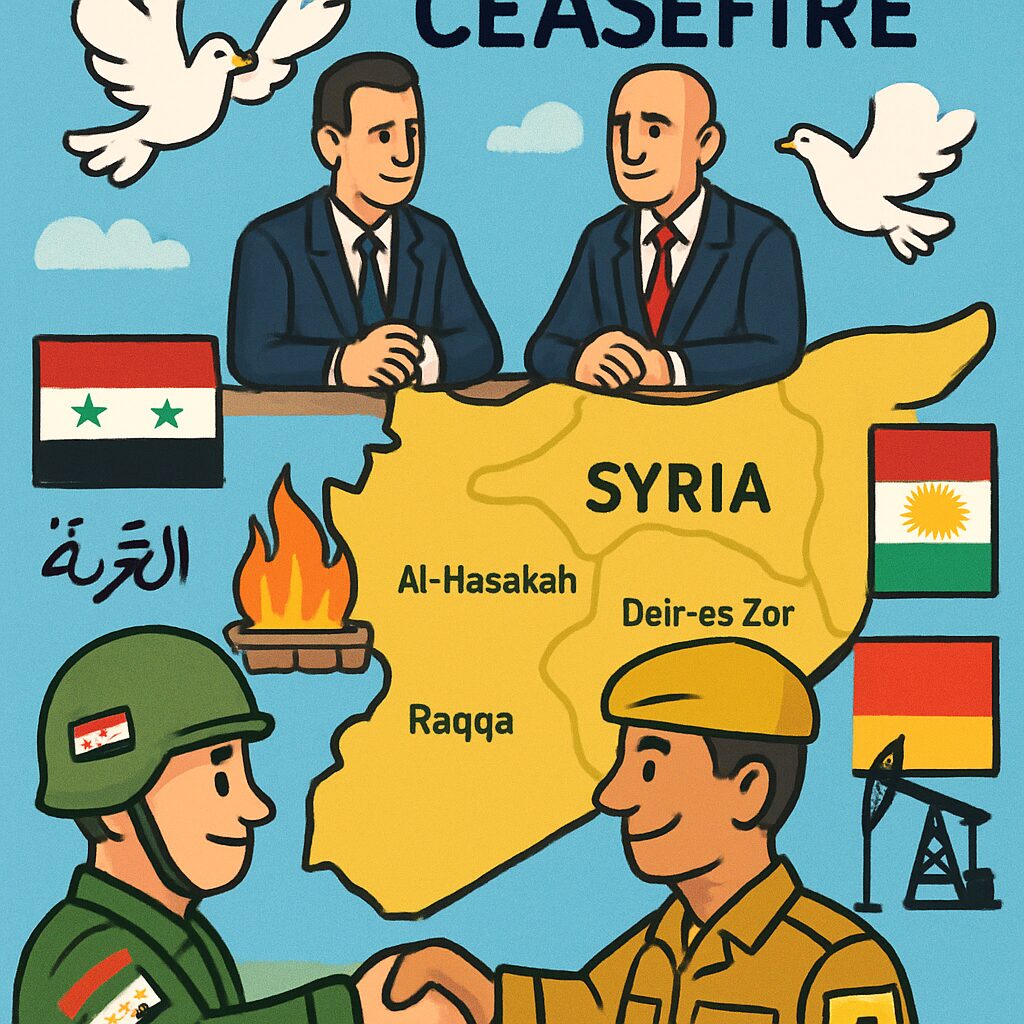
The Syrian government has announced an immediate nationwide ceasefire with the Kurdish-led Syrian Democratic Forces (SDF), ending nearly two weeks of intense fighting and marking a significant step towards integrating the SDF into Syria’s military and state institutions. This agreement, part of a broader 14-point deal, aims to reassert government control over key northeastern provinces while granting formal recognition to Kurdish cultural rights.
The ceasefire was declared on Sunday, January 18, 2026, by Syrian President Ahmed al-Sharaa, following a meeting with U.S. Special Envoy Tom Barrack in Damascus. Al-Sharaa stated that the deal would allow Syrian state institutions to take control of the provinces of al-Hasakah, Deir Ezzor, and Raqqa, which have been under SDF administration for nearly a decade. The announcement came after Syrian forces advanced into Raqqa, the SDF’s stronghold, capturing strategic assets like oil fields and dams, and triggered celebrations among local Arab populations.
Fighting between the Syrian army and the SDF erupted on January 6 after months of stalled negotiations over integrating the Kurdish-led fighters into the national army. Previous clashes had occurred in December, with a U.S.-brokered ceasefire taking effect on January 10, but tensions escalated leading to the recent offensive. The SDF, formed in 2015 with U.S. backing to combat the Islamic State group, had governed autonomous areas in northeast Syria, creating a de facto Kurdish administration that Damascus viewed as a threat to national unity.
Under the new agreement, the SDF will be integrated into Syria’s defence and interior ministries after vetting, while Damascus assumes control over civilian institutions, border crossings, and oil and gas fields. The deal also includes provisions for Kurdish rights, such as recognizing Kurdish as an official language alongside Arabic, declaring the Kurdish New Year (Newroz) a national holiday, and restoring citizenship to Kurds stripped of it in past censuses. President al-Sharaa emphasized that this marks the first formal recognition of Kurdish rights since Syria’s independence in 1946.
External actors played key roles in the negotiations. The United States, which had armed and trained the SDF against ISIS, praised the ceasefire as a move towards a “unified Syria.” Special Envoy Barrack commended both sides for their constructive efforts. However, Turkey, which views the SDF as linked to the Kurdistan Workers’ Party (PKK), a group it considers terrorist, has expressed concerns. The agreement addresses this by requiring the SDF to expel PKK elements from Syria, potentially easing tensions with Ankara.
The integration of the SDF poses significant challenges, including logistical hurdles in merging military units and ensuring the protection of Kurdish rights in practice. SDF commander Mazloum Abdi, who was unable to attend the Damascus meeting due to weather, confirmed the deal on Kurdish television, stressing that the ceasefire was necessary to avoid a broader war. He pledged to share details with Syria’s Kurds and emphasized the SDF’s commitment to preserving the “achievements” of their administration.
Looking ahead, the implementation of the agreement will be closely watched. Syrian authorities have begun deploying forces in Raqqa and other areas, while the SDF withdraws. The deal also reaffirms Syria’s participation in the U.S.-led coalition against ISIS, addressing security concerns over detention camps holding thousands of ISIS fighters. If successful, this ceasefire could pave the way for lasting stability in northeast Syria, but mistrust and historical grievances may complicate the transition.
In conclusion, the ceasefire represents a pivotal moment in Syria’s long-running conflict, potentially ending a factional divide that has persisted since the civil war. By bridging differences between Damascus and the Kurds, it aims to reunify the country under a single authority, though the path forward requires careful negotiation and international support to ensure peace and justice for all Syrians.

