

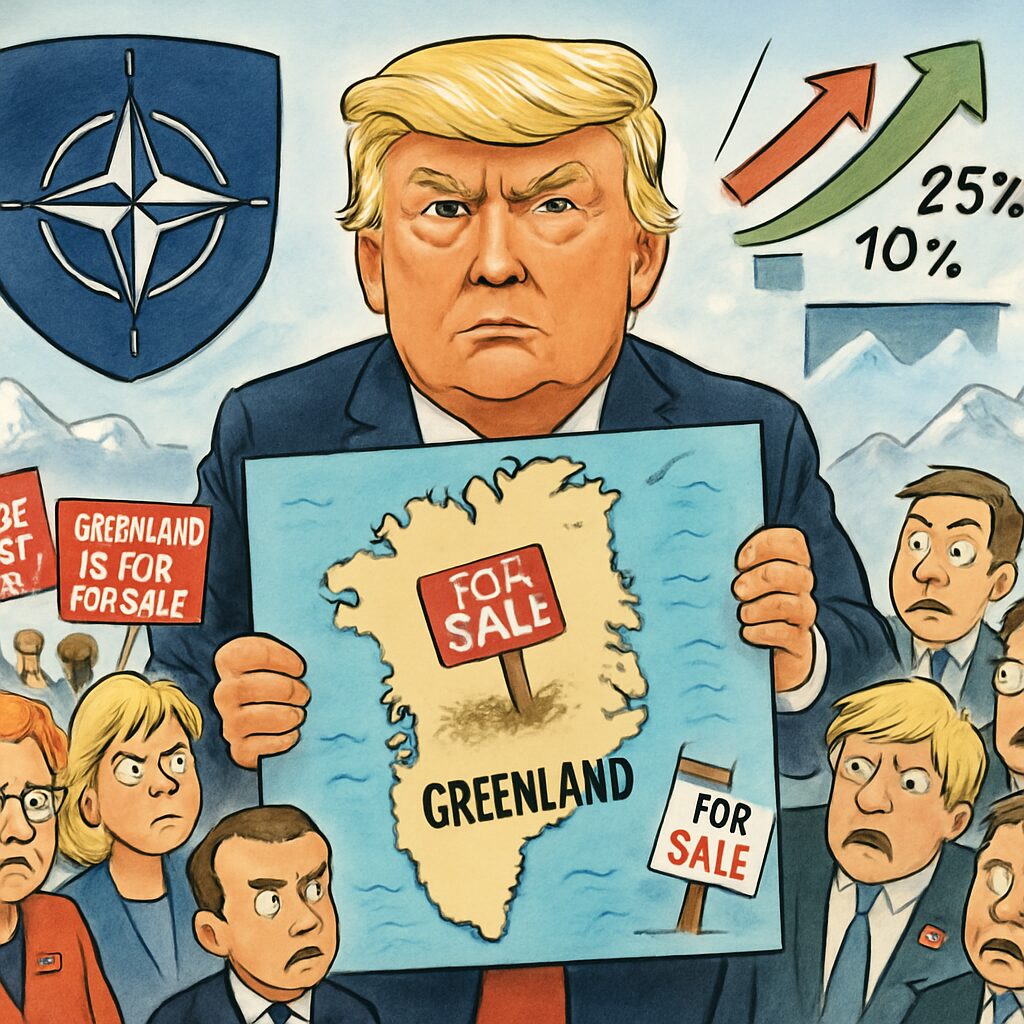
European leaders have united in condemnation after U.S. President Donald Trump threatened to impose escalating tariffs on eight NATO allies unless they agree to sell Greenland to the United States, calling the move ‘wrong’ and ‘unacceptable’ and sparking a major diplomatic crisis.
On Saturday, January 17, 2026, President Trump declared on his social media platform Truth Social that he would impose tariffs starting at 10% on February 1 and rising to 25% by June 1 on imports from Denmark, Norway, Sweden, France, Germany, the U.K., the Netherlands, and Finland if a deal is not reached for the U.S. to purchase Greenland. He asserted that acquiring Greenland is critical for U.S. national security to counter Russian and Chinese influence in the Arctic, repeating claims that Denmark has failed to address security threats in the region.
The response from European capitals was immediate and emphatic. U.K. Prime Minister Keir Starmer stated that ‘applying tariffs on allies for pursuing the collective security of NATO allies is completely wrong,’ following a phone call with Trump. French President Emmanuel Macron, who has sought to maintain a personal rapport with Trump, described the tariff threat as ‘unacceptable’ and pledged that Europeans would respond in a united and coordinated manner. Italian Prime Minister Giorgia Meloni, typically aligned with Trump, called the move an ‘error,’ revealing she had already discussed it with the U.S. president.
In reaction, EU ambassadors convened an emergency meeting in Brussels on Sunday, January 18, with European Council President Antonio Costa announcing an extraordinary council meeting in the coming days. A joint statement issued by the eight targeted countries emphasized that ‘tariff threats undermine transatlantic relations and risk a dangerous downward spiral,’ affirming their solidarity with Denmark and Greenland. European Commission President Ursula von der Leyen and Council President Costa reiterated the EU’s full support for Denmark and commitment to dialogue, despite the setback.
Greenland itself has firmly rejected Trump’s overtures. As a semi-autonomous territory under Denmark, Greenland seeks eventual independence but opposes becoming part of the U.S. Protests in Nuuk on January 17 saw nearly a third of the capital’s population demonstrating against annexation, with signs declaring ‘Greenland is not for sale.’ Danish Foreign Minister Lars Lokke Rasmussen expressed surprise at the tariff threat, noting that recent talks with U.S. Vice President JD Vance and Secretary of State Marco Rubio had been constructive.
The escalating tensions threaten the U.S.-EU trade agreement struck in August 2025. Manfred Weber, a senior member of the European Parliament, stated that approval of the deal is ‘not possible at this stage’ due to Trump’s threats. Economists like Holger Schmieding of Berenberg Bank warn that additional tariffs could raise U.S. consumer prices by up to 0.15%, and if the trade deal collapses, the economic damage could be nearly three times worse, highlighting the broader economic stakes.
Geopolitically, European leaders fear that Trump’s unilateralism plays into the hands of adversaries. Spanish Prime Minister Pedro Sanchez warned that any U.S. military action over Greenland would ‘legitimize’ Russian President Vladimir Putin’s invasion of Ukraine and could spell the ‘death knell for NATO.’ EU foreign policy chief Kaja Kallas noted that China and Russia ‘must be having a field day’ from the divisions among allies, underscoring the strategic risks.
Looking ahead, the crisis marks a significant deterioration in transatlantic relations, with Europe now grappling with the need for greater defense autonomy. While dialogue is expected to continue, the EU is considering responses such as activating the Anti-Coercion Instrument. The situation remains fluid, with potential for further escalation as deadlines for tariffs approach, testing the resilience of the Western alliance in an increasingly polarized world.

